

3 months 3 weeks ago
The deceiver is really the fool.
▼
Source
source
Kant, Immanuel (1996), page 101
2 months 1 week ago
In all philosophic theory there is an ultimate which is actual in virtue of its accidents. It is only then capable of characterization through its accidental embodiments, and apart from these accidents is devoid of actuality. In the philosophy of organism this ultimate is termed creativity; and [[God] is its primordial, non-temporal accident. In monistic philosophies, Spinoza's or absolute idealism, this ultimate is God, who is also equivalently termed The Absolute. In such monistic schemes, the ultimate is illegitimately allowed a final, eminent reality, beyond that ascribed to any of its accidents. In this general position the philosophy of organism seems to approximate more to some strains of Indian, or Chinese, thought, than to western Asiatic, or European, thought. One side makes process ultimate; the other side makes fact ultimate.
▼
Source
source
Pt. I, ch. 1, sec. 2.

2 months 3 weeks ago
We are taught to believe that a desire of domineering over our countrymen is love to our country; and those who hate civil war abet rebellion, and that the amiable and conciliatory virtues of lenity, moderation, and tenderness to the privileges of those who depend on this kingdom are a sort of treason to the state. It is impossible that we should remain long in a situation, which breeds such notions and dispositions, without some great alteration in the national character.
1 day ago
The grand discoveries which scientific experiment yielded at and about the turn of the century, in which investigators in many countries took an eminent part and which were destined all unexpectedly to give us a fresh insight into the structure of atoms, were due in the first instance, as all are aware, to the work of the great investigators of the English school, Sir Joseph Thomson and Sir Ernest Rutherford, who have inscribed their names on the tablets of the history of scientific research as distinguished witnesses to the truth that imagination and acumen are capable of penetrating the crowded mass of registered experience and of revealing Nature's simplicity to our gaze.
▼
Source
source
Niels Bohr's speech at the Nobel Banquet in Stockholm
4 months 1 week ago
Do not despair: one thief was saved. Do not presume: one thief was damned.
▼
Source
source
Attributed to St. Augustine in The Repentance of Robert Greene, Master of Arts (1592) by Robert Greene.
2 months 2 weeks ago
Greatness by nature includes a power, but not a will to power.
▼
Source
source
p. 150
3 months 3 weeks ago
Because people have no thoughts to deal in, they deal cards, and try and win one another's money. Idiots!
1 week 2 days ago
If the church had deadly sins, the state has capital crimes; if the one had heretics, the other has traitors; the one ecclesiastical penalties, the other criminal penalties; the one inquisitorial processes, the other fiscal; in short, there sins, here crimes, there inquisition and here - inquisition. Will the sanctity of the state not fall like the church's? The awe of its laws, the reverence for its highness, the humility of its 'subjects', will this remain? Will the 'saint's' face not be stripped of its adornment?
▼
Source
source
Cambridge 1995, p. 211, 212

4 months 3 weeks ago
Scientific theories can always be improved and are improved. That is one of the glories of science. It is the authoritarian view of the Universe that is frozen in stone and cannot be changed, so that once it is wrong, it is wrong forever.

3 months 3 weeks ago
I think so badly of philosophy that I don't like to talk about it. ... I do not want to say anything bad about my dear colleagues, but the profession of teacher of philosophy is a ridiculous one. We don't need a thousand of trained, and badly trained, philosophers - it is very silly. Actually most of them have nothing to say.
▼
Source
source
As quoted in "At 90, and Still Dynamic : Revisiting Sir Karl Popper and Attending His Birthday Party" by Eugene Yue-Ching Ho, in Intellectus 23

3 months 3 weeks ago
A minister of state is excusable for the harm he does when the helm of government has forced his hand in a storm; but in the calm he is guilty of all the good he does not do.
▼
Source
source
Le Siècle de Louis XIV, ch. VI: "État de la France jusqu'à la mort du cardinal Mazarin en 1661" (1752)
2 months 2 weeks ago
The entire universe is perfused with signs, if it is not composed exclusively of signs.
▼
Source
source
Quoted in Essays in Zoosemiotics (1990) by Thomas A. Sebeok

3 months 2 weeks ago
Why in the world shouldn't they have regarded with awe and reverence that act by which the human race is perpetuated. Not every religion has to have St. Augustine's attitude to sex. Why even in our culture marriages are celebrated in a church, everyone present knows what is going to happen that night, but that doesn't prevent it being a religious ceremony.
▼
Source
source
Intentionality, and Romanticism (1997) by Richard Thomas Eldridge, p. 130

3 months 3 weeks ago
The "through-and-through" universe seems to suffocate me with its infallible impeccable all-pervasiveness. Its necessity, with no possibilities; its relations, with no subjects, make me feel as if I had entered into a contract with no reserved rights ... It seems too buttoned-up and white-chokered and clean-shaven a thing to speak for the vast slow-breathing unconscious Kosmos with its dread abysses and its unknown tides.
▼
Source
source
Essays in Radical Empiricism (1912), Ch. 12 : Absolutism and Empiricism

3 months 3 weeks ago
Man can, indeed, act contrarily to the decrees of God, as far as they have been written like laws in the minds of ourselves or the prophets, but against that eternal decree of God, which is written in universal nature, and has regard to the course of nature as a whole, he can do nothing.
▼
Source
source
Ch. 2, Of Natural Right

1 week 1 day ago
If you are wise, mingle these two elements: do not hope without despair, or despair without hope.
▼
Source
source
Line 12 Alternate translation: Hope not without despair, despair not without hope. (translated by Zachariah Rush).

2 weeks ago
A mystic bond of brotherhood makes all men one.
▼
Source
source
Essays, Goethe's Works.

2 months 2 weeks ago
Not content with real sufferings, the anxious man imposes imaginary ones on himself; he is a being for whom unreality exists, must exist; otherwise where would he obtain the ration of torment his nature demands?
2 months 1 day ago
From any vocabulary of ideas we can build other ideas by formal combinations of signs. But not any set of ideas will be instructive. One must have the right ideas.
▼
Source
source
Chapter 15, Inductive Logic, p. 139.


4 months 1 day ago
Superstition, idolatry, and hypocrisy have ample wages, but truth goes a-begging.
▼
Source
source
53

3 months 3 weeks ago
Dreams are the touchstones of our characters.

3 months 3 weeks ago
One is still what one is going to cease to be and already what one is going to become. One lives one's death, one dies one's life.
▼
Source
source
Book 2, "The Melodious Child Dead in Me"

4 months 2 weeks ago
Great feelings take with them their own universe, splendid or abject. They light up with their passion an exclusive world in which they recognize their climate. There is a universe of jealousy, of ambition, of selfishness or generosity. A universe in other words a metaphysic and an attitude of mind.
3 months 2 weeks ago
With a drunken man do not walk on the road.

3 months 3 weeks ago
I observe that a very large portion of the human race does not believe in God and suffers no visible punishment in consequence. And if there were a God, I think it very unlikely that he would have such an uneasy vanity as to be offended by those who doubt his existence.
▼
Source
source
Bertrand Russell's Best: Silhouettes in Satire (1958), "On Religion".
4 months 1 day ago
The Clergy is the greatest hindrance to faith.
▼
Source
source
58
3 months 3 weeks ago
I wanted pure love: foolishness; to love one another is to hate a common enemy: I will thus espouse your hatred. I wanted Good: nonsense; on this earth and in these times, Good and Bad are inseparable: I accept to be evil in order to become good.
▼
Source
source
Act 11, sc. 2
4 months 1 week ago
Virtue (or the man of virtue) is not left to stand alone. He who practices it will have neighbors.
1 week 2 days ago
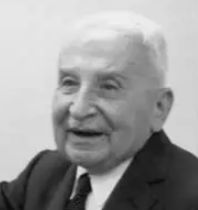
A free man must be able to endure it when his fellow men act and live otherwise than he considers proper. He must free himself from the habit, just as soon as something does not please him, of calling for the police.
▼
Source
source
Ch. 1 : The Foundations of Liberal Policy § 11 : The Limits of Governmental Activity
3 months 2 weeks ago
Nothing is more important than the formation of fictional concepts, which teach us at last to understand our own.
▼
Source
source
p. 85e
3 months 3 weeks ago
Newton... (after having remarked that geometry only requires two of the mechanical actions which it postulates, namely, to describe a straight line and a circle) says: geometry is proud of being able to achieve so much while taking so little from extraneous sources. One might say of metaphysics, on the other hand: it stands astonished, that with so much offered it by pure mathematics it can effect so little. In the meantime, this little is something which mathematics indispensably requires in its application to natural science, which, inasmuch as it must here necessarily borrow from metaphysics, need not be ashamed to allow itself to be seen in company with the latter.
▼
Source
source
Preface, Tr. Bax (1883) citing Isaac Newton's Principia
2 months 5 days ago
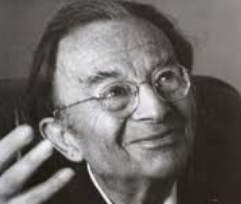
The existential split in man would be unbearable could he not establish a sense of unity within himself and with the natural and human world outside.
▼
Source
source
p. 262
3 months 1 week ago
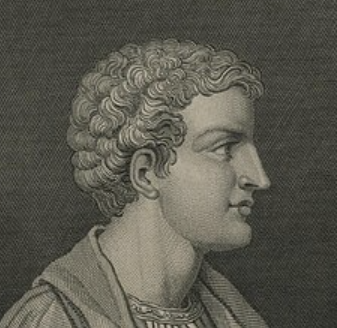
What odds does it make to the man who lives within Nature's bounds, whether he ploughs a hundred acres or a thousand?
▼
Source
source
Book I, satire i, line 48
2 months 2 weeks ago
Death poses a problem which replaces all the others. What is deadly to philosophy, to the naive belief in the hierarchy of perplexities.
2 weeks ago
To a shower of gold most things are penetrable.
▼
Source
source
Pt. I, Bk. III, ch. 7.
3 months 3 weeks ago
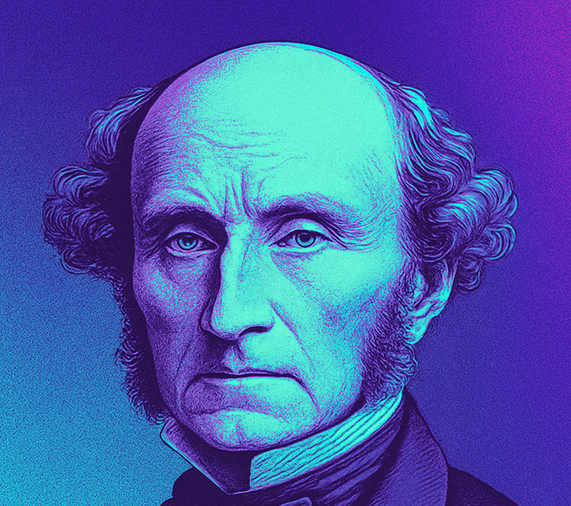
[My father] impressed upon me from the first, that the manner in which the world came into existence was a subject on which nothing was known: that the question, "Who made me?" cannot be answered, because we have no experience or authentic information from which to answer it; and that any answer only throws the difficulty a step further back, since the question immediately presents itself, "Who made God?"
▼
Source
source
(pp. 42-43)

3 months 3 weeks ago
Beauty is no quality in things themselves: It exists merely in the mind which contemplates them; and each mind perceives a different beauty. One person may even perceive deformity, where another is sensible of beauty; and every individual ought to acquiesce in his own sentiment, without pretending to regulate those of others.
▼
Source
source
Part I, Essay 23: Of The Standard of Taste
3 months 3 weeks ago
This I think is sufficiently evident, that children generally hate to be idle. All the care then is, that their busy humour should be constantly employ'd in something of use to them; which, if you will attain, you must make what you would have them do a recreation to them, and not a business.
▼
Source
source
Sec. 129
1 week 1 day ago
Just as we suffer from excess in all things, so we suffer from excess in literature; thus we learn our lessons, not for life, but for the lecture room.
▼
Source
source
Line 12 Alternate translation: Not for life, but for school do we learn. (translator unknown) Alternate translation: We are taught for the schoolroom, not for life. (translator unknown).
2 months 2 weeks ago
Whenever a nation is converted to Christianity, its Christianity, in practice, must be largely converted to paganism.
▼
Source
source
p. 35
3 days ago
Of the splendid constellation of great names... we admire the living and revere dead far too warmly and too deeply to suffer us sit in judgment on their respective claims to in this or that particular discovery; to balance mathematical skill of one against the experimental dexterity of another, or the philosophical acumen a third. So long as "one star differs from another in glory," - so long as there shall exist varieties, or even incompatibilities of excellence, - so long will the admiration of mankind be found sufficient for all who merit it.
▼
Source
source
On the Theory of Light (1828) p.494
3 days ago
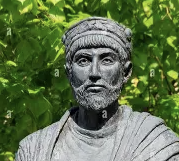
But let us now dismiss these poetical fictions; because with what is divine they have mingled much of human alloy; and let us now consider what the deity has declared concerning himself and the other gods. The region surrounding the Earth has its existence in virtue of birth. From whom then does it receive its eternity and imperishability, if not from him who holds all things together within defined limits, for it is impossible that the nature of bodies (material) should be without a limit, inasmuch as they cannot dispense with a Final Cause, nor exist through themselves.
2 months 2 weeks ago
Woe to the book you can read without constantly wondering about the author!
3 months 3 weeks ago
it is absurd ... to hope that maybe another Newton may some day arise, to make intelligible to us even the genesis of but a blade of grass
▼
Source
source
("Dialectic of Teleological Judgment" §75)
2 months 3 weeks ago
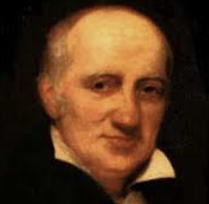
I did not hate the author of my misfortunes - truth and justice acquit me of that; I rather pitied the hard destiny to which he seemed condemned. But I thought with unspeakable loathing of those errors, in consequence of which every man is fated to be, more or less, the tyrant or the slave. I was astonished at the folly of my species, that they did not rise up as one man, and shake off chains so ignominious, and misery so insupportable. So far as related to myself, I resolved - and this resolution has never been entirety forgotten by me - to hold myself disengaged from this odious scene, and never fill the part either of the oppressor or the sufferer.

3 months 3 weeks ago
In short, competition has to shoulder the responsibility of explaining all the meaningless ideas of the economists, whereas it should rather be the economists who explain competition.
▼
Source
source
Vol. III, Ch. L, Illusions Created by Competition, p. 866.

3 months 3 weeks ago
In manufactures, a very small advantage will enable foreigners to undersell our own workmen, even in the home market. It will require a very great one to enable them to do so in the rude produce of the soil. If the free importation of foreign manufactures were permitted, several of the home manufactures would probably suffer, and some of them, perhaps, go to ruin altogether, and a considerable part of the stock and industry at present employed in them, would be forced to find out some other employment. But the freest importation of the rude produce of the soil could have no such effect upon the agriculture of the country.
▼
Source
source
Chapter II
4 months 1 week ago
The superior man honors his virtuous nature, and maintains constant inquiry and study, seeking to carry it out to its breadth and greatness, so as to omit none of the more exquisite and minute points which it embraces, and to raise it to its greatest height and brilliancy, so as to pursue the course of the Mean. He cherishes his old knowledge, and is continually acquiring new. He exerts an honest, generous earnestness, in the esteem and practice of all propriety. Thus, when occupying a high situation he is not proud, and in a low situation he is not insubordinate. When the kingdom is well governed, he is sure by his words to rise; and when it is ill governed, he is sure by his silence to command forbearance to himself.
CivilSimian.com created by AxiomaticPanic, CivilSimian, Kalokagathia