
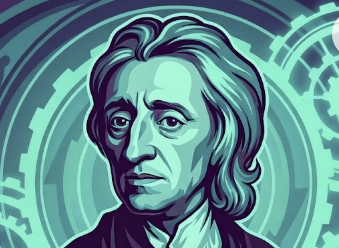
John Locke — Father of Liberalism and Champion of the Mind’s Blank Slate (1632–1704)
Locke reshaped the Western world by challenging absolute authority and redefining the nature of the human mind. His work helped lay the foundations of modern democracy, religious tolerance, and empirical psychology — all from a belief that knowledge comes not from innate ideas but from lived experience.
A Quiet Scholar in a Turbulent Age
Born in Somerset during a period of political upheaval, Locke grew up amid civil war, religious conflict, and changing notions of sovereignty. He studied at Oxford, where he encountered both the classical curriculum and the new experimental sciences inspired by Francis Bacon.
His friendship with the Earl of Shaftesbury drew him into the center of political life, eventually forcing him into exile in the Netherlands. This period of reflection and relative freedom shaped much of his later thought on liberty, toleration, and constitutional government.
“New opinions are always suspected, and usually opposed, without any other reason but because they are not already common.”
The Mind as a Blank Slate — Experience as the Source of Knowledge
Locke’s Essay Concerning Human Understanding transformed ideas about human psychology. He argued that the mind at birth is a tabula rasa — a blank slate — and that all ideas arise from experience: sensation and reflection. This view challenged innate ideas defended by earlier rationalists.
His empiricism provided a new method for understanding human development, education, politics, and society. It also anticipated later scientific approaches to the mind, from behaviorism to cognitive psychology.
“The mind is furnished with ideas by experience alone.”
Natural Rights and the Foundations of Modern Democracy
Locke revitalized political philosophy through his Two Treatises of Government. Rejecting the divine right of kings, he argued that political authority arises from the consent of the governed and that individuals possess natural rights — life, liberty, and property — that no ruler may violate.
These ideas became the intellectual backbone of constitutional liberalism, influencing the American and French revolutions, and shaping debates about human rights to this day.
“Where there is no law, there is no freedom.”
Religious Toleration and the Rights of Conscience
Locke believed that the state has no authority over the inner life of individuals. In his Letter Concerning Toleration, he argued that genuine faith cannot be compelled by force and that a peaceful society depends on respecting differing religious beliefs.
His argument for toleration did not extend to atheists or Catholics — limitations of his era — but the core of his reasoning laid the groundwork for modern pluralistic societies.
“All mankind... being all equal and independent, no one ought to harm another in his life, health, liberty, or possessions.”
Legacy — The Philosopher of Freedom
Locke’s ideas remain woven into the fabric of political and intellectual life. His empiricism shaped scientific inquiry; his political philosophy underpins constitutional democracy; and his defense of personal liberty continues to inspire movements for civil rights across the world.
His vision of a society grounded in rights, consent, and reason remains one of the most influential frameworks for thinking about justice and human dignity.
“Every man has a property in his own person.”
CivilSimian.com created by AxiomaticPanic, CivilSimian, Kalokagathia