
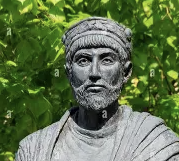
Emperor Julian — The Last Pagan and the Defense of the Ancient World (331–363)
Julian was Roman Emperor from 361 to 363, philosopher, soldier, and theologian — the last ruler of the ancient world to openly champion the traditional religion of Rome against the rising tide of Christianity.
Raised as a Christian in a dynasty that had embraced the new faith, he underwent a secret conversion to Neoplatonic paganism and spent his brief reign attempting to reverse the Christianization of the empire.
His central concern: that the spiritual and philosophical inheritance of Greece and Rome was being extinguished — and that it was worth the full weight of imperial power to save it.
A Philosopher on the Throne
Julian was one of the most learned men ever to hold the purple. Educated in Athens alongside the future great figures of late antique thought, he immersed himself in Plato, Aristotle, the Stoics, and above all the Neoplatonism of Iamblichus.
He wrote prolifically — orations, satires, theological treatises, and a pointed critique of Christianity — bringing to imperial office a philosopher's conviction that ideas had ultimate consequences.
He saw himself not merely as a political ruler but as an instrument of the gods, called to restore what centuries of tradition had built and what one generation of Christian emperors had begun to dismantle.
Power, for Julian, was inseparable from philosophical obligation.
"I worship the gods openly, and the whole army that returned with me worships the gods. I sacrifice oxen in public."
The Restoration of Traditional Religion
Upon becoming sole emperor in 361, Julian moved swiftly to restore the old religion. He reopened temples that had been closed, revived public sacrifice, and redirected imperial patronage away from the church and back toward pagan institutions.
He issued an edict of religious tolerance — recalling Christian bishops exiled by his predecessor — calculating that internal Christian divisions would weaken the church more effectively than persecution.
He attempted to reform paganism itself, urging its priests toward the kind of moral seriousness and charity that had made Christianity so socially effective. He saw clearly that the old religion needed institutional renewal if it was to compete.
It was restoration, not reaction — though his opponents saw little difference.
"Why do we not observe that it is their benevolence to strangers, their care for the graves of the dead, and the pretended holiness of their lives that have done most to increase atheism?"
The Schools Edict and the War of Culture
Julian's most controversial measure was his edict forbidding Christians to teach classical literature and rhetoric — the educational foundation of the ancient world.
His argument was pointed: teachers who did not believe in the gods Homer and Hesiod described had no business teaching those poets. If Christians found the old texts offensive, they should stick to their own.
Critics ancient and modern have seen this as intolerance dressed in logic. Julian saw it as cultural consistency — a refusal to allow a civilization's tools to be wielded by those committed to its destruction.
The edict was brief in effect but long in controversy, touching the nerve of what a civilization owes its own tradition.
"If they want to learn literature, they have Luke and Mark; let them go back and expound them in the Christian churches."
Soldier and Commander
Julian was no mere scholar-emperor. Before his accession he had served as Caesar in Gaul, where he proved an unexpectedly gifted general — winning decisive victories against the Alemanni and earning the fierce loyalty of his troops.
His Persian campaign of 363 was his greatest military gamble — a deep invasion intended to deliver a knockout blow to Rome's eastern rival. The campaign reached the walls of Ctesiphon before supply problems and strategic miscalculation forced a retreat.
During that retreat, Julian was struck by a spear — whether thrown by a Persian or, as some ancient sources darkly hinted, by a disaffected soldier from within his own ranks. He died on the banks of the Tigris, aged thirty-one.
With him died the last serious attempt to reverse the Christianization of Rome.
"You have won, Galilean."
— attributed, perhaps apocryphally, as Julian's dying words
Legacy — The Apostate and His Afterlife
Christian tradition remembered Julian as "the Apostate" — the emperor who betrayed the faith. The label stuck, colouring his reputation for centuries.
Later ages have read him differently. Enlightenment thinkers like Voltaire admired him as a champion of reason against superstition. Gibbon treated him with nuanced sympathy. Gore Vidal gave him a rich fictional life.
What is not in dispute is the poignancy of his position: a man of genuine intelligence and sincerity, fighting with the full power of the empire for a cause that was already lost — attempting to hold open a door that history had already decided to close.
He forces the question that haunts every cultural turning point: was the outcome inevitable, or did it require the accident of one man's early death?
"It is not right that one man should rule over all — one alone is enough to hold the reins of justice."
CivilSimian.com created by AxiomaticPanic, CivilSimian, Kalokagathia