
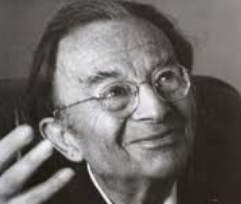
Erich Fromm — The Humanist Psychoanalyst of Freedom, Love, and Social Pathology (1900–1980)
Erich Fromm was the great diagnostician of modern anxiety — a thinker who fused psychoanalysis, philosophy, and social criticism to explain why supposedly free societies so often produce fear, conformity, and cruelty. Against both Freudian pessimism and economic determinism, Fromm insisted that human beings are shaped by social conditions but never reducible to them. His work asks a simple but unsettling question: what does it actually mean to live as a sane human being in an insane society?
Roots in Tradition, Crisis, and Exile
Born in Frankfurt into an orthodox Jewish family, Fromm grew up immersed in religious study, ethical debate, and the moral seriousness of Jewish intellectual life. Early exposure to the trauma of World War I and the collapse of European certainties left a permanent mark on his thinking.
He trained first as a sociologist, then as a psychoanalyst, studying under figures connected to Freud while maintaining a growing skepticism toward biological reductionism. The rise of Nazism forced Fromm into exile — first to the United States, later to Mexico — confirming his belief that mass irrationality was not an anomaly, but a structural danger of modern life.
“The history of mankind is the history of increasing individualization and increasing freedom — but also of increasing isolation.”
Beyond Freud — A Humanistic Psychoanalysis
Fromm admired Freud’s discovery of the unconscious, but rejected his emphasis on instinct and sexual drives as the core of human motivation. Human beings, Fromm argued, are not driven primarily by libido, but by existential needs: the need for meaning, belonging, identity, and orientation in the world.
Neurosis, in this view, is not merely an individual pathology. It is often a rational response to distorted social conditions. A society can be sick — and produce “well-adjusted” individuals who are psychologically crippled.
Mental health, therefore, cannot be defined solely in clinical terms. It must be measured against human flourishing.
“A sane society is one that serves the needs of man, not the needs of things.”
Escape from Freedom — Why We Flee Autonomy
Fromm’s most famous work, Escape from Freedom, examined a paradox at the heart of modernity: as traditional authority weakens and individual freedom expands, anxiety increases.
Freedom, Fromm argued, brings responsibility, uncertainty, and isolation. Many people respond by fleeing freedom through submission to authority, conformity to mass culture, or destructive domination of others.
Fascism, in this analysis, was not a historical accident, but an emotional refuge for individuals overwhelmed by freedom they could not bear.
“Freedom has frightened man, and he tries to escape from it.”
Having vs. Being — Two Modes of Existence
Fromm sharply distinguished between the having mode of existence and the being mode. Modern capitalist societies, he argued, encourage people to define themselves by what they own, control, or consume.
In the having mode, identity becomes fragile and competitive. Life turns into accumulation. People relate to one another as objects or resources.
The being mode, by contrast, emphasizes aliveness, creativity, sharing, and presence. It values experience over possession, growth over control.
“If I am what I have and if what I have is lost, who then am I?”
Love as an Art, Not a Feeling
In The Art of Loving, Fromm dismantled the romantic myth that love is something one simply “falls into.” Love, he argued, is an activity, a discipline, and a practice.
Genuine love requires care, responsibility, respect, and knowledge. It is incompatible with domination, narcissism, or possession.
A society that teaches people to consume everything — including relationships — makes love extraordinarily difficult.
“Love is not a sentiment which can be experienced by anyone regardless of the level of maturity reached.”
Socialism, Humanism, and Ethical Vision
Fromm was a lifelong socialist, but fiercely critical of authoritarian communism. He advocated a humanistic socialism grounded in democracy, decentralization, and human needs rather than productivity alone.
He believed ethics could not be derived from commandments or economic laws, but from an understanding of human nature as a being capable of reason, love, and creativity.
The goal of society, in his view, was the full development of human potential — not efficiency, growth, or power.
Legacy — A Psychology with a Moral Spine
Erich Fromm occupies a rare position: respected by millions of readers, yet often sidelined by academic orthodoxy. His refusal to separate psychology from ethics made him unfashionable — and indispensable.
His work continues to resonate wherever people feel alienated, anxious, overworked, or spiritually hollow in affluent societies. Fromm reminds us that freedom without love becomes terror, and reason without compassion becomes cruelty.
He leaves behind a demanding message: the question is not only what kind of society we live in, but what kind of people it is making us become.
“The task we must set for ourselves is not to feel secure, but to be able to tolerate insecurity.”
CivilSimian.com created by AxiomaticPanic, CivilSimian, Kalokagathia