
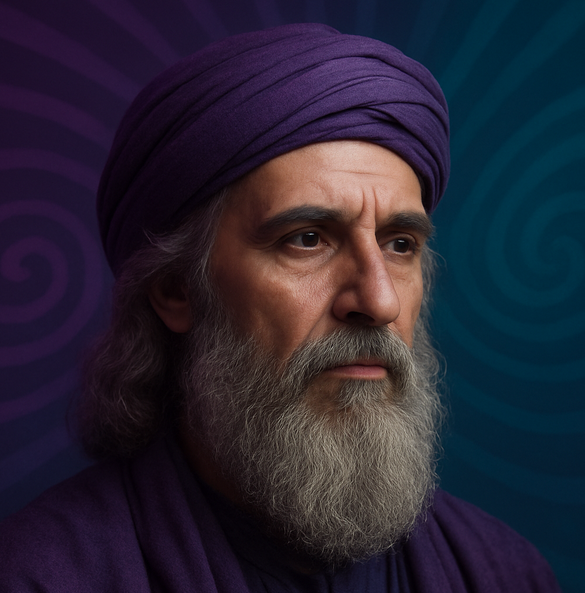
Zoroaster (Zarathustra) — The Prophet of Cosmic Choice and Moral Fire (c. 1500–1000 BCE?)
Zoroaster stands at the dawn of moral philosophy as a religious revolutionary. He transformed ancient ritual religion into an ethical vision centered on truth, choice, and responsibility. In his thought, the universe itself becomes a moral arena, and every human life a decisive participant in the struggle between truth and falsehood.
A Voice Against the Old Gods
Little is known with certainty about Zoroaster’s life. He lived somewhere in ancient Persia, in a world dominated by polytheistic ritual and priestly authority. According to tradition, he experienced a vision of divine truth that set him against the prevailing religious order of his time.
Zoroaster rejected the violent sacrifices and chaotic pantheon of earlier traditions. Instead, he proclaimed a single supreme principle of goodness, Ahura Mazda, the Wise Lord who embodies truth, order, and rationality.
“Hear with your ears the best things; consider them with clear thought.”
Truth (Asha) and the Lie (Druj)
At the center of Zoroaster’s teaching lies a stark moral dualism. Reality is structured by the opposition between Asha — truth, order, and rightness — and Druj — deceit, chaos, and moral distortion.
This conflict is not symbolic or abstract. It is woven into the fabric of the cosmos and enacted daily through human thought, speech, and action. Ethics is not obedience but alignment with reality itself.
“Between these two paths, each person must choose.”
Freedom, Responsibility, and Moral Choice
Zoroaster introduced one of history’s most radical ideas: that humans are genuinely free moral agents. Good and evil are not predetermined, nor are they imposed by divine whim. Each person must choose which side to serve.
Salvation is not achieved through ritual purity alone, but through good thoughts, good words, and good deeds. The moral life is active, rational, and participatory.
“Good thoughts, good words, good deeds.”
Fire as Symbol, Not Idol
Fire plays a central role in Zoroastrian worship, not as an object of worship, but as a symbol of truth, clarity, and divine presence. Fire illuminates without deceiving, transforms without corruption, and consumes falsehood.
This symbolism reflects Zoroaster’s deep philosophical intuition: that truth is something to be kept alive, tended, and protected against darkness and decay.
“I will speak of what is best in life.”
Judgment, Renewal, and the End of Time
Zoroaster envisioned history as moving toward a moral resolution. At the end of time, truth will triumph, evil will be exposed and defeated, and the world will be renewed. Souls will be judged not by status or belief, but by the lives they have chosen to live.
This eschatological vision profoundly influenced later religious traditions, shaping ideas of heaven and hell, final judgment, and cosmic justice.
“Then shall truth overcome the lie.”
Legacy — The First Moral Cosmologist
Zoroaster’s influence reaches far beyond Zoroastrianism itself. His ideas shaped Judaism, Christianity, and Islam, especially concepts of moral struggle, free will, judgment, and redemption.
He stands as one of history’s earliest thinkers to unite cosmology, ethics, and personal responsibility into a single, coherent vision. In Zoroaster’s world, to live truthfully is to help remake the universe.
“May we be among those who make the world renewed.”
CivilSimian.com created by AxiomaticPanic, CivilSimian, Kalokagathia