
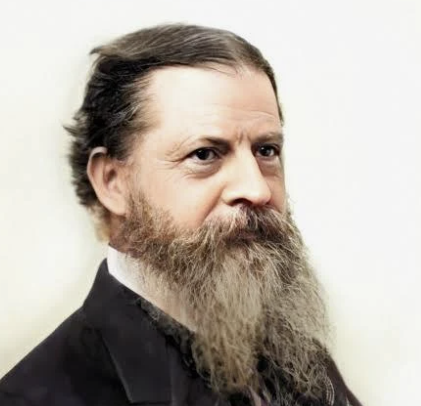
Charles Sanders Peirce — The Architect of Pragmatism and the Logic of Inquiry (1839–1914)
Charles Sanders Peirce was one of the most original minds America ever produced — a philosopher who laid the foundations of pragmatism, modern logic, semiotics, and a scientific theory of knowledge, only to be overshadowed in his lifetime by clearer popularizers and institutional politics. Where others sought certainty, Peirce built a philosophy designed to live with doubt, error, and the long, communal struggle toward truth.
A Scientific Mind from the Beginning
Peirce was born in Cambridge, Massachusetts, the son of a distinguished mathematician at Harvard. He was immersed early in logic, mathematics, and experimental science, and this background shaped everything he would later write. Philosophy, for Peirce, was not armchair speculation — it was continuous with scientific inquiry.
Trained as a chemist, Peirce worked for decades at the U.S. Coast Survey, conducting precise measurements and developing instruments. This daily engagement with fallible data and experimental error convinced him that philosophy must account not for perfect knowledge, but for how inquiry actually proceeds in the real world.
“Do not block the way of inquiry.”
Pragmatism — Meaning Through Consequences
Peirce originated pragmatism, though he would later rename his version pragmaticism to distinguish it from what others made of it. His pragmatic maxim is deceptively simple: to understand what a concept means, consider the practical effects its truth would have in experience.
Meaning, on this view, is not a hidden essence but a pattern of possible consequences. Concepts that make no difference to experience make no difference at all. Pragmatism was not anti-theoretical — it was anti-emptiness.
“Consider what effects, that might conceivably have practical bearings, we conceive the object of our conception to have.”
Belief, Doubt, and the Logic of Inquiry
Peirce rejected the Cartesian idea that philosophy begins with radical doubt. Genuine doubt, he argued, is not something we choose — it arises when habits of belief break down. Inquiry begins not in skepticism, but in the irritation of doubt.
Beliefs are habits of action. To believe something is to be prepared to act in certain ways. Inquiry aims not at psychological comfort, but at beliefs that would survive indefinite investigation by a community of inquirers.
“The opinion which is fated to be ultimately agreed to by all who investigate is what we mean by the truth.”
Abduction — The Logic of Discovery
One of Peirce’s most enduring contributions was his theory of abduction, or inference to the best explanation. Alongside deduction and induction, abduction explains how new ideas arise.
Abduction is the logic of creative guesswork — the moment when the mind proposes a hypothesis that would make surprising facts intelligible. Science, Peirce insisted, advances not by certainty, but by disciplined imagination.
“Abduction is the only logical operation which introduces any new idea.”
Signs, Symbols, and Semiotics
Peirce was also the founder of modern semiotics, the theory of signs. He argued that all thought occurs through signs — words, images, diagrams, gestures — and that meaning arises from the relations between sign, object, and interpreter.
This triadic view rejected simple representations. Meaning is not static. It unfolds through interpretation over time, linking logic, language, and experience into a single evolving process.
“We think only in signs.”
Poverty, Isolation, and an Unfinished System
Despite his brilliance, Peirce lived much of his life in poverty and isolation. His difficult personality, unconventional life, and sprawling unfinished manuscripts kept him on the margins of academic success. He published relatively little in polished form.
His philosophy survives largely through fragments, lectures, and notes — a vast, unfinished system reflecting his belief that inquiry itself is never complete.
Legacy — Truth as a Communal Horizon
Peirce’s influence runs quietly but deeply through philosophy, logic, linguistics, cognitive science, and scientific methodology. Pragmatism, abductive reasoning, and semiotics all trace back to him.
His enduring vision rejects both absolutism and relativism. Truth is not what anyone happens to believe — nor is it a static foundation. It is the horizon toward which inquiry tends, sustained by fallibility, cooperation, and the courage to keep thinking.
“The essence of belief is the establishment of a habit.”
CivilSimian.com created by AxiomaticPanic, CivilSimian, Kalokagathia