
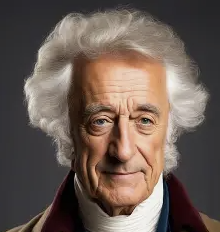
John Herschel — Science, Light, and the Mapping of the Heavens (1792–1871)
John Herschel was a British polymath and astronomer whose contributions ranged across mathematics, chemistry, photography, and the philosophy of science.
Son of the great William Herschel, he extended his father's survey of the heavens to the southern sky, completing the first systematic map of the entire celestial sphere.
His central concern: that science is not merely the accumulation of facts but a disciplined and philosophically coherent method for uncovering the laws of nature.
Completing the Survey of the Heavens
William Herschel had catalogued thousands of nebulae and double stars visible from the northern hemisphere. John resolved to complete what his father had begun.
From 1834 to 1838 he transported his telescope to the Cape of Good Hope, spending four years systematically observing the southern sky — a sustained act of scientific dedication with few parallels in the history of astronomy.
His resulting catalogue documented nearly 1,700 nebulae and over 2,000 double stars, giving science its first complete picture of the stellar heavens.
The Cape observations also brought him into contact with the Magellanic Clouds and the richness of the southern Milky Way — landscapes of the universe no systematic observer had previously recorded.
"The contemplation of the heavens is calculated to impress us with a sense of our own insignificance and of the immeasurable greatness of nature."
Pioneering Photography
Herschel was one of the founding figures of photography, working independently alongside Talbot and Daguerre in the critical years of the late 1830s.
He discovered that sodium thiosulfate could fix photographic images — preventing them from darkening further on exposure to light — a breakthrough that made photography practically viable.
He invented the cyanotype process, the blueprint, and coined the terms "photography," "negative," and "positive" that remain in use to this day.
For Herschel, photography was not merely a technical curiosity but an extension of the scientific impulse to record and preserve the evidence of nature faithfully.
"Photography is the application of chemistry and optics to the production of permanent images."
Philosophy of Scientific Method
Herschel's "Preliminary Discourse on the Study of Natural Philosophy," published in 1830, was one of the most influential accounts of scientific method of the nineteenth century.
He articulated with unusual clarity how science moves from careful observation through hypothesis and experiment to the formulation of general laws.
The young Charles Darwin read it with passionate attention before embarking on the Beagle voyage, and later described it as one of the books that most shaped his scientific outlook.
Herschel insisted that science was a human activity requiring imagination and judgment, not merely the mechanical application of rules.
"To travel through the regions of science is to travel through a country of which every part has something new and striking to offer."
Mathematics and Optics
Before turning his full attention to astronomy, Herschel made significant contributions to pure mathematics, working on the theory of finite differences and translating and extending the work of continental mathematicians for a British audience still wedded to Newtonian notation.
Together with Babbage and Peacock, he helped found the Analytical Society at Cambridge, a campaign to reform British mathematics by introducing the superior notation of Leibniz.
His work in optics extended to the study of light polarization, the spectrum, and the chemical action of different wavelengths of light — research that fed directly into both photography and astronomical spectroscopy.
Across all these fields he brought the same qualities: precise observation, careful reasoning, and a broad synthetic vision.
"Self-correction is the great strength of the scientific method — nature cannot be deceived, and sooner or later the truth prevails."
Legacy — A Giant of Victorian Science
Herschel was the most celebrated British scientist of his generation, honored across Europe and regarded by many contemporaries as the model of what a man of science should be.
His range was genuinely extraordinary — few figures have made lasting contributions to astronomy, chemistry, mathematics, photography, and the philosophy of science simultaneously.
He influenced Darwin, Whewell, Mill, and Maxwell, and his "Preliminary Discourse" helped shape the Victorian understanding of what science was and why it mattered.
In an era before rigid specialization, Herschel embodied the ideal of the natural philosopher — one who sought to comprehend nature as a whole.
"The grand aim of all science is to cover the greatest number of empirical facts by logical deduction from the smallest number of hypotheses or axioms."
CivilSimian.com created by AxiomaticPanic, CivilSimian, Kalokagathia