

1 day ago
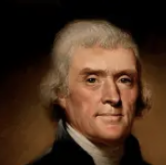
No one has a natural right to the trade of a money lender, but he who has the money to lend. Let those then among us who have a moneyed capital and who prefer employing it in loans rather than otherwise, set up banks and give cash or national bills for the notes they discount. Perhaps, to encourage them, a larger interest than is legal in the other cases might be allowed them, on the condition of their lending for short periods only.
▼
Source
source
ME 13:277

3 months 2 days ago
The objects of a financier are, then, to secure an ample revenue; to impose it with judgment and equality; to employ it economically; and, when necessity obliges him to make use of credit, to secure its foundations in that instance, and for ever, by the clearness and candour of his proceedings, the exactness of his calculations, and the solidity of his funds.
3 months 2 days ago
Our patience will achieve more than our force.

4 months 1 week ago
He who should teach men to die would at the same time teach them to live.
▼
Source
source
Ch. 18. That Men are not to judge of our Happiness till after Death, tr. Cotton, rev. W. Hazlitt, 1842

4 months 2 days ago
Any fool can make a ruleAnd every fool will mind it.
▼
Source
source
February 3, 1860
2 months 4 weeks ago
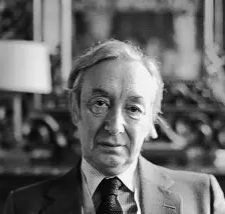
The ground for taking ignorance to be restrictive of freedom is that it causes people to make choices which they would not have made if they had seen what the realization of their choices involved.
▼
Source
source
"The Concept of Freedom".



4 months ago
The only non-Christians who seemed to me really to know anything were the Romantics; and a good many of them were dangerously tinged with something like religion, even at times with Christianity. The upshot of it all could nearly be expressed in a perversion of Roland's great line in the Chanson: 'Christians are wrong, but all the rest are bores.'
2 months 2 weeks ago
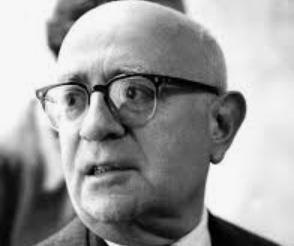
Words of the jargon sound as if they said something higher than what they mean.
▼
Source
source
p. 9
2 months 3 weeks ago
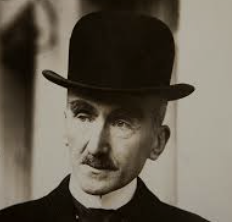
People talk, indeed, of a "primitive mentality", as, for example, to-day that of the inferior races, and in days gone by that of humanity in general, at whose door the responsibility for superstition should be laid.
▼
Source
source
Chapter II : Static Religion
Just now
More is given to us than to any people at any time before; and, therefore, more is required of us. We have made, and still are making, enormous advances on material lines. It is necessary that we commensurately advance on moral lines. Civilization, as it progresses, requires a higher conscience, a keener sense of justice, a warmer brotherhood, a wider, loftier, truer public spirit. Falling these, civilization must pass into destruction. It cannot be maintained on the ethics of savagery. For civilization knits men more and more closely together, and constantly tends to subordinate the individual to the whole, and to make more and more important social conditions.
▼
Source
source
Ch. 21 : Conclusion
4 months 2 days ago
The great thing however is, in the show of the temporal and the transient to recognize the substance which is immanent and the eternal which is present. For the work of Reason (which is synonymous with the Idea) when considered in its own actuality, is to simultaneously enter external existence and emerge with an infinite wealth of forms, phenomena and phases - a multiplicity that envelops its essential rational kernel with a motley outer rind with which our ordinary consciousness is earliest at home. It is this rind that the Concept must penetrate before Reason can find its own inward pulse and feel it still beating even in the outward phases. But this infinite variety of circumstances which is formed in this element of externality by the light of the rational essence shining in it - all this infinite material, with its regulatory laws - is not the object of philosophy....To comprehend what is, is the task of philosophy: and what is is Reason.
▼
Source
source
Works, VII, 17.
2 months 1 week ago
A schoolteacher or professor cannot educate individuals, he educates only species.
▼
Source
source
J 10

2 weeks 2 days ago
The much occupied man has no time for wantonness, and it is an obvious commonplace that the evils of leisure can be shaken off by hard work.
▼
Source
source
Line 9

3 weeks 1 day ago
Friend!-Will the ballot-box raise the Noblest to the chief place; does any sane man deliberately believe such a thing?

3 months 1 week ago
He is not rich, that enjoyeth not his own goods.

4 months 1 day ago
The word liberty in the mouth of Mr. Webster sounds like the word love in the mouth of a courtesan.
▼
Source
source
February 12, 1851; cf. the remark of John Wilkes about Samuel Johnson, "Liberty is as ridiculous in his mouth as Religion in mine" (20 March 1778), quoted in Boswell's Life of Johnson, 1791
1 month 1 week ago
If we already lived in a cruelty-free world, the notion of re-introducing suffering, exploitation and creatures eating each other would seem not so much frightful as unimaginable - no more seriously conceivable than reverting to surgery without anaesthesia today.
▼
Source
source
Reprogramming Predators, BLTC Research, 2009
3 months 1 day ago
The purpose of the State is, as we have already shown in our last lecture, no other than that of the Human Race itself:-to order all its relations according to the Laws of Reason. It is only after the Age of Reason as Science shall have been traversed, and we shall have arrived at the Age of Reason as Art, that the State can reflect upon this purpose with clear consciousness. Till then it constantly promotes this purpose, but without its own knowledge, or free pre meditated design; prompted thereto by the natural law of the development of our Race, even while it has a totally different purpose in view;-with which purpose of its own, Nature has indissolubly bound up the purpose of the whole Race.
▼
Source
source
p. 168
4 months 2 weeks ago
If the room is smoky, if only moderately, I will stay; if there is too much smoke I will go. Remember this, keep a firm hold on it, the door is always open.
▼
Source
source
Book I, ch. 25, 18.
1 month 2 weeks ago
It is the indignity of being treated as disposable that pushes people towards religious fundamentalism in order to retrieve a sense of self, of meaning, of significance. This is why globalization breeds religious fundamentalism and free markets create terrorism and extremism, not democracy.
▼
Source
source
(p80)

2 months 3 weeks ago
One disgust, then another - to the point of losing the use of speech and even of the mind...The greatest exploit of my life is to be still alive.
1 week 3 days ago
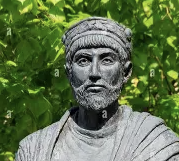
I am aware that the great Plato himself, and after him, a man posterior to him in date, though not in mind, I mean Iamblichus of Chalcis (who initiated us into other branches of philosophy, and also into this by means of his discourses), did both of them as far as hypothesis goes, take for granted the fact of a Creation and assumed the universe to have been, in a certain sense, the Work of Time, in order that the most important of the effects produced by this Power, may be reduced into a shape for examination.
3 months 3 weeks ago
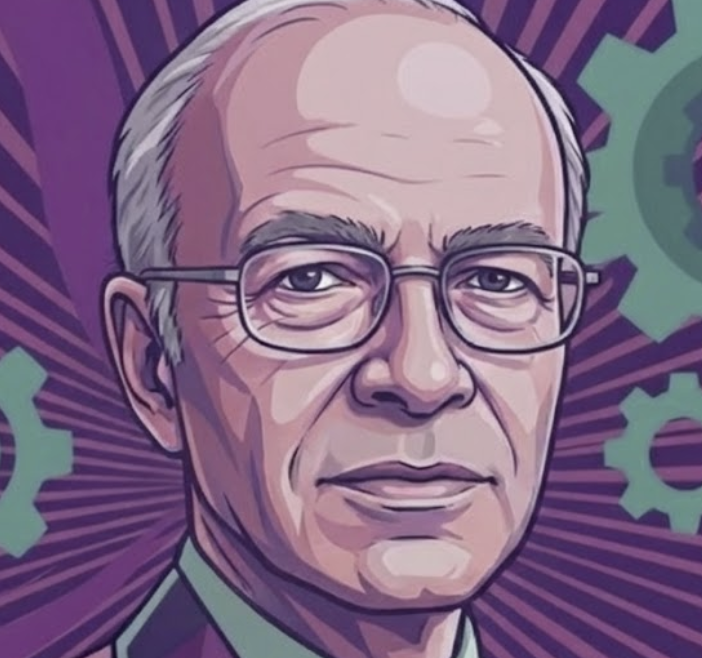
Philosophy is not politics, and we do our best, within our all-too-human limitations, to seek the truth, not to score points against opponents. There is little satisfaction in gaining an easy triumph over a weak opponent while ignoring better arguments against your views.
▼
Source
source
'Last Generation': A Response, The New York Times, June 16, 2010.
4 months 1 day ago
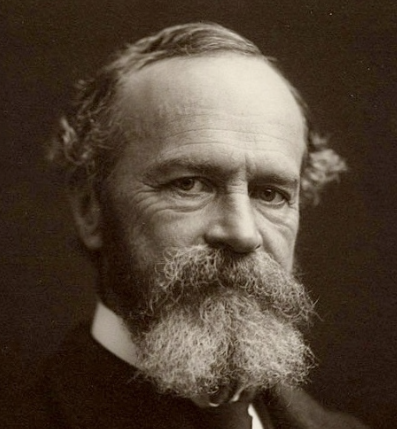
"What is meant by saying that my choice of which way to walk home after the lecture is ambiguous and matter of chance?...It means that both Divinity Avenue and Oxford Street are called but only one, and that one either one, shall be chosen.
▼
Source
source
The Dilemma of Determinism (1884) p.155
3 weeks 2 days ago
Before a man can do things there must be things he will not do.
▼
Source
source
Eugene H. Peterson, A Long Obedience in the Same Direction (IVP, 1980), Ch 2

1 month 2 weeks ago
It is quite true that, to the best of my judgment, the argumentation which applies to brutes holds equally good of men; and, therefore, that all states of consciousness in us, as in them, are immediately caused by molecular changes of the brain-substance. It seems to me that in men, as in brutes, there is no proof that any state of consciousness is the cause of change in the motion of the matter of the organism. If these positions are well based, it follows that our mental conditions are simply the symbols in consciousness of the changes which takes place automatically in the organism; and that, to take an extreme illustration, the feeling we call volition is not the cause of a voluntary act, but the symbol of that state of the brain which is the immediate cause of that act.

4 months 4 weeks ago
I shall have to test the theory of my father Parmenides, and contend forcibly that after a fashion not-being is and on the other hand in a sense being is not. For unless these statements are either disproved or accepted, no one who speaks about false words, or false opinion whether images or likenesses or imitations or appearances about the arts which have to do with them, can ever help being forced to contradict himself and make himself ridiculous.

4 months 1 week ago
Again, we should notice the force, effect, and consequences of inventions, which are nowhere more conspicuous than in those three which were unknown to the ancients; namely, printing, gunpowder, and the compass. For these three have changed the appearance and state of the whole world; first in literature, then in warfare, and lastly in navigation: and innumerable changes have been thence derived, so that no empire, sect, or star, appears to have exercised a greater power and influence on human affairs than these mechanical discoveries.
▼
Source
source
Aphorism 129

2 months 3 weeks ago
The capabilities (intellectual and material) of contemporary society are immeasurably greater than ever before-which means that the scope of society's domination over the individual is immeasurably greater than ever before. Our society distinguishes itself by conquering the centrifugal social forces with Technology rather than Terror, on the dual basis of an overwhelming efficiency and an increasing standard of living.
▼
Source
source
p. xliii
2 months 3 weeks ago
Progress, far from consisting in change, depends on retentiveness. When change is absolute there remains no being to improve and no direction is set for possible improvement: and when experience is not retained, as among savages, infancy is perpetual. Those who cannot remember the past are condemned to repeat it. This famous statement has produced many paraphrases and variants: Those who cannot learn from history are doomed to repeat it. Those who do not remember their past are condemned to repeat their mistakes. Those who do not read history are doomed to repeat it. Those who fail to learn from the mistakes of their predecessors are destined to repeat them. Those who do not know history's mistakes are doomed to repeat them.
▼
Source
source
There is a similar quote by Edmund Burke (in Revolution in France) that often leads to misattribution: "People will not look forward to posterity, who never look backward to their ancestors."

4 months 3 weeks ago
Let the states of equilibrium and harmony exist in perfection, and a happy order will prevail throughout heaven and earth, and all things will be nourished and flourish.
2 months 3 weeks ago
Subjective reason ... is inclined to abandon the fight with religion by setting up two different brackets, one for science and philosophy, and one for institutionalized mythology, thus recognizing both of them. For the philosophy of objective reason there is no such way out. Since it hold to the concept of objective truth, it must take a positive or a negative stand with regard to the content of established religion.
▼
Source
source
p. 12.

3 months 6 days ago
We are all instruments endowed with feeling and memory. Our senses are so many strings that are struck by surrounding objects and that also frequently strike themselves.
▼
Source
source
"Conversation Between D'Alembert and Diderot"
3 months 6 days ago
Morals are in all countries the result of legislation and government; they are not African or Asian or European: they are good or bad.

3 months 1 week ago
It is then unnecessary to investigate whether there be beyond the heaven Space, Void or Time. For there is a single general space, a single vast immensity which we may freely call Void; in it are innumerable globes like this one on which we live and grow. This space we declare to be infinite, since neither reason, convenience, possibility, sense-perception nor nature assign to it a limit. In it are an infinity of worlds of the same kind as our own.
1 week 5 days ago
So, too, in the Vedanta the whole world is seen as the lila and the maya of the Self, the first word meaning "play" and the second having the complex sense of illusion (from the Latin ludere, to play), magic, creative power, art, and measuring-as when one dances or draws a design to a certain measure. From this point of view the universe in general and playing in particular are, in a special sense, "meaningless": that is, they do not-like words and symbols-signify or point to something beyond themselves, just as a Mozart sonata conveys no moral or social message and does not try to suggest the natural sounds of wind, thunder, or birdsong.
▼
Source
source
p. 94
2 months 1 week ago
What are novels? What is the secret of the charm of every romance that ever was written? The first thing in a good novel is to place the persons together in circumstances which naturally call out the high feelings and thoughts of the character, which afford food for sympathy between them on these points - romantic events they are called. The second is that the heroine has generally no family ties (almost invariably no mother), or, if she has, these do not interfere with her entire independence. These two things constitute the main charm of reading novels.

4 months 3 weeks ago
Natural justice is a symbol or expression of usefulness, to prevent one person from harming or being harmed by another.
1 week 4 days ago
A new development began for relativity theory after 1925 with its absorption into quantum physics. The first great success was scored by Dirac's quantum mechanical equations of the electron, which introduced a new sort of quantities, the spinors, besides the vectors and tensors into our physical theories. ...But difficulties of the gravest kind turned up when one passed from one electron or photon to the interaction among an indeterminate number of such particles. In spite of several advances a final solution of this problem is not yet in sight and may well require a deep modification of the foundation of quantum mechanics, such as would account in the same basic manner for the elementary electric charge e as relativity theory and our present quantum mechanics account for c and h.
▼
Source
source
Preface to the First American Printing (1950) Note: see Paul Dirac, The Principles of Quantum Mechanics
2 months 4 days ago
The simulacrum is never what hides the truth-it is truth that hides the fact that there is none. The simulacrum is true.
▼
Source
source
- Ecclesiastes "The Precession of Simulacra," p. 1

4 months ago
I mistrust illuminations: what we take for a discovery is very often only a familiar thought that we have not recognized.
▼
Source
source
p. 439

2 months 2 weeks ago
A child might be overawed by a great city, but a civil engineer knows that he might demolish it and rebuild it himself. Husserl's philosophy has the same aim: to show us that, although we may have been thrust into this world without a 'by your leave,' we are mistaken to assume that it exists independently of us. It is true that reality exists apart from us; but what we mistake for the world is actually a world constituted by us, selected from an infinitely complex reality.
▼
Source
source
p. 63

4 months 2 days ago
As the chosen people bore in their features the sign manual of Jehovah, so the division of labour brands the manufacturing workman as the property of capital.
▼
Source
source
Vol. I, Ch. 14, Section 5, pg. 396.
4 months 1 day ago
When a whole nation is roaring Patriotism at the top of its voice, I am fain to explore the cleanness of its hands and purity of its heart.
▼
Source
source
December 10, 1824
4 months 2 days ago
Aeschylus had a clear eye for the commonest things. His genius was only an enlarged common sense. He adverts with chaste severity to all natural facts. His sublimity is Greek sincerity and simpleness, naked wonder which mythology had not helped to explain... Whatever the common eye sees at all and expresses as best it may, he sees uncommonly and describes with rare completeness. The multitude that thronged the theatre could no doubt go along with him to the end... The social condition of genius is the same in all ages. Aeschylus was undoubtedly alone and without sympathy in his simple reverence for the mystery of the universe.
▼
Source
source
January 29, 1840
4 months ago
My dear Wormwood, I note what you say about guiding your patient's reading and taking care that he sees a good deal of his materialist friend. But are you not being a trifle naive? It sounds as if you suppose that argument was the way to keep him out of the enemy's clutches. That might have been so if he had lived a few centuries earlier.
▼
Source
source
Letter I

2 months 3 weeks ago
Wherefore think ye evil in your hearts? For whether is easier, to say, Thy sins be forgiven thee; or to say, Arise, and walk? But that ye may know that the Son of man hath power on earth to forgive sins, (then saith he to the sick of the palsy,) Arise, take up thy bed, and go unto thine house.
▼
Source
source
9:4-6 (KJV) Said to some scribes.
2 months 1 week ago
Organizations are systems of coordinated action among individuals and groups whose preferences, information, interests, or knowledge differ. Organization theories describe the delicate conversion of conflict into cooperation, the mobilization of resources, and the coordination of effort that facilitate the joint survival of an organization and its members.
▼
Source
source
Simon (1993. p. 2); Cited in Mario Catalani, Giuseppe F. Clerico (1996) Decision making structures. p. 1.
CivilSimian.com created by AxiomaticPanic, CivilSimian, Kalokagathia