
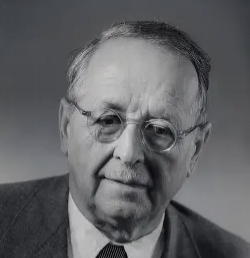
Hermann Weyl — Mathematics, Physics, and the Nature of Reality (1885–1955)
Hermann Weyl was a German mathematician and theoretical physicist whose work spanned an extraordinary range — from pure mathematics and logic to relativity, quantum mechanics, and philosophy.
A student of Hilbert and a colleague of Einstein, he brought rare depth of both technical mastery and philosophical reflection to every subject he touched.
His central concern: that mathematics, physics, and philosophy are not separate pursuits but aspects of a single search for the structure underlying reality.
Symmetry and Group Theory
Weyl's most far-reaching contribution to physics was his systematic application of group theory to the study of symmetry in nature.
He showed that the symmetries of physical systems — the transformations that leave their laws unchanged — could be captured with mathematical precision through the theory of groups.
This insight proved foundational for modern physics, underpinning quantum mechanics, particle physics, and the Standard Model of fundamental forces.
Weyl believed symmetry was not merely a tool but a window into the deepest structure of the physical world.
"Symmetry, as wide or as narrow as you may define its meaning, is one idea by which man through the ages has tried to comprehend and create order, beauty, and perfection."
Contributions to Relativity
In 1918, Weyl attempted one of the most ambitious projects in theoretical physics — a unified field theory combining Einstein's general relativity with electromagnetism through the concept of gauge invariance.
Though Einstein raised a powerful objection that ultimately blocked the original theory, the mathematical framework Weyl introduced — gauge theory — survived and flourished.
Gauge theory became the conceptual foundation of all modern quantum field theories, one of the most consequential mathematical legacies in physics.
Weyl had planted a seed whose full fruit would not appear for decades.
"My work always tried to unite the true with the beautiful; but when I had to choose one or the other, I usually chose the beautiful."
The Foundations of Mathematics
Weyl was deeply engaged with the foundational crisis shaking mathematics in the early twentieth century.
Influenced by the intuitionism of Brouwer, he grew skeptical of the classical assumption that infinite mathematical objects could be handled as freely as finite ones.
His book "The Continuum" offered a rigorous reconstruction of analysis on more restricted, constructive grounds — an attempt to place mathematics on foundations that matched what the mind could actually grasp.
He remained a persistent questioner of mathematical certainty, unwilling to accept formalism as a substitute for understanding.
"Logic is the hygiene the mathematician practices to keep his ideas healthy and strong."
Philosophy of Mathematics and Science
Unlike many mathematicians of his era, Weyl never retreated into pure formalism. He remained committed to the view that mathematics must ultimately connect to human intuition and lived experience.
He engaged seriously with Husserl's phenomenology, Kant's philosophy of space and time, and the broader question of how abstract structures can describe a concrete world.
His book "Space, Time, Matter" remains one of the most philosophically serious introductions to general relativity ever written.
For Weyl, the unreasonable effectiveness of mathematics was not a curiosity to be noted and set aside but a deep philosophical problem demanding attention.
"The objective world simply is; it does not happen. Only to the gaze of my consciousness, crawling upward along the life line of my body, does a section of this world come to life as a fleeting image in space which continuously changes in time."
Legacy — The Last Universal Mathematician
Weyl is often described as one of the last mathematicians to command the full breadth of his subject — pure mathematics, applied mathematics, theoretical physics, and philosophy all at the highest level.
His influence is woven into the fabric of modern science: in gauge theory, in the representation theory of Lie groups, in the mathematical foundations of quantum mechanics, and in the philosophy of space and time.
Yet he wore this mastery lightly, always returning to fundamental questions about what it means to understand, and what mathematics ultimately is.
In an age of increasing specialization, Weyl stands as a reminder of what integrated mathematical and philosophical vision can achieve.
"Without the concepts, methods, and results found and developed by previous generations right down to Greek antiquity, one cannot understand either the aims or the achievements of mathematics in the last fifty years."
CivilSimian.com created by AxiomaticPanic, CivilSimian, Kalokagathia