
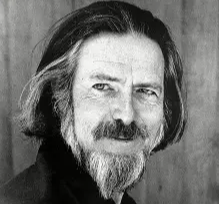
Alan Watts — The Interpreter of Eastern Wisdom (1915–1973)
Alan Watts was a British-born philosopher, writer, and speaker who helped introduce Eastern philosophy to Western audiences in the 20th century.
Blending clarity, humor, and poetic insight, he translated complex ideas from Zen Buddhism, Taoism, and Hinduism into language that felt immediate and alive.
His central message: the self we cling to is often an illusion — and freedom lies in recognizing our unity with the whole.
The Illusion of the Separate Self
Watts challenged the Western idea of the individual as a separate, isolated entity.
Drawing from Eastern traditions, he argued that the self is not a fixed thing, but a process — inseparable from the world around it.
The feeling of being a detached “ego,” he suggested, is a kind of social and psychological construct.
Letting go of this illusion leads to a deeper sense of connection and peace.
“You are not a drop in the ocean. You are the entire ocean in a drop.”
Life as Play
One of Watts’s most distinctive ideas is that life is not a problem to be solved, but a game to be played.
He criticized the tendency to treat existence as a constant struggle toward future goals.
Instead, he emphasized the importance of fully experiencing the present moment.
Meaning, in his view, is found in the act of living itself — not in some distant achievement.
“This is the real secret of life — to be completely engaged with what you are doing in the here and now.”
Bridging East and West
Watts did not present Eastern philosophy as something foreign or exotic, but as a perspective that could illuminate Western thought.
He drew parallels between Eastern insights and Western ideas in psychology, science, and art.
His work helped spark interest in meditation, mindfulness, and alternative approaches to consciousness.
He became especially influential during the cultural transformations of the 1960s.
“Trying to define yourself is like trying to bite your own teeth.”
Language and Reality
Watts often pointed out that language can distort our understanding of reality.
Words divide the world into categories, but reality itself is fluid and continuous.
By taking language too literally, we mistake our descriptions of the world for the world itself.
Philosophy, for Watts, involves seeing through these conceptual limitations.
“The menu is not the meal.”
Legacy — A New Way of Seeing
Alan Watts remains one of the most accessible and influential interpreters of Eastern philosophy in the West.
His work continues to resonate with those seeking a more integrated understanding of self and world.
He invites us to reconsider our assumptions about identity, purpose, and reality itself.
Not by offering rigid answers, but by shifting the way we see the question.
“You didn’t come into this world. You came out of it, like a wave from the ocean.”
CivilSimian.com created by AxiomaticPanic, CivilSimian, Kalokagathia