
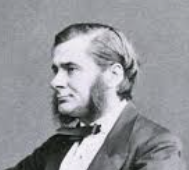
Thomas Henry Huxley — The Bulldog of Science and Defender of Evolution (1825–1895)
Thomas Henry Huxley was the great public champion of scientific reason — a biologist, educator, and polemicist who believed truth must be defended not only in laboratories, but in lecture halls, newspapers, and public debate. Fiercely articulate and intellectually fearless, he became the most famous defender of evolutionary theory in the nineteenth century, transforming science from a specialized pursuit into a cultural force.
From Ship Surgeon to Scientific Authority
Born in modest circumstances in England, Huxley had little formal schooling. Much of his education was self-directed, driven by voracious reading and disciplined curiosity. He trained as a medical assistant and later served as a naval surgeon, where his studies of marine organisms launched his scientific career.
His meticulous anatomical research quickly earned recognition. Huxley rose through the scientific establishment not by privilege, but by intellectual force and relentless work. He came to represent a new kind of scientist: professional, rigorous, and publicly engaged.
“Sit down before fact as a little child, be prepared to give up every preconceived notion.”
Defender of Evolution
Huxley became famous as the most formidable advocate of Charles Darwin’s theory of evolution by natural selection. Though initially cautious about some of Darwin’s ideas, he recognized the theory’s revolutionary implications and devoted himself to defending it against critics.
His debates with religious authorities and traditionalists became legendary. He did not merely argue for evolution as a biological theory; he argued for science as a method — a disciplined way of discovering truth that must remain independent of dogma.
For Huxley, evolution was not just a scientific claim. It was evidence that nature operates according to discoverable laws, not inherited assumptions.
“The great tragedy of science — the slaying of a beautiful hypothesis by an ugly fact.”
Agnosticism — Intellectual Honesty as a Principle
Huxley coined the term agnosticism to describe a philosophical stance grounded in epistemic humility. He rejected both dogmatic religion and dogmatic atheism, arguing that one should neither affirm nor deny what cannot be supported by evidence.
Agnosticism, for Huxley, was not a compromise position. It was a moral commitment to follow evidence wherever it leads — and to refuse conclusions that outrun proof.
“Agnosticism is of the essence of science.”
Science for the Public
Huxley believed science should not belong only to specialists. He lectured widely, wrote essays for general readers, and advocated educational reform. Scientific literacy, he argued, was essential for a modern society.
He helped professionalize scientific education in Britain, promoting laboratory training and replacing rote memorization with experimental learning.
Knowledge, in his view, should empower citizens, not merely decorate elites.
Character and Combativeness
Huxley’s personality was as influential as his ideas. Sharp-witted and unafraid of confrontation, he relished intellectual combat. His friends admired his courage; his opponents feared his precision.
Yet beneath his combative reputation lay a consistent ethical principle: loyalty to evidence above ideology. He insisted that truth-seeking requires both boldness and restraint — boldness to challenge authority, restraint to accept correction.
Legacy — Science as a Cultural Force
Thomas Henry Huxley helped redefine the role of science in modern life. He demonstrated that scientific thinking is not merely technical expertise, but a civic virtue.
His influence extended far beyond biology. He shaped debates about education, religion, ethics, and public reasoning. Through his writing and advocacy, science became a central voice in modern intellectual culture.
Huxley’s enduring lesson is uncompromising: beliefs must answer to evidence, not authority.
“Science is nothing but trained and organized common sense.”
CivilSimian.com created by AxiomaticPanic, CivilSimian, Kalokagathia