
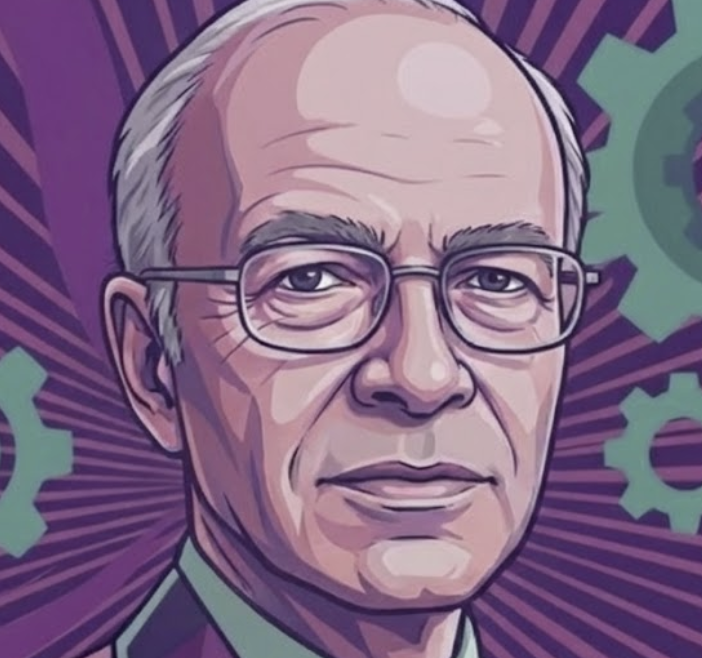
Peter Singer — The Philosopher Who Expanded the Circle of Moral Concern (1946– )
Peter Singer is one of the most influential and controversial moral philosophers of the modern era. With disarming clarity and relentless logic, he has argued that ethical thinking must be impartial, evidence-based, and willing to challenge deeply rooted intuitions. His work insists on a simple but unsettling idea: if we can reduce suffering without sacrificing something of comparable importance, then failing to do so is morally indefensible.
From Postwar Melbourne to Global Ethics
Born in Melbourne, Australia, to Jewish parents who fled Nazi persecution, Singer grew up acutely aware of moral catastrophe and human responsibility. He studied philosophy at the University of Melbourne before continuing at Oxford, where he encountered utilitarian ethics — the tradition that evaluates actions by their consequences for overall well-being.
At Oxford, Singer refined a style that would define his career: precise argumentation, minimal jargon, and an insistence that philosophy should matter beyond the seminar room. He would later teach at institutions around the world, most prominently at Princeton University.
“Ethics is not an ideal system which is all very noble in theory but no good in practice. Ethics is practical.”
Utilitarianism Without Sentimentality
Singer is a utilitarian, but not a naïve one. He argues that moral status depends not on species, intelligence, or social role, but on the capacity to suffer or experience well-being. From this premise follows a radical demand for impartiality: the suffering of any being counts equally, no matter how distant or unfamiliar.
This leads to conclusions many find uncomfortable. Ethical reasoning, Singer insists, cannot be guided by tradition, emotional comfort, or cultural habit alone. If logic points somewhere disturbing, we must follow it honestly.
“The question is not, Can they reason? nor, Can they talk? but, Can they suffer?”
Animal Liberation and the Challenge to Speciesism
Singer’s Animal Liberation helped ignite the modern animal rights movement. He argued that privileging human interests simply because they are human is a prejudice he called speciesism, morally comparable to racism or sexism.
Factory farming, animal experimentation, and industrial cruelty, he claimed, are ethical scandals hidden behind convenience and tradition. His arguments reshaped public debate, academic ethics, and the practical choices of millions regarding diet and consumption.
“All animals are equal — or none are.”
Global Poverty and the Demands of Moral Consistency
In essays such as Famine, Affluence, and Morality, Singer argued that distance does not diminish obligation. If we would save a drowning child nearby at little cost to ourselves, we are equally obligated to help strangers suffering far away.
This reasoning laid the philosophical foundation for the effective altruism movement, which emphasizes using evidence and reason to do the most good possible. Charity, on this view, is not optional generosity but moral responsibility.
“If it is in our power to prevent something bad from happening, without sacrificing anything of comparable moral importance, we ought, morally, to do it.”
Bioethics, Disability, and Controversy
Singer’s work in bioethics — especially on euthanasia, disability, and end-of-life care — has sparked intense criticism. He argues that ethical decisions must consider quality of life, suffering, and interests rather than sanctity alone.
Critics accuse him of cold rationalism or moral overreach; supporters praise his willingness to confront taboo questions honestly. Singer accepts the controversy as the cost of taking ethics seriously.
“We are responsible not only for what we do, but also for what we could have prevented.”
Legacy — Ethics That Refuses Comfort
Peter Singer’s legacy is a philosophy that refuses moral complacency. He has forced millions to rethink everyday choices — what they eat, how they give, and whom they include in their moral community.
Whether admired or resisted, Singer exemplifies a rare ideal: philosophy as a practical discipline that demands consistency between what we believe and how we live. His work continues to expand the boundaries of moral concern in a world increasingly aware of its shared vulnerability.
CivilSimian.com created by AxiomaticPanic, CivilSimian, Kalokagathia