
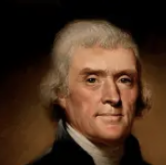
Thomas Jefferson — Liberty, Reason, and the Unfinished Republic (1743–1826)
Thomas Jefferson was an American statesman, philosopher, architect, scientist, and primary author of the Declaration of Independence — one of the most consequential political documents in human history.
Third President of the United States and founder of the University of Virginia, he embodied the Enlightenment ideal of the philosophe-statesman — a man who believed that reason, properly applied, could remake the political world.
His central concern: that human beings possess inherent rights no government can legitimately extinguish — and that the permanent danger of history is the tendency of power to forget this.
The Declaration of Independence
In the summer of 1776, at thirty-three years old, Jefferson drafted the document that would define the moral foundation of the American experiment.
The Declaration's second paragraph — perhaps the most famous political sentence in the English language — asserted that all men are created equal, endowed with unalienable rights to life, liberty, and the pursuit of happiness, and that governments derive their just powers from the consent of the governed.
Jefferson drew on Locke, on the Scottish Enlightenment, and on classical republican traditions — but the synthesis was his own, and its implications extended far beyond what even its author was prepared to follow.
Every subsequent American struggle for rights — abolition, suffrage, civil rights — would return to Jefferson's words to demand that the republic honor its own founding promise.
"We hold these truths to be self-evident, that all men are created equal."
Enlightenment Philosophy and Religious Liberty
Jefferson was a child of the Enlightenment in the fullest sense — a deist who believed in a rational creator but rejected orthodox Christian theology, privately editing the Gospels to remove miracles and retain what he regarded as the moral core of Jesus's teaching.
His Virginia Statute for Religious Freedom, enacted in 1786, established the principle that the state had no authority over the inner life — that compelling a man to support a religion he did not believe was tyranny over the mind.
The statute was the direct precursor to the First Amendment's establishment clause, and Jefferson regarded it as one of the three achievements he most wanted remembered — alongside the Declaration and the founding of the university.
For Jefferson, freedom of conscience was not one liberty among others but the foundation on which all others rested.
"It does me no injury for my neighbor to say there are twenty gods or no god. It neither picks my pocket nor breaks my leg."
Democracy, Agrarianism, and the Yeoman Ideal
Jefferson's political philosophy rested on a vision of a republic of independent farmers — citizens whose economic self-sufficiency made them capable of genuine political freedom.
He distrusted cities, manufacturing, and concentrated wealth as corrosive to the civic virtue a republic required. The man who owned his own land and fed his own family could afford to think and vote freely; the man dependent on a wage or a patron could not.
He was deeply skeptical of Hamilton's vision of a commercial, industrial, financially sophisticated America — a skepticism that defined one of the republic's oldest and most enduring political fault lines.
History vindicated Hamilton's economics while vindicating Jefferson's democratic instincts — a tension the republic has never fully resolved.
"Those who labor in the earth are the chosen people of God, if ever He had a chosen people."
The Contradiction — Liberty and Slavery
No honest account of Jefferson can avoid the central contradiction of his life: the man who wrote that all men are created equal owned over six hundred enslaved people across his lifetime and freed only a handful, most of them his own children by the enslaved woman Sally Hemings.
He knew it was wrong. He wrote so privately and occasionally publicly, describing slavery as a moral and political catastrophe while doing virtually nothing to end his personal participation in it. Financial dependence on enslaved labor, the social world of Virginia planter culture, and a failure of moral courage all played their part.
The contradiction is not incidental to Jefferson — it is structural. His ideals were universal; his life was not. The gap between them is not a footnote but the defining tension of American history itself.
To read Jefferson honestly is to hold both things simultaneously: the genuine power of the ideas and the genuine weight of the betrayal.
"We have the wolf by the ear, and we can neither hold him nor safely let him go. Justice is in one scale, and self-preservation in the other."
Legacy — The Argument That Continues
Jefferson died on July 4, 1826 — the fiftieth anniversary of the Declaration, within hours of John Adams, his great rival and late-life friend. The coincidence struck contemporaries as providential.
His legacy is the most contested in American political life. Conservatives claim his suspicion of central government; liberals claim his egalitarian ideals; those demanding racial justice claim his words while indicting his life. All of them are drawing on something real.
What makes Jefferson inexhaustible is that the tension he embodied — between universal principle and particular failure, between the ideal republic and the actual one — is not his alone. It is the tension the republic has lived with ever since.
He gave America its highest standard and its most glaring hypocrisy simultaneously — and in doing so, made both the aspiration and the reckoning inescapable.
"I like the dreams of the future better than the history of the past."
CivilSimian.com created by AxiomaticPanic, CivilSimian, Kalokagathia