
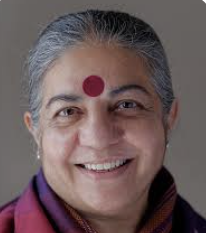
Vandana Shiva — The Philosopher of Ecology, Seeds, and Earth Democracy (1952– )
Vandana Shiva is a philosopher of the living earth — a thinker who unites ecology, ethics, science, and political resistance into a single vision of planetary responsibility. Against industrial monoculture, corporate globalization, and extractive economics, she defends biodiversity, local knowledge, and the rights of nature. Her work insists that the ecological crisis is not merely environmental, but civilizational.
From Physics to Ecology
Born in Dehradun, India, Shiva was trained as a physicist, completing doctoral work on the philosophy of quantum theory. Her early scientific education grounded her in rigorous analysis, but it also led her to question reductionist models that treated nature as inert matter rather than living process.
Witnessing deforestation, soil degradation, and the displacement of rural communities, she shifted from theoretical physics to ecological activism and environmental philosophy. For Shiva, science was never abandoned — it was redirected toward life.
“In nature’s economy, the currency is not money — it is life.”
Critique of Industrial Agriculture
Shiva became internationally known for her critique of industrial agriculture and its ecological and social consequences. She argues that monocultures, chemical inputs, and corporate seed patents undermine biodiversity, farmer autonomy, and long-term soil health.
According to her analysis, industrial agriculture treats the earth as a machine and farmers as replaceable components. By contrast, traditional farming systems operate as living networks, balancing soil, water, plants, animals, and communities.
Food, in her philosophy, is not merely a commodity. It is a relationship between humans and the earth.
“Soil, not oil, is the basis of our future.”
Seed Freedom and Biodiversity
One of Shiva’s central causes is seed sovereignty — the principle that farmers should have the right to save, exchange, and cultivate their own seeds. She argues that patenting life forms transforms a shared biological heritage into private property.
Through initiatives such as community seed banks, she promotes biodiversity as both ecological necessity and cultural inheritance.
Diversity, she maintains, is the true foundation of resilience.
“The seed is the source of life and the first link in the food chain.”
Earth Democracy — A Political Philosophy
Shiva’s concept of Earth Democracy extends democratic principles beyond human societies to the entire community of life. She argues that political systems must recognize the intrinsic value of ecosystems, species, and future generations.
In this vision, rights are not limited to citizens. Rivers, forests, and soils become participants in moral consideration.
Economic systems, therefore, should measure success not by growth alone, but by ecological flourishing.
“The Earth is not a resource. She is the source of life.”
Activism and Global Influence
Shiva’s work spans scholarship, grassroots activism, and international advocacy. She has advised governments, spoken at global forums, and supported local farming movements.
Her influence extends across environmental philosophy, feminist theory, postcolonial studies, and development ethics. Admirers see her as a prophetic voice for ecological justice; critics challenge aspects of her scientific and economic claims.
Yet even her critics acknowledge that she has helped reshape global debate about agriculture, biodiversity, and sustainability.
Legacy — Thinking Like the Earth
Vandana Shiva’s philosophy calls for a transformation not only of policies, but of perception. She urges humanity to move from domination to partnership, from extraction to regeneration, from ownership to stewardship.
Her central claim is radical in its simplicity: ecological balance is not a luxury. It is the condition for civilization itself.
“We are members of the earth community, not its masters.”
CivilSimian.com created by AxiomaticPanic, CivilSimian, Kalokagathia