
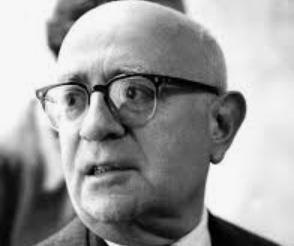
Theodor W. Adorno — The Philosopher of Negative Dialectics, Culture, and Modern Unfreedom (1903–1969)
Theodor Adorno was the great diagnostician of modern damage — a philosopher who believed that twentieth-century society had learned to rationalize cruelty, aestheticize domination, and mistake conformity for freedom. Suspicious of reconciliation and hostile to easy hope, Adorno developed a philosophy that refuses closure, insisting that thought must remain loyal to suffering by never pretending the world is already whole.
A Child of Music, Philosophy, and Catastrophe
Born in Frankfurt to a cultured, bourgeois family, Adorno was trained as both a philosopher and a musician. He studied composition with Alban Berg and was deeply shaped by modernist music, especially its resistance to harmony and resolution.
This dual formation mattered. Adorno never separated aesthetics from philosophy. Art, for him, was not decoration — it was a register of social truth, capable of revealing contradictions that theory alone could not articulate.
The rise of Nazism forced Adorno into exile. The experience of fascism, genocide, and mass deception would permanently scar his thinking. After Auschwitz, philosophy could no longer proceed as before.
“To write poetry after Auschwitz is barbaric.”
Critical Theory and the Frankfurt School
Adorno was a central figure of the Frankfurt School, alongside Max Horkheimer, Herbert Marcuse, and Walter Benjamin. Their project — critical theory — sought to understand why Enlightenment rationality, instead of producing freedom, had culminated in domination, bureaucracy, and terror.
In Dialectic of Enlightenment, co-written with Horkheimer, Adorno argued that reason had turned against itself. Instrumental rationality — the reduction of thinking to calculation and control — had hollowed out ethics, imagination, and autonomy.
Enlightenment mythologized itself. Progress became regression.
“Myth is already enlightenment, and enlightenment reverts to mythology.”
The Culture Industry — Entertainment as Domination
One of Adorno’s most influential ideas is the concept of the culture industry. Modern mass culture, he argued, does not liberate or enlighten — it pacifies.
Film, radio, popular music, and advertising standardize experience, train passive consumption, and eliminate genuine individuality. What appears as choice is pre-selected. What appears as pleasure is administered.
Culture no longer challenges society; it reproduces it. Art becomes commodity. Rebellion becomes style.
“Amusement under late capitalism is the prolongation of work.”
Negative Dialectics — Thinking Without Reconciliation
Adorno rejected traditional dialectics, especially Hegel’s belief that contradictions are ultimately resolved in higher unity. History, Adorno insisted, offers no guarantee of synthesis.
His alternative was negative dialectics: a mode of thought that refuses to subsume the particular under totalizing concepts. Concepts always fail to capture reality fully. Identity thinking — the attempt to make things fit neatly into categories — is itself a form of violence.
Philosophy must therefore think against itself, preserving contradiction, resisting closure, and remaining faithful to what does not fit.
“The whole is the false.”
Ethics After Auschwitz
Adorno believed that the twentieth century shattered traditional moral frameworks. Ethics could no longer rely on universal principles abstracted from suffering.
His minimal moral imperative was stark: arrange thought and action so that Auschwitz never happens again. This required vigilance against authoritarianism, obedience, and the normalization of cruelty.
Morality begins not with ideals, but with responsiveness to pain.
Return to Germany and Intellectual Conflict
After the war, Adorno returned to Germany and became a public intellectual. He lectured widely, critiqued rearmament, consumerism, and the persistence of authoritarian psychology.
Ironically, his pessimism put him at odds with the student movements of the 1960s. While sympathetic to their critique, he feared activism without reflection could reproduce the domination it opposed.
He remained an outsider — even among radicals.
Legacy — Thinking in the Ruins
Adorno left behind no system, only constellations — fragments arranged to illuminate what systematic philosophy suppresses. He influenced philosophy, sociology, cultural studies, music theory, and political critique.
His work remains difficult, often abrasive, deliberately resistant to consumption. This is its point. Adorno believed that philosophy must not console prematurely. To think truthfully is already a form of resistance.
In a world eager for optimism, Adorno insists on remembering what optimism forgets.
“Wrong life cannot be lived rightly.”
CivilSimian.com created by AxiomaticPanic, CivilSimian, Kalokagathia