


3 months 2 weeks ago
What has to be accepted, the given, is - so one could say - forms of life.
▼
Source
source
Pt II, p. 226 of the 1968 English edition
3 months 3 weeks ago
We can come to look upon the deaths of our enemies with as much regret as we feel for those of our friends, namely, when we miss their existence as witnesses to our success.
▼
Source
source
Vol. 2, Ch. 26, sect. 311a
2 months 2 weeks ago
The other conclusion is that art is the complement of science. Science as I have said is concerned wholly with relations, not with individuals. Art, on the other hand, is not only the disclosure of the individuality of the artist but also a manifestation of individuality as creative of the future, in an unprecedented response to conditions as they were in the past. Some artists in their vision of what might be, but is not, have been conscious rebels. But conscious protest and revolt is not the form which the labor of the artist in creation of the future must necessarily take. Discontent with things as they are is normally the expression of the vision of what may be and is not, art in being the manifestation of individuality is this prophetic vision.
3 months 6 days ago
Place is the greatest thing, as it contains all things.
▼
Source
source
As quoted in Diogenes Laërtius, The Lives and Opinions of Eminent Philosophers, I, 35
3 months 3 weeks ago
Europeans are awakening more and more to a sense that beasts have rights, in proportion as the strange notion is being gradually overcome and outgrown, that the animal kingdom came into existence solely for the benefit and pleasure of man. This view, with the corollary that non-human living creatures are to be regarded merely as things, is at the root of the rough and altogether reckless treatment of them, which obtains in the West.
▼
Source
source
Part III, Ch. VIII, 7, p. 225

2 months 1 week ago
But it has been necessary, for the benefit of the social order, to convert religion into a kind of police system, and hence hell. Oriental or Greek Christianity is predominantly eschatological, Protestantism predominantly ethical, and Catholicism is a compromise between the two, although with the eschatological element predominating.
2 months 1 week ago
The vanity of the passing world and love are the two fundamental and heart-penetrating notes of true poetry. And they are two notes of which neither can be sounded without causing the other to vibrate. The feeling of the vanity of the passing world kindles love in us, the only thing that triumphs over the vain and transitory, the only thing that fills life again and eternalizes it.
2 months 2 weeks ago
All natures, all formed things, all creatures exist in and with one another and will again be resolved into their own roots, because the nature of matter is dissolved into the roots of its nature alone. He who has ears to hear, let him hear.
2 weeks ago
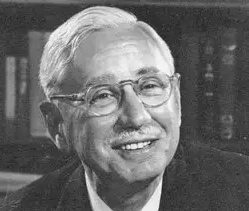
Love one another. My final lesson of history is the same as that of Jesus. You may think that's a lot of lollipop but just try it. Love is the most practical thing in the world. If you take an attitude of love toward everybody you meet, you'll eventually get along. When asked, at the age of 92, if he could summarize the lessons of history into a single sentence.
▼
Source
source
As quoted in "Durants on History from the Ages, with Love," by Pam Proctor, Parade (6 August 1978) p. 12.

3 months 3 weeks ago
Fanaticism is the danger of the world, and always has been, and has done untold harm. I might almost say that I was fanatical against fanaticism.
▼
Source
source
The Future of Science (1959), p. 79; also in BBC The Listener, Vol. 61 (1959), p. 505

2 months 1 week ago
I began with a strong bias toward skepticism. Besides, to tell the truth, I still find occult phenomena a little preposterous and irrelevant. What do they really matter if you place them against the truly great human achievements - against the creative genius of a Michaelangelo, a Beethoven, an Einstein? In that context they seem almost trivial.
▼
Source
source
p. 120

4 months 2 weeks ago
A happy and eternal being has no trouble himself and brings no trouble upon any other being; hence he is exempt from movements of anger and partiality, for every such movement implies weakness.
2 months 1 week ago
Society creates the victims that it afterwards vainly attempts to get rid of.

3 months 3 weeks ago
The activity of to-day and the assurance of to-morrow.
▼
Source
source
p. 215

2 months 3 weeks ago
France had for some time been guilty of a continued series of hostile acts against this country, both external and internal: first, she directed her pursuits to universal empire, under the name of fraternity, in order to overturn the fabric of our laws and government.
▼
Source
source
Speech in the House of Commons (12 February 1793)
4 months 3 weeks ago
You want to know whether I can make a long speech, such as you are in the habit of hearing; but that is not my way. Socrates speaking to Alcibiades
2 months 2 weeks ago
The precepts "Love your enemies, do good to them which hate you, bless them that curse you" ... are born from the Gospel's profound spirit of individualism, which refuses to let one's own actions and conduct depend in any way on somebody else's acts. The Christian refuses to let his acts be mere reactions-such conduct would lower him to the level of his enemy. The act is to grow organically from the person, "as the fruit from the tree." ... What the Gospel demands is not a reaction which is the reverse of the natural reaction, as if it said: "Because he strikes you on the cheek, tend the other"-but a rejection of all reactive activity, of any participation in common and average ways of acting and standards of judgment.
▼
Source
source
L. Coser, trans. (1961), pp. 99-100

2 months 3 weeks ago
When... in the course of all these thousands of years has man ever acted in accordance with his own interests?
▼
Source
source
Part 1, Chapter 7
4 months 2 weeks ago
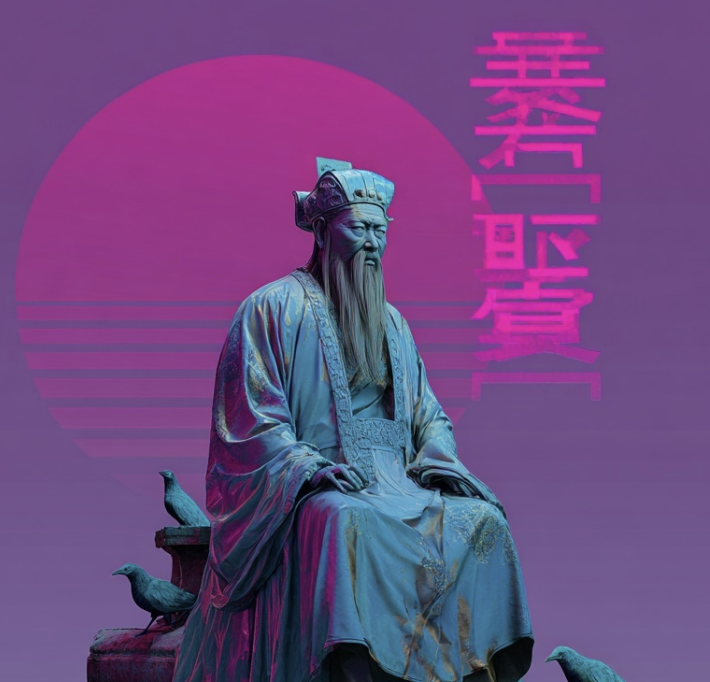
The aged are cared for until death; adults are employed in jobs that make full use of their abilities; and children are nourished, educated, and fostered;...orphans... the disabled and the diseased are all well taken care of....
2 months 3 weeks ago
All presentation, all demonstration-and the presentation of thought is demonstration-has, according to its original determination-and this is all that matters to us-the cognitive activity of the other person as its ultimate aim.
▼
Source
source
Z. Hanfi, trans., in The Fiery Brook (1972), p. 67
3 months 3 weeks ago
To different minds, the same world is a hell, and a heaven.
▼
Source
source
December 20, 1822
4 months 3 weeks ago
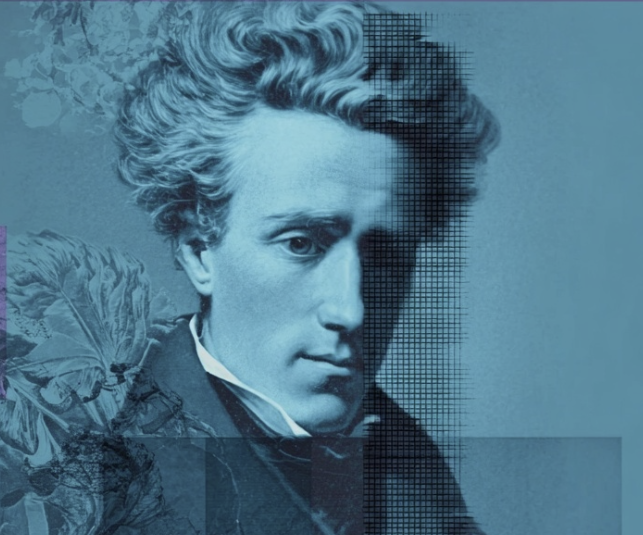
There is a contrast of primary significance between Augustine and Pelagius. The former crushes everything in order to rebuild it again. The other addresses himself to man as he is. The first system, therefore, in respect to Christianity, falls into three stages: creation – the fall and a consequent condition of death and impotence; a new creation - whereby man is placed in a position where he can choose; and then, if he chooses - Christianity. The other system addresses itself to man as he is (Christianity fits into the world). From this is seen the significance of the theory of inspiration for the first system; from this also is seen the relationship between the synergistic and the semipelagian conflict. It is the same question, only that the syngeristic struggle has its presupposition in the new creation of the Augustinian system.
2 months 1 week ago
Someone has said that it requires less mental effort to condemn than to think. The widespread mental indolence, so prevalent in society, proves this to be only too true. Rather than to go to the bottom of any given idea, to examine into its origin and meaning, most people will either condemn it altogether, or rely on some superficial or prejudicial definition of non-essentials.

2 months 1 week ago
There are no whole truths; all truths are half-truths. It is trying to treat them as whole truths that plays the devil.
▼
Source
source
Prologue.
2 months 2 weeks ago
How did this division of the nations come about, what was its basis? The division is in accordance with all the previous history of the nationalities in question. It is the beginning of the decision on the life or death of all these nations, large and small. All the earlier history of Austria up to the present day is proof of this and 1848 confirmed it. Among all the large and small nations of Austria, only three standard-bearers of progress took an active part in history, and still retain their vitality - the Germans, the Poles and the Magyars. Hence they are now revolutionary. All the other large and small nationalities and peoples are destined to perish before long in the revolutionary world storm. (Weltsturm). For that reason they are now counter-revolutionary.
▼
Source
source
The Magyar Struggle in Neue Rheinische Zeitung (13 January 1849).

3 months 3 weeks ago
I think they do it to pass the time, nothing more. But time is too large, it can't be filled up. Everything you plunge into it is stretched and disintegrates.
▼
Source
source
Diary entry of Friday (2 February), concerning a card game
3 months 3 weeks ago
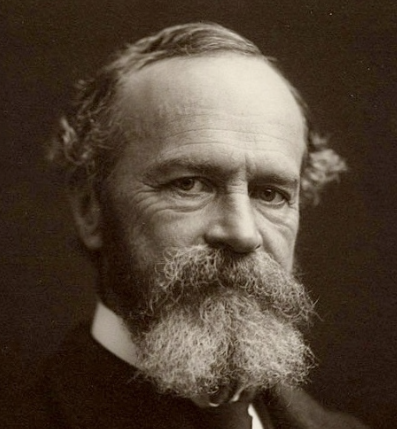
Tell him to live by yes and no - yes to everything good, no to everything bad.
▼
Source
source
As quoted in The Thought and Character of William James (1935) by Ralph Barton Perry, Vol. II, ch. 91

3 months 3 weeks ago
A totally unmystical world would be a world totally blind and insane.
▼
Source
source
Grey Eminence, 1940
4 months 3 weeks ago
All things as subsist from nature appear to contain in themselves a principle of motion and permanency; some according to place, others according to increase and diminuation; and others according to change in quality.
▼
Source
source
Book II, Ch. I, p. 88.

3 months 3 weeks ago
There is only one man who gets his own way-he who can get it single-handed; therefore freedom, not power, is the greatest good. That man is truly free who desires what he is able to perform, and does what he desires. This is my fundamental maxim. Apply it to childhood, and all the rules of education spring from it. Society has enfeebled man, not merely by robbing him of the right to his own strength, but still more by making his strength insufficient for his needs. This is why his desires increase in proportion to his weakness; and this is why the child is weaker than the man. If a man is strong and a child is weak it is not because the strength of the one is absolutely greater than the strength of the other, but because the one can naturally provide for himself and the other cannot. Thus the man will have more desires and the child more caprices, a word which means, I take it, desires which are not true needs, desires which can only be satisfied with the help of others.


2 months 2 weeks ago
Tragic paradox of freedom: the mediocre men who alone make its exercise possible cannot guarantee its duration.

2 months 2 weeks ago
Functional communication is only the outer layer of the one- dimensional universe in which man is trained to target-to translate the negative into the positive so that he can continue to function, reduced but fit and reasonably well. The institutions of free speech and freedom of thought do not hamper the mental coordination with the established reality. What is taking place is a sweeping redefinition of thought itself, of its function and content. The coordination of the individual with his society reaches into those layers of the mind where the very concepts are elaborated which are designed to comprehend the established reality. These concepts are taken from the intellectual tradition and translated into operational terms-a translation which has the effect of reducing the tension between thought and reality by weakening the negative power of thought.
▼
Source
source
p. 104
2 months 6 days ago
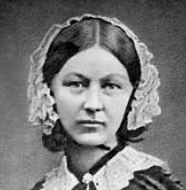
Nothing can well be imagined more painful than the present position of woman, unless, on the one hand, she renounces all outward activity and keeps herself within the magic sphere, the bubble of her dreams; or, on the other, surrendering all aspiration, she gives herself to her real life, soul and body. For those to whom it is possible, the latter is best; for out of activity may come thought, out of mere aspiration can come nothing.
1 month 3 weeks ago
Everything is worth what its purchaser will pay for it.
▼
Source
source
Maxim 847
2 months 2 weeks ago
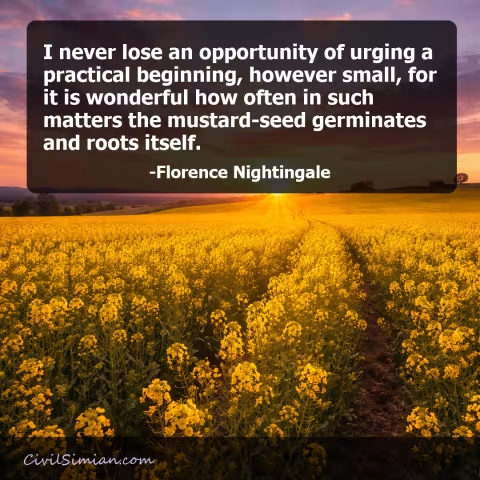
When you have understood that nothing is, that things do not even deserve the status of appearances, you no longer need to be saved, you are saved, and miserable forever.
3 months 2 weeks ago
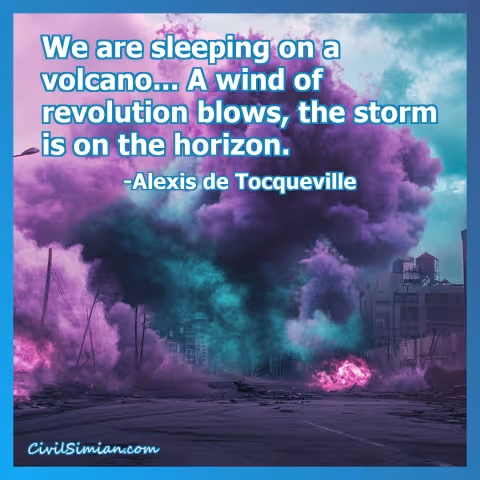
I am showing my pupils details of an immense landscape which they cannot possibly know their way around.
▼
Source
source
p. 56e
2 months 3 weeks ago
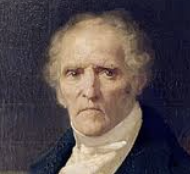
Deny them this participation of freedom, and you break that sole bond, which originally made, and must still preserve the unity of the empire.
2 weeks 6 days ago
Hitherto men have speculated vaguely on the unity of universes; it is now about to be demonstrated by reasoning from the passional world to material, guided by the analogy which exists between the two.
▼
Source
source
L'attraction passioneé, Harmonian Man: Selected Writings of Charles Fourier, p. 54
4 days ago
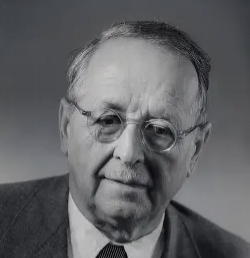
Space and time are commonly regarded as the forms of existence of the real world, matter as its substance. A definite portion of matter occupies a definite part of space at a definite moment of time. It is in the composite idea of motion that these three fundamental conceptions enter into intimate relationship.
▼
Source
source
Introduction
2 months 3 weeks ago
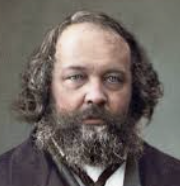
The great honor of Christianity, its incontestable merit, and the whole secret of its unprecedented and yet thoroughly legitimate triumph, lay in the fact that it appealed to that suffering and immense public to which the ancient world, a strict and cruel intellectual and political aristocracy, denied even the simplest rights of humanity. Otherwise it never could have spread.
▼
Source
source
Dover edition, p. 75

1 month 2 weeks ago
Even sticking to the higher plane of love, is it so very obvious that you can't love more than one person? We seem to manage it with parental love (parents are reproached if they don't at least pretend to love all their children equally), love of books, of food, of wine (love of Chateau Margaux does not preclude love of a fine Hock, and we don't feel unfaithful to the red when we dally with the white), love of composers, poets, holiday beaches, friends . . . why is erotic love the one exception that everybody instantly acknowledges without even thinking about it?
▼
Source
source
Banishing the Green-Eyed Monster, November 2007.
2 months 1 week ago
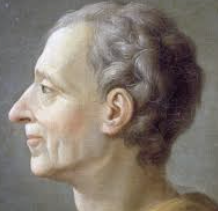
And yet there is nothing so badly imagined: nature seems to have provided, that the follies of men should be transient, but they by writing books render them permanent. A fool ought to content himself with having wearied those who lived with him: but he is for tormenting future generations; he is desirous that his folly should triumph over oblivion, which he ought to have enjoyed as well as his grave; he is desirous that posterity should be informed that he lived, and that it should be known for ever that he was a fool. Commonly paraphrased as "An author is a fool who, not content with having bored those who have lived with him, insists on boring future generations".
▼
Source
source
No. 66. (Rica writing to * * *)
1 month 1 week ago
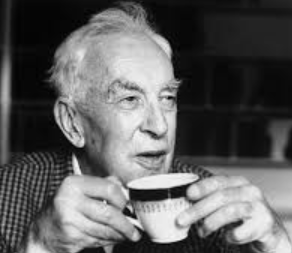
The supreme accomplishment is to blur the line between work and play.
▼
Source
source
In Ellen J. Langer (ed.) Mindfulness (Merloyd Lawrence Books, 1989) p. 133
3 months 3 weeks ago
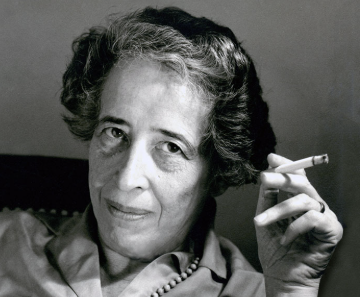
Kant stated defensively that he had "found it necessary to deny knowledge. . . to make room for faith," but he had not made room for faith; he had made room for thought, and he had not "denied knowledge" but separated knowledge from thinking.
▼
Source
source
p. 14
2 months 1 week ago
It is a safe rule to apply that, when a mathematical or philosophical author writes with a misty profundity, he is talking nonsense.
▼
Source
source
ch. 15.
4 months 3 weeks ago
I was brought up in the Christian religion, and although I can scarcely sanction all the improper attempts to gain the emancipation of woman, all paganlike reminiscences also seem foolish to me. My brief and simple opinion is that woman is certainly as good as man-period. Any more discursive elaboration of the difference between the sexes or deliberation on which sex is superior is an idle intellectual occupation for loafers and bachelors.

2 months 1 week ago
To die is to wander.
CivilSimian.com created by AxiomaticPanic, CivilSimian, Kalokagathia