
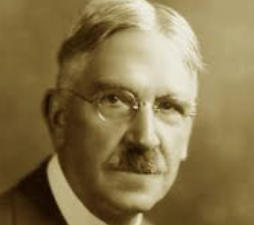
John Dewey — The Philosopher of Democracy, Experience, and Education (1859–1952)
John Dewey was philosophy’s great experimentalist — a thinker who refused to separate thought from action, theory from practice, or knowledge from life. Against traditions that treated truth as something to be discovered once and for all, Dewey insisted that ideas are tools, tested and reshaped through experience. For him, philosophy was not about escaping the world, but about improving how we live in it.
From Hegel to the Laboratory of Life
Dewey began his career under the influence of German idealism, especially Hegel, with its emphasis on organic wholes and historical development. But he soon became dissatisfied with metaphysical systems that floated above concrete human problems.
As psychology and biology advanced, Dewey turned toward a naturalistic view of mind. Thought, he argued, is not a mirror of reality, but a biological and social activity — a way organisms adapt to their environments.
Philosophy, therefore, should start not with eternal truths, but with the troubles people actually face.
“Philosophy recovers itself when it ceases to be a device for dealing with the problems of philosophers and becomes a method for dealing with the problems of men.”
Experience as Interaction, Not Inner Theater
Dewey rejected the idea that experience happens inside a private mental space. Experience, for him, is transactional: it arises from the ongoing interaction between organisms and their surroundings.
We do not first perceive the world and then act upon it. Perception, action, habit, and meaning are woven together in continuous activity.
Knowledge grows out of problematic situations — moments when habitual responses fail and reflection becomes necessary.
“We do not learn from experience… we learn from reflecting on experience.”
Pragmatism — Truth as What Works, Over Time
Dewey is one of the central figures of American pragmatism, alongside Peirce and William James. For pragmatists, ideas are instruments, not representations of fixed realities.
Truth is not correspondence with eternal facts, but the long-term success of beliefs in guiding action and inquiry. What matters is not whether an idea is metaphysically pure, but whether it helps resolve the problems that gave rise to it.
Knowledge is always provisional. Inquiry is never finished.
“Truth happens to an idea.”
Democracy as a Way of Life
Dewey did not view democracy merely as a political system. He saw it as a form of social intelligence — a way communities solve problems together.
Democratic life depends on communication, shared inquiry, and public participation. Without education and open dialogue, formal voting becomes empty ritual.
Democracy, for Dewey, is always unfinished. It must be rebuilt in every generation.
“Democracy is more than a form of government; it is primarily a mode of associated living.”
Education as Growth
Dewey’s most lasting influence lies in education. He rejected rote memorization and authoritarian classrooms, arguing that learning happens through active engagement.
Schools, he believed, should function as miniature communities where students learn by doing — experimenting, collaborating, and solving real problems.
The goal of education is not the accumulation of facts, but the cultivation of habits of inquiry. Education is growth, not preparation for life. It is life.
Art, Emotion, and Meaning
In Art as Experience, Dewey argued that aesthetic experience is not confined to museums and concert halls. It emerges wherever experience reaches heightened coherence and intensity.
Art, like science, grows out of ordinary life. It organizes emotion and perception into meaningful form, revealing possibilities hidden in routine existence.
Beauty, for Dewey, is not transcendence from the world, but deeper participation in it.
Legacy — Philosophy with Its Sleeves Rolled Up
Dewey left behind no metaphysical cathedral, only workshops for inquiry. His thought reshaped education, influenced political theory, and anticipated modern cognitive science.
He reminds philosophy that ideas are not ornaments, but instruments — meant to be tested, revised, and sometimes discarded.
In Dewey’s hands, philosophy becomes civic labor: patient, experimental, and hopeful, committed not to certainty, but to better ways of living together.
“Every great advance in science has issued from a new audacity of imagination.”
CivilSimian.com created by AxiomaticPanic, CivilSimian, Kalokagathia