
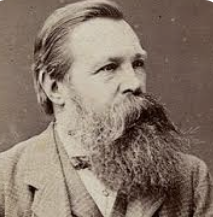
Friedrich Engels — Capitalism, History, and the Material Logic of Revolution (1820–1895)
Friedrich Engels was the great systematizer of revolt. Where Marx excavated, Engels clarified. Where theory risked abstraction, Engels anchored it in factories, wages, streets, and smoke. He believed philosophy must begin from material life — from how people work, suffer, organize, and survive — or it becomes ideological theater.
Born into the Contradiction
Engels was born into a wealthy industrial family in Prussia, heir to a textile empire that embodied everything he would later critique. Rather than shield him from capitalism’s underside, this position exposed him to it.
While working in his family’s factories in Manchester, Engels witnessed industrial capitalism at full throttle — child labor, disease, slums, and the systematic reduction of human life to profit. These experiences became the empirical backbone of his early and devastating work, The Condition of the Working Class in England.
“An ounce of action is worth a ton of theory.”
Historical Materialism
Engels co-developed historical materialism with Marx — the idea that history is driven not by ideas, moral ideals, or divine plans, but by material conditions and class struggle.
Economic structures determine social relations, political institutions, and even dominant philosophies. Ideas do not float freely; they emerge from lived conditions. Change occurs when contradictions within material systems become unbearable.
“History is nothing but the activity of people pursuing their ends.”
Dialectics Beyond Philosophy
Engels expanded dialectical thinking beyond politics into science and nature. In works like Anti-Dühring and Dialectics of Nature, he argued that contradiction, transformation, and process are fundamental features of reality itself.
Nature is not static. Quantitative changes produce qualitative shifts. Stability is temporary. Crisis is structural. Engels treated dialectics not as a mystical method, but as a description of how complex systems behave over time.
“Motion is the mode of existence of matter.”
Partner, Editor, Architect
Engels was not merely Marx’s collaborator — he was Marxism’s architect after Marx. He financially supported Marx for decades, edited and published the later volumes of Capital, and translated dense theory into accessible political language.
Without Engels, Marx’s work might have remained fragmentary. Engels ensured continuity, coherence, and global reach.
Science, Socialism, and Strategy
Engels insisted socialism was not a moral dream but a scientific analysis of historical development. Capitalism contained the conditions of its own collapse. Socialism was not inevitable — but it was structurally plausible.
This emphasis on structure, forces, and material constraints distinguished Engels from utopian socialists and moral reformers. Revolution required understanding systems, not merely condemning injustice.
Legacy — The Engineer of Marxism
Engels’ legacy is double-edged. He made Marxism coherent, teachable, and scalable — but in doing so, some argue he hardened it into doctrine.
Yet at his best, Engels reminds us that philosophy must stay grounded: in labor, in material life, in history as it is actually lived. Thought that forgets this becomes ideology.
“Freedom is the insight into necessity.”
CivilSimian.com created by AxiomaticPanic, CivilSimian, Kalokagathia