
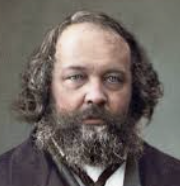
Mikhail Bakunin — The Philosopher of Revolt, Freedom, and Anti-Authority (1814–1876)
Mikhail Bakunin was philosophy with its sleeves rolled up and its fists unclenched. Where other thinkers asked how power should be organized, Bakunin asked why it should exist at all. He believed that freedom cannot survive hierarchy, that authority corrupts even the best intentions, and that human dignity flourishes only where people govern themselves directly. His thought is anarchism not as chaos, but as a moral rebellion against domination.
From Noble Origins to Revolutionary Fire
Born into Russian nobility, Bakunin’s early life was steeped in privilege, military training, and the expectations of obedience. Yet he proved constitutionally incapable of submission. He abandoned a military career and plunged into philosophy, absorbing German idealism — especially Hegel — before turning decisively against its reverence for the state.
For Bakunin, Hegel’s dialectic revealed something dangerous: the tendency of abstract ideas to justify real suffering. History was not reason realizing itself through institutions, but a battlefield between living freedom and organized authority. From this insight, his lifelong revolt began.
“Liberty without socialism is privilege and injustice; socialism without liberty is slavery and brutality.”
Anarchism — Freedom Without Masters
Bakunin’s anarchism was both political and existential. He rejected the state, the church, and capitalism as interlocking systems of domination. Any institution that claims the right to command, he argued, trains people in obedience and dependence. Even benevolent authority infantilizes those subjected to it.
Against this, Bakunin proposed a world of voluntary association, federated communities, and collective ownership of productive resources. Freedom is not isolation. It is mutual recognition — individuals becoming more free precisely because others around them are free as well.
“I am truly free only when all human beings around me are equally free.”
Against the State — The Clash with Marx
Bakunin’s most famous intellectual conflict was with Karl Marx. Both sought the abolition of exploitation, but their visions diverged sharply. Marx emphasized centralized organization and the conquest of state power. Bakunin saw this as a fatal mistake.
Any “temporary” dictatorship, Bakunin warned, would harden into permanent domination. A revolutionary elite governing in the name of the people would soon govern over them. The state, no matter who controls it, reproduces hierarchy by its very structure.
“No state, however democratic, can give the people what they themselves must create.”
God, Authority, and Human Emancipation
Bakunin’s critique of religion was inseparable from his politics. He argued that belief in divine authority conditions people to accept earthly authority. God becomes the ultimate master, sanctifying obedience, guilt, and submission.
His atheism was not merely metaphysical but ethical. To reject God was to reclaim responsibility for the human world. Freedom requires that no power — celestial or bureaucratic — stand above human judgment and collective will.
“If God existed, it would be necessary to abolish him.”
Prison, Exile, and Unbroken Revolt
Bakunin paid dearly for his convictions. He spent years in prisons and exile, including confinement in the Russian Empire’s harshest fortresses. His health was broken, but his spirit was not.
Unlike armchair theorists, Bakunin lived his philosophy. He accepted failure, chaos, and uncertainty as the price of genuine freedom. Revolution, for him, was not a blueprint but an eruption of human creativity against oppression.
Legacy — The Philosophy of Unruly Freedom
Bakunin left behind no closed system, only a relentless refusal to bow. His influence runs through anarchism, libertarian socialism, and every movement that mistrusts power even when it claims good intentions.
He remains unsettling because he removes our favorite excuse: that domination is necessary. In Bakunin’s world, freedom is dangerous, imperfect, and irreversible — and worth every risk.
“The urge to destroy is also a creative urge.”
CivilSimian.com created by AxiomaticPanic, CivilSimian, Kalokagathia