

2 weeks 4 days ago
Is not my present nearer my past of yesterday than the present of Sirius?
3 months 2 weeks ago
The end of man (as a factual anthropological limit) is announced to thought from the vantage of the end of man (as a determined opening or the infinity of a telos). Man is that which is in relation to his end, in the fundamentally equivocal sense of the word. Since always.
▼
Source
source
"The Ends of Man," Margins of Philosophy, tr. w/ notes by Alan Bass. The University of Chicago Press. Chicago, 1982. (original French published in Paris, 1972, as Marges de la philosophie). p. 123
2 months 3 weeks ago
If there is a devil in human history, that devil is the principle of command. It alone, sustained by the ignorance and stupidity of the masses, without which it could not exist, is the source of all the catastrophes, all the crimes, and all the infamies of history.
▼
Source
source
On the Program of the Alliance (1871), in Bakunin on Anarchy (1971), translated and edited by Sam Dolgoff Variant translation: If there is a devil in history, it is the power principle.

3 months 3 weeks ago
I read your piece on Plato. Holmes, when you strike at a king, you must kill him.
▼
Source
source
as reported by Felix Frankfurter in Harlan Buddington Phillips, Felix Frankfurter Reminisces (1960), p. 59
4 months 3 weeks ago
For well-being and health, again, the homestead should be airy in summer, and sunny in winter. A homestead possessing these qualities would be longer than it is deep; and its main front would face the south.
2 months 1 week ago
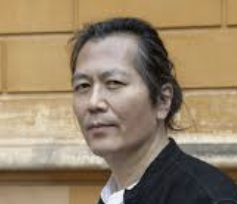
The inner music of things sounds only when you close your eyes.
1 month 2 weeks ago
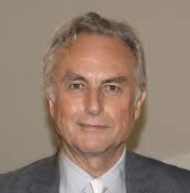
Just because science so far has failed to explain something, such as consciousness, to say it follows that the facile, pathetic explanations which religion has produced somehow by default must win the argument is really quite ridiculous.
▼
Source
source
Steve Paulson, "The flying spaghetti monster" Salon.com

3 months 2 weeks ago
There are many who know many things, yet are lacking in wisdom.
1 month 3 weeks ago
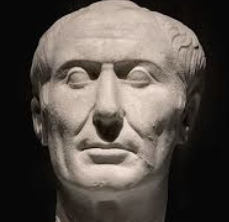
Never promise more than you can perform.
▼
Source
source
Maxim 528

3 months 3 weeks ago
"They would say," he answered, "that you do not fail in obedience through lack of love, but have lost love because you never attempted obedience."
▼
Source
source
Ch. 7 : The Pendragon, section 2

2 months 2 weeks ago
Beware of thinkers whose minds function only when they are fueled by a quotation.
4 months 2 days ago
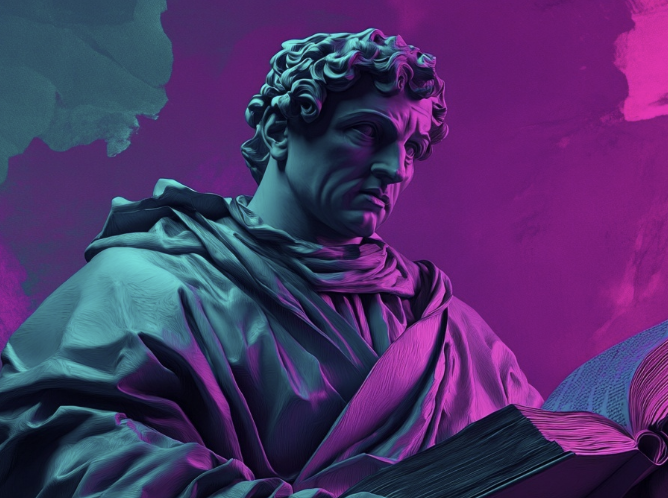
In Matthew 12:23 Christ says: "Either make the tree good, and its fruit good; or make the tree bad and its fruit bad," as if to say: "Let the one who wishes to have good fruit begin by planting a good tree." Therefore, let the person who wishes to do good works being not with the works but with the believing, for this alone makes a person good.
▼
Source
source
p. 76
3 weeks ago
Democracy is a meaningless word unless it signifies that differences of opinion have been expressed, represented, and even satisfied in the decision.
▼
Source
source
Ch. IV: "The Line of Least Resistance", pp. 47-48

2 months 2 weeks ago
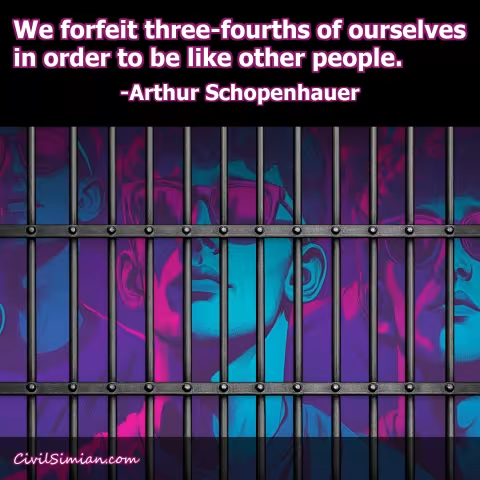
In order to conceive, and to steep ourselves in, unreality, we must have it constantly present to our minds. The day we feel it, see it, everything becomes unreal, except that unreality which alone makes existence tolerable.
2 months 1 week ago
Tactically, conceptualism is no doubt the strongest position of the three; for the tired nominalist can lapse into conceptualism and still allay his puritanic conscience with the reflection that he has not quite taken to eating lotus with the Platonists.
▼
Source
source
"Logic and the Reification of Universals"
2 months 3 weeks ago
You rejoice in having made a convert to Atheism. I think there is something unnatural in a zeal of proselytism in an Atheist. I do not believe in an intellectual God, a God made after the image of man. In the vulgar acceptation of the word, therefore, I think a man is right who does not believe in God, but I am also persuaded that a man is wrong who is without religion.
▼
Source
source
Letter to H. B. Rosser (7 March 1820), quoted in C. Kegan Paul, William Godwin: His Friends and Contemporaries, Vol. II (1876), p. 263

4 months 3 days ago
They [theologians] will explain to you how Christ was formed in the Virgin's womb; how accident subsists in synaxis without domicile in place. The most ordinary of them can do this. Those more fully initiated explain further whether there is an instans in Divine generation; whether in Christ there is more than a single filiation; whether 'the Father hates the Son' is a possible proposition; whether God can become the substance of a woman, of an ass, of a pumpkin, or of the devil, and whether, if so, a pumpkin could preach a sermon, or work miracles, or be crucified. And they can discover a thousand other things to you besides these. They will make you understand notions, and instants, formalities, and quiddities, things which no eyes ever saw, unless they were eyes which could see in the dark what had no existence.
▼
Source
source
as quoted by Froude ibid.,
2 months 3 weeks ago
No nation which has sunk into this state of dependence can raise itself out of it by the means which have usually been adopted hitherto. Since resistance was useless to it when it was still in possession of all its powers, what can such resistance avail now that it has been deprived of the greater part of them?
▼
Source
source
Introduction p. 9-10
1 month 2 weeks ago
There is a sort of dead-alive, hackneyed people about, who are scarcely conscious of living except in the exercise of some conventional occupation. ... They have no curiosity; they cannot give themselves over to random provocations; they do not take pleasure in the exercise of their faculties for its own sake; and unless necessity lays about them with a stick, they will even stand still. It is no good speaking to such folk: they cannot be idle, their nature is not generous enough; and they pass those hours in a sort of coma, which are not dedicated to furious moiling in the gold-mill.
▼
Source
source
An Apology for Idlers.
2 weeks 2 days ago
It would be silly, of course, to be either 'for' or 'against' modernity tout court, not only because it is pointless to try to stop the development of technology, science, and economic rationality, but because both modernity and antimodernity may be expressed in barbarous and antihuman terms.
▼
Source
source
"Modernity on Endless Trial"

4 months 3 weeks ago
"In the light, the earth remains our first and our last love. Our brothers are breathing under the same sky as we; justice is a living thing. Now is born that strange joy which helps one live and die, and which we shall never again postpone to a later time."

3 months 3 weeks ago
A man cannot become a child again, or he becomes childish.
▼
Source
source
Introduction, p. 31.
1 month 3 days ago
Assume, provisionally at any rate, a utilitarian ethic. The abolitionist project follows naturally, in "our" parochial corner of Hilbert space at least. On its completion, if not before, we should aim to develop superintelligence to maximise the well-being of the fragment of the cosmos accessible to beneficent intervention. And when we are sure - absolutely sure - that we have done literally everything we can do to eradicate suffering elsewhere, perhaps we should forget about its very existence.
▼
Source
source
Quantum Ethics? Suffering in the Multiverse, BLTC Research, 2008
2 months 2 weeks ago
The Bible is literature, not dogma.

3 months 3 weeks ago
We thus have a kind of see-saw: first, pure persuasion leading to the conversion of a minority; then force exerted to secure that the rest of the community shall be exposed to the right propaganda; and finally a genuine belief on the part of the great majority, which makes the use of force again unnecessary.
▼
Source
source
Ch. 9: Power over opinion
3 months 3 weeks ago
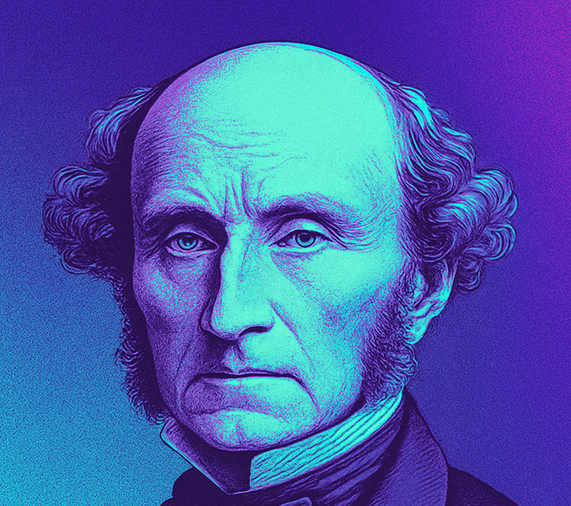
Everybody knows that the same sum of money is of much greater value to a poor man that to a rich one. Give £10 a year to the man who has but £10 a year, you double his income, and you nearly double his enjoyments. Add £10 more, you do not add to his enjoyments so much as you did by the first £10. The third £10 is less valuable than the second, and the fourth less valuable than the third. To the possessor of £1,000 a year the addition of £10 would be scarcely perceptible; to the possessor of £10,000 it would not be worth slooping for.The richer a man is the less he is benefited by any further addition to his income. The man of £4,000 a year has four times the income of the man who has but £1,000; but does anybody suppose that he has four times the happiness?
▼
Source
source
John Stuart Mill, Primogeniture, in The Collected Works of John Stuart Mill, Toronto, 1988, vol. 26, p. 336
2 months 1 week ago
But the truth is that my work - I was going to say my mission - is to shatter the faith of men here, there, and everywhere, faith in affirmation, faith in negation, and faith in abstention in faith, and this for the sake of faith in faith itself; it is to war against all those who submit, whether it be to Catholicism, or to rationalism, or to agnosticism; it is to make all men live the life of inquietude and passionate desire.
2 months 2 weeks ago
Few new truths have ever won their way against the resistance of established ideas save by being overstated.
▼
Source
source
As quoted in Communications and History : Theories of Knowledge, Media and Civilization (1988) by Paul Heyer, p. 125

1 month 3 weeks ago
The hot radio medium used in cool or nonliterate cultures has a violent effect, quite unlike its effect, say in England or America, where radio is felt as entertainment.
▼
Source
source
(p. 30)

2 months 1 week ago
The motto should not be: Forgive one another; rather, Understand one another.
2 months 2 weeks ago
The detour to ideality leads to coinciding with oneself, that is, to certainty, which remains the guide and guarantee of the whole spiritual adventure of being.
▼
Source
source
The Levinas reader by Levinas, Emmanuel p. 89
2 months 1 week ago
Faith makes us live by showing us that life, although it is dependent upon reason, has its well spring and source of power elsewhere, in something supernatural and miraculous. Cournot the mathematician, a man of singularly well-balanced and scientifically equipped mind has said that it is this tendency towards the supernatural and miraculous that gives life, and that when it is lacking, all the speculations of reason lead to nothing but affliction of the spirit. ...And in truth we wish to live.

1 month 1 day ago
Progress in civilization seems possible only in interludes when history is idling.
▼
Source
source
An Old Chaos: The Emperor's Tomb (p. 35)

2 months 3 weeks ago
A man full of warm, speculative benevolence may wish his society otherwise constituted than he finds it, but a good patriot and a true politician always considers how he shall make the most of the existing materials of his country. A disposition to preserve and an ability to improve, taken together, would be my standard of a statesman. Everything else is vulgar in the conception, perilous in the execution.
3 months 3 weeks ago
Thank you for your letter and for the enclosure which I return herewith. I have been wondering whether there is any means of preventing the confusion between you and me, and I half-thought that we might write a joint letter to The Times in the following terms: Sir, To prevent the continuation of confusions which frequently occur, we beg to state that neither of us is the other. Do you think this would be a good plan?
▼
Source
source
Letter to Lord Russell of Liverpool, February 18, 1959
3 months 3 weeks ago
The goal to be reached is the mind's insight into what knowing is. Impatience asks for the impossible, wants to reach the goal without the means of getting there. The length of the journey has to be borne with, for every moment is necessary, ... because by nothing less could that all-pervading mind ever manage to become conscious of what itself is - for that reason, the individual mind, in the nature of the case, cannot expect by less toil to grasp what its own substance contains.
▼
Source
source
Preface (J. B. Baillie translation), § 29
3 months 3 weeks ago
Man is a credulous animal, and must believe something; in the absence of good grounds for belief, he will be satisfied with bad ones.
2 months 2 weeks ago
Eros is a superhuman power which, like nature herself, allows itself to be conquered and exploited as though it were impotent. But triumph over nature is dearly paid for. Nature requires no explanations of principle, but asks only for tolerance and wise measure. "Eros is a mighty daemon," as the wise Diotima said to Socrates. We shall never get the better of him, or only to our own hurt. He is not the whole of our inward nature, though he is at least one of its essential aspects.
▼
Source
source
Two Essays on Analytical Psychology, CW 7 (1957). "On the Psychology of the Unconscious" P.32f
3 months 3 weeks ago
We tend to believe the premises because we can see that their consequences are true, instead of believing the consequences because we know the premises to be true. But the inferring of premises from consequences is the essence of induction; thus the method in investigating the principles of mathematics is really an inductive method, and is substantially the same as the method of discovering general laws in any other science.
▼
Source
source
"The Regressive Method of Discovering the Premises of Mathematics" (1907), in Essays in Analysis (1973), pp. 273-274
2 months 3 weeks ago
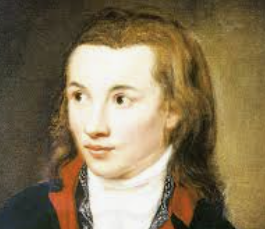
The poem of the understanding is philosophy.
▼
Source
source
"Logological Fragments," Philosophical Writings, M. Stolijar, trans. (Albany: 1997) #24
3 months 3 weeks ago
Since property here exists in the form of stock, its movement and transfer become purely a result of gambling on the stock exchange, where the little fish are swallowed by the sharks and the lambs by the stock exchange wolves.
▼
Source
source
Vol. III, Ch. XXVII, The Role of Credit, p. 440.
3 months 3 weeks ago
Cock-sure certainty is the source of much that is worst in our present world, and it is something of which the contemplation of history ought to cure us, not only or chiefly because there were wise men in the past, but because so much that was thought wisdom turned out to be folly - which suggests that much of our own supposed wisdom is no better. I do not mean to maintain that we should lapse into a lazy scepticism. We should hold our beliefs, and hold them strongly. Nothing great is achieved without passion, but underneath the passion there should always be that large impersonal survey which sets limits to actions that our passions inspire.
▼
Source
source
History as an Art (1954), p. 9
2 weeks ago
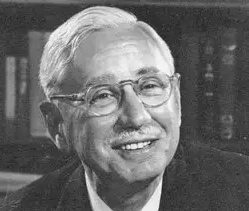
Love one another. My final lesson of history is the same as that of Jesus. You may think that's a lot of lollipop but just try it. Love is the most practical thing in the world. If you take an attitude of love toward everybody you meet, you'll eventually get along. When asked, at the age of 92, if he could summarize the lessons of history into a single sentence.
▼
Source
source
As quoted in "Durants on History from the Ages, with Love," by Pam Proctor, Parade (6 August 1978) p. 12.
1 week 2 days ago
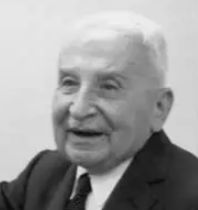
From a correct Marxian point of view ... all measures designed to restrain, to regulate and to improve capitalism were simply "petty-bourgeois" nonsense ... True socialists should not place any obstacles in the way of capitalist evolution. For only the full maturity of capitalism could bring about socialism. It is not only vain, but harmful to the interests of the proletarians to resort to such measures.

2 months 1 week ago
He alone is aware of the truth, and if all men were aware of it, there would be an end of life. In the country of the blind, the one-eyed man is king. But his kingship is kingship over nothing. It brings no powers and privileges, only loss of faith and exhaustion of the power to act. Its world is a world without values.
▼
Source
source
Chapter one, The Country of the Blind, referencing a quote by Desiderius Erasmus.

3 months 3 weeks ago
The universe is what it is, not what I choose that it should be.
▼
Source
source
The Value of Free Thought: How to Become a Truth-seeker and Break the Chains of Mental Slavery (1944), p. 24
CivilSimian.com created by AxiomaticPanic, CivilSimian, Kalokagathia