
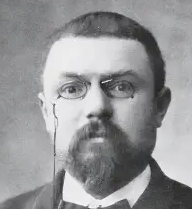
Henri Poincaré — The Mathematician Who Discovered Chaos and the Shape of Thought (1854–1912)
Henri Poincaré was one of the greatest mathematicians and scientific thinkers of the modern era. His work reshaped mathematics, physics, and philosophy, revealing deep patterns in nature that were previously invisible.
Long before modern computers allowed scientists to simulate complex systems, Poincaré discovered that even simple physical systems can produce unpredictable behavior — an insight that would later become the foundation of chaos theory.
A Universal Mathematical Mind
Poincaré was born in France and quickly demonstrated extraordinary intellectual ability.
His work spanned nearly every branch of mathematics: geometry, topology, differential equations, celestial mechanics, and mathematical physics.
Few scientists have influenced such a wide range of disciplines.
In many fields, he did not merely solve problems — he invented entirely new ways of thinking about them.
“Mathematics is the art of giving the same name to different things.”
The Three-Body Problem and Chaos
One of Poincaré’s most famous achievements came from studying the three-body problem.
This problem asks how three gravitational bodies — such as the Sun, Earth, and Moon — move under each other’s gravitational influence.
Physicists had hoped for a simple formula that would predict their motion forever.
Poincaré discovered something surprising.
The system can behave in extraordinarily complex ways. Tiny differences in initial conditions can produce dramatically different outcomes over time.
In other words, deterministic systems can still be practically unpredictable.
“A very small cause which escapes our notice determines a considerable effect that we cannot fail to see.”
The Birth of Topology
Poincaré also helped create a new branch of mathematics known as topology.
Topology studies the properties of shapes that remain unchanged when they are stretched or bent without tearing.
In topology, a coffee mug and a doughnut are mathematically similar because each has one hole.
This abstract way of thinking about space became crucial in modern physics, geometry, and cosmology.
“Geometry is not true; it is advantageous.”
Philosophy of Science
Poincaré was also a subtle philosopher of science.
He argued that scientific theories are not perfect mirrors of reality.
Instead, they are models — useful frameworks that help humans organize and predict experience.
Scientific concepts such as geometry, space, and time are partly shaped by human conventions.
This perspective later influenced thinkers in philosophy of science and physics.
Creativity in Mathematics
Poincaré was fascinated by the psychology of discovery.
He described moments when solutions to difficult mathematical problems appeared suddenly, after long periods of unconscious reflection.
For him, creativity involved both rigorous reasoning and intuitive insight.
“It is by logic that we prove, but by intuition that we discover.”
Legacy — The Hidden Complexity of Nature
Henri Poincaré revealed something profound about the universe.
Even when the laws of nature are simple, the systems governed by those laws can behave in astonishingly complex ways.
His ideas anticipated modern chaos theory, dynamical systems, and many areas of contemporary mathematics and physics.
Poincaré helped scientists recognize that the universe is not merely orderly — it is delicately balanced between order and unpredictability.
“Science is built of facts, as a house is built of stones; but an accumulation of facts is no more a science than a pile of stones is a house.”
CivilSimian.com created by AxiomaticPanic, CivilSimian, Kalokagathia