


1 month 2 weeks ago
Of all the inventions of man I doubt whether any was more easily accomplished than that of a Heaven.
▼
Source
source
L 34

3 days ago
The polarization has a number of different roots. The economic... fact that many working class voters have been left behind by the prosperity of globalization. ...The more important division is a cultural one ...the feeling on the part of many populist voters, that they are not being respected by the elites that are running the country... [H]ere, all of the identity issues... play themselves out.
▼
Source
source
22:57
2 months ago
In Walt Whitman democracy is carried into psychology and morals. The various sights, moods, and emotions are given each one vote; they are declared to be all free and equal, and the innumerable commonplace moments of life are suffered to speak like the others. Those moments formerly reputed great are not excluded, but they are made to march in the ranks with their companions-plain foot-soldiers and servants of the hour.
▼
Source
source
p. 53

2 months 6 days ago
If there be such a thing as truth, it must infallibly be struck out by the collision of mind with mind.
▼
Source
source
Vol. 1, bk. 1, ch.4
3 weeks 6 days ago
The conformation of his mind was such that whatever was little seemed to him great, and whatever was great seemed to him little. Serious business was a trifle to him, and trifles were his serious business.
▼
Source
source
'Horace Walpole', The Edinburgh Review (October 1833), quoted in T. B. Macaulay, Critical and Historical Essays Contributed to The Edinburgh Review, Vol. II (1843), p. 99

3 months 1 week ago
It is easy to see that the existing generation are conspiring with a beneficence, which, in its working for coming generations, sacrifices the passing one, which infatuates the most selfish men to act against their private interest for the public welfare. We build railroads, we know not for what or for whom; but one thing is certain, that we who build will receive the very smallest share of benefit. Benefit will accrue; they are essential to the country, but that will be felt not until we are no longer countrymen. We do the like in all matters: - 'Man's heart the Almighty to the Future setBy secret and inviolable springs.'

3 months 1 week ago
Though experience be our only guide in reasoning concerning matters of fact; it must be acknowledged, that this guide is not altogether infallible, but in some cases is apt to lead us into errors.
▼
Source
source
Section 10 : Of Miracles Pt. 1

1 month 3 weeks ago
I am the center of my universe, the center of the universe, and in my supreme anguish I cry with Michelet, "Mon moi, ils m'arrachent mon moi!" What is a man profited if he shall gain the world and lose his own soul? (Matt. xvi. 26).

3 months 1 week ago
The only thing that will redeem mankind is co-operation, and the first step towards co-operation lies in the hearts of individuals.
▼
Source
source
p. 212

3 months 4 days ago
You always hear people say that philosophy makes no progress and that the same philosophical problems which were already preoccupying the Greeks are still troubling us today. But people who say that do not understand the reason why it has to be so. The reason is that our language has remained the same and always introduces us to the same questions. ... I read: "philosophers are no nearer to the meaning of 'Reality' than Plato got,...". What a strange situation. How extraordinary that Plato could have got even as far as he did! Or that we could not get any further! Was it because Plato was so extremely clever?
▼
Source
source
p. 15e

1 month 1 week ago
Having acknowledged the measure of the good to be pleasure, i.e., beauty, the European upper classes went back in their comprehension of art to the gross conception of the primitive Greeks which Plato had already condemned. And with this understanding of life, a theory of art was formulated.
3 months 4 days ago
Resting on your laurels is as dangerous as resting when you are walking in the snow. You doze off and die in your sleep.
▼
Source
source
p. 35e

3 months 1 week ago
And, oddly enough, even at times when the current style permitted a treatment of the less epileptic aspects of religion, no fully adequate rendering of the contemplative life was ever achieved in the plasdc arts of Christendom. The peace that passes all understanding was often sung and spoken; it was hardly ever painted or carved. Thus, in the writings of St. Bernard, of Albertus Magnus, of Eckhart and Tauler and Ruysbroeck one may find passages that express very clearly the nature and significance of mystical contemplation. But the saints who figure in medieval painting and sculpture tell us next to nothing about this anticipation of the beatific vision. There are no equivalents of those Far Eastern Buddhas and Bodhisattvas who incarnate, in stone and paint, the experience of ultimate reality.
1 month 6 days ago
There is but a step between a proud man's glory and his disgrace.
▼
Source
source
Maxim 138

2 months 1 week ago
The effect of liberty to individuals is, that they may do what they please: we ought to see what it will please them to do, before we risk congratulations.
3 months 1 week ago
If I could put my hand on the north star, would it be as beautiful? The sea is lovely, but when we bathe in it, the beauty forsakes all the near water. For the imagination and senses cannot be gratified at the same time.
▼
Source
source
Beauty

3 months 2 weeks ago
There is no passion so contagious as that of fear.
3 months 2 weeks ago
Tis the sharpness of our mind that gives the edge to our pains and pleasures.
▼
Source
source
Book I, Ch. 14

1 month 4 days ago
Even the constantly reiterated insistence that we are miserable offenders, born in sin, is a kind of inverted arrogance: such vanity, to presume that our moral conduct has some sort of cosmic significance, as though the Creator of the Universe wouldn't have better things to do than tot up our black marks and our brownie points. The universe is all concerned with me. Is that not the arrogance that passeth all understanding? The Intellectual and Moral Courage of Atheism
▼
Source
source
Originally from 2007; quotes are from the slightly revised 2019 version on the website
1 month 2 weeks ago
I believe that the man choosing progress can find a new unity through the full development of all his human forces, which are produced in three orientations. These can be presented separately or together: biophilia, love for humanity and nature, and independence and freedom.

2 months 4 days ago
Ennui is the echo in us of time tearing itself apart.
3 months 1 week ago
During such calm sunshine of the mind, these spectres of false divinity never make their appearance.
▼
Source
source
Part XIV - Bad influence of popular religions on morality
1 month 3 weeks ago
Tactically, conceptualism is no doubt the strongest position of the three; for the tired nominalist can lapse into conceptualism and still allay his puritanic conscience with the reflection that he has not quite taken to eating lotus with the Platonists.
▼
Source
source
"Logic and the Reification of Universals"
1 month 4 weeks ago
At present, when the prevailing forms of society have become hindrances to the free expression of human powers, it is precisely the abstract branches of science, mathematics and theoretical physics, which ... offer a less distorted form of knowledge than other branches of science which are interwoven with the pattern of daily life, and the practicality of which seemingly testifies to their realistic character.
▼
Source
source
p. 133.
3 months 1 week ago
Mark what 'tis his mind aims at in the question, and not what words he expresses it in: and when you have informed and satisfied him in that, you shall see how his thoughts will enlarge themselves, and how by fit answers he may be led on farther than perhaps you could have imagine. For knowledge is grateful to the understanding, as light to the eyes.
▼
Source
source
Sec. 118

3 months 1 week ago
What extracts from the Vedas I have read fall on me like the light of a higher and purer luminary, which describes a loftier course through purer stratum. It rises on me like the full moon after the stars have come out, wading through some far stratum in the sky.
▼
Source
source
1850

3 months 1 week ago
I know nothing, I am neither woman nor girl; I have been living in a dream and when someone kissed me, it made me want to laugh. Now I am here before you, it seems as though I have just awakened and it is morning.
▼
Source
source
Act 6, sc. 2
2 months 4 days ago
Haven't people learned yet that the time of superficial intellectual games is over, that agony is infinitely more important than syllogism, that a cry of despair is more revealing than the most subtle thought, and that tears always have deeper roots than smiles?
1 month 2 weeks ago
I believe in the possible realization of a world in which man can be much, even if he has little; a world in which the dominant motivation of existence is not consumption; a world in which "man" is the end, first and last; a world in which man can find the way of giving a purpose to his life as well as the strength to live free and without illusions.

3 months 1 week ago
Theologian: But what is to love? Philosopher: To be delighted by the happiness of another.
▼
Source
source
Confessio philosophi, 1673

3 months 1 week ago
Quite a heavy weight, a name too quickly famous.
▼
Source
source
La Henriade, chant troisième, l.41, 1722
2 months 4 days ago
Erect I make a resolution; prone I revoke it.
3 months 1 week ago
The next thing is by gentle degrees to accustom children to those things they are too much afraid of. But here great caution is to be used, that you do not make too much haste, nor attempt this cure too early, for fear lest you increase the mischief instead of remedying it.
▼
Source
source
Sec. 115
3 months 1 week ago
New truth is often uncomfortable, especially to the holders of power; nevertheless, amid the long record of cruelty and bigotry, it is the most important achievement of our intelligent but wayward species.
▼
Source
source
Religion and Science (1935), Ch. X: Conclusion
2 months 6 days ago
We wish, in a word, equality - equality in fact as a corollary, or rather, as primordial condition of liberty. From each according to his faculties, to each according to his needs; that is what we wish sincerely and energetically.
▼
Source
source
As quoted in The Old Order and the New (1890) by J. Morris Davidson
3 months 1 week ago
Marriage is for women the commonest mode of livelihood, and the total amount of undesired sex endured by women is probably greater in marriage than in prostitution.
2 months ago
And whereas many men, by accident unevitable, become unable to maintain themselves by their labour; they ought not to be left to the Charity of private persons; but to be provided for, (as far-forth as the necessities of Nature require,) by the Lawes of the Common-wealth. For as it is Unchariablenesse in any man, to neglect the impotent; so it is in the Soveraign of a Common-wealth, to expose them to the hazard of such uncertain Charity.
▼
Source
source
The Second Part, Chapter 30, p. 181
3 months 3 days ago
The public execution is to be understood not only as a judicial, but also as a political ritual. It belongs, even in minor cases, to the ceremonies by which power is manifested.
▼
Source
source
Chapter One, The body of the condemned
3 months 1 week ago
Whate'er we leave to God, God doesAnd blesses us.
▼
Source
source
"Inspiration", in An American Anthology, 1900

3 months 3 days ago
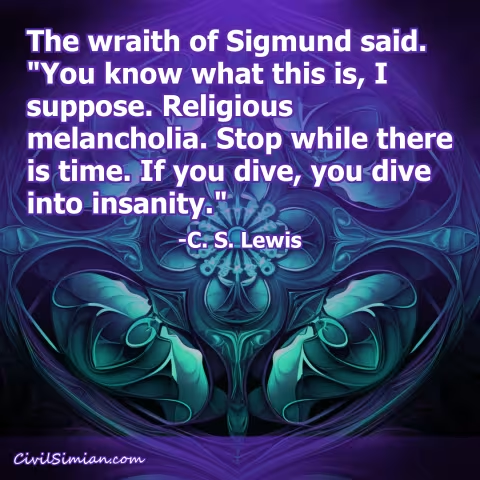
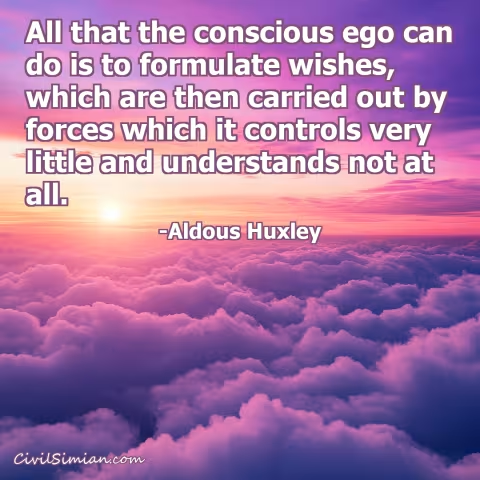
Of course, the aim of a constitutional democracy is to safeguard the rights of the minority and avoid the tyranny of the majority. Yet the concrete practice of the US legal system from 1883 to 1964 promoted a tyranny of the white majority much more than a safeguarding of the rights of black Americans.
▼
Source
source
(p. 102-3)

3 months 1 week ago
It's so much easier to pray for a bore than to go and see one.
3 months 1 week ago
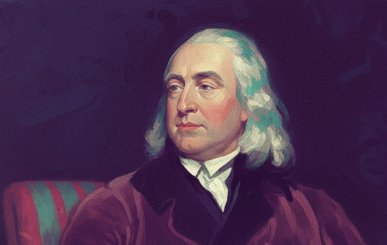
Intense, long, certain, speedy, fruitful, pure-Such marks in pleasures and in pains endure.Such pleasures seek if private be thy end:If it be public, wide let them extend.Such pains avoid, whichever be thy view:If pains must come, let them extend to few.
▼
Source
source
Ch. 4: Value of a Lot of Pleasure or Pain, How to be Measured
1 month 1 week ago
We live in a world where there is more and more information, and less and less meaning.
▼
Source
source
"The Implosion of Meaning in the Media," p. 79

1 month 3 weeks ago
A modern factory reaches perhaps almost the limit of horror. Everybody in it is constantly harassed and kept on edge by the interference of extraneous wills while the soul is left in cold and desolate misery. What man needs is silence and warmth; what he is given is an icy pandemonium.Physical labour may be painful, but it is not degrading as such. It is not art; it is not science; it is something else, possessing an exactly equal value with art and science, for it provides an equal opportunity to reach the impersonal stage of attention.
▼
Source
source
p. 59

1 month 6 days ago
People never remember but the computer never forgets.
▼
Source
source
(p. 69)
CivilSimian.com created by AxiomaticPanic, CivilSimian, Kalokagathia