


2 weeks 6 days ago
It is all work and forgotten work, this peopled, clothed, articulate-speaking, high-towered, wide-acred World. The hands of forgotten brave men have made it a World for us; they,- honour to them; they, in spite of the idle and the dastard. This English Land, here and now, is the summary of what was found of wise, and noble, and accordant with God's Truth, in all the generations of English Men. Our English Speech is speakable because there were Hero-Poets of our blood and lineage; speakable in proportion to the number of these. This Land of England has its conquerors, possessors, which change from epoch to epoch, from day to day; but its real conquerors, creators, and eternal proprietors are these following, and their representatives if you can find them: All the Heroic Souls that ever were in England, each in their degree; all the men that ever cut a thistle, drained a puddle out of England, contrived a wise scheme in England, did or said a true and valiant thing in England.

3 months 4 weeks ago
One always dies too soon - or too late. And yet, life is there, finished: the line is drawn, and it must all be added up. You are nothing other than your life.
▼
Source
source
Inès, Act 1, sc. 5
3 months ago
I'll know how to die with courage; that is easier than living.
▼
Source
source
Act II.

4 months 3 days ago
The value which the workmen add to the materials, therefore, resolves itself in this case into two parts, of which the one pays their wages, the other the profits of the employer upon the whole stock of materials and wages which he advanced.
▼
Source
source
Chapter VI, p. 58.
2 months 2 days ago
People no longer look at each other, but there are institutes for that. They no longer touch each other, but there is contactotherapy. They no longer walk, but they go jogging, etc. Everywhere one recycles lost faculties, or lost bodies, or lost sociality, or the lost taste for food.
▼
Source
source
"The Precession of Simulacra," p. 13
3 months 4 weeks ago
It is not murder which is forgiven but the killer, his person as it appears in circumstances and intentions. The trouble with the Nazi criminals was precisely that they renounced voluntarily all personal qualities, as if nobody were left to be either punished or forgiven. They protested time and again that they had never done anything out of their own initiative, that they had no intentions whatsoever, good or bad, and that they only obeyed orders.

2 months 3 weeks ago
Philosophers write for professors; thinkers for writers.

1 month 3 weeks ago
The unformulated message of an assembly of news items from every quarter of the globe is that the world today is one city. All war is civil war. All suffering is our own.
▼
Source
source
p. 291
1 month 3 weeks ago
Great ages of innovation are the ages in which entire cultures are junked or scrapped.
▼
Source
source
(p. 309)

4 months ago
We are not so absurd as to propose that the teacher should not set forth his own opinions as the true ones and exert his utmost powers to exhibit their truth in the strongest light. To abstain from this would be to nourish the worst intellectual habit of all, that of not finding, and not looking for, certainty in any teacher. But the teacher himself should not be held to any creed; nor should the question be whether his own opinions are the true ones, but whether he is well instructed in those of other people, and, in enforcing his own, states the arguments for all conflicting opinions fairly.
▼
Source
source
"Civilization," London and Westminster Review, April 1836

5 months 2 days ago
Style ought to prove that one believes in an idea; not only that one thinks it but also feels it.
4 months 1 week ago
What is it, in your opinion, to be a great nobleman? It is to be master of several objects that men covet, and thus to be able to satisfy the wants and the desires of many. It is these wants and these desires that attract them towards you, and that make them submit to you: were it not for these, they would not even look at you; but they hope, by these services... to obtain from you some part of the good which they desire, and of which they see that you have the disposal.
4 months 2 weeks ago
This is the ideal world, a perfect world of equality, fraternity, harmony, welfare, and justice.

2 months 2 weeks ago
"God does not think, He creates; He does not exist, He is eternal," wrote Kierkegaard (Afslutende uvidenskabelige Efterskrift); but perhaps it is more exact to say with Mazzini, the mystic of the Italian city, that "God is great because his thought is action" (Ai giovani d'Italila), because with Him to think is to create, and He gives existence to that which exists in His thought by the mere fact of thinking it, and the impossible is unthinkable by God. It is not written in the Scriptures that God creates with His word - that is to say, with His thought - and that by this, by His Word, He made everything that exists? And what God has once made does He ever forget? May it not be that all the thoughts that have ever passed through the Supreme Consciousness still subsist therein? In Him, who is eternal, is not all existence eternalized?
1 week 2 days ago
I pray the Sovereign Sun himself to grant me ability to explain the nature of the station that he holds amongst those in whose middle he is placed! By the term "middle" we are to understand not what is so defined in the case of things contrary to each other, as "equi-distant from the extremes," as orange and dark brown in the case of colours; lukewarm, in that of hot and cold, and other things of the sort; but the power that collects and unites into one things dispersed, like the "Harmony" of Empedocles, from which he completely excludes all discord and contention.
2 months 1 week ago
Instead of wishing to see more doctors made by women joining what there are, I wish to see as few doctors, either male or female, as possible. For, mark you, the women have made no improvement - they have only tried to be men and they have only succeeded in being third-rate men.
▼
Source
source
Letter to John Stuart Mill (12 September 1860), published in Florence Nightingale on Society and Politics, Philosophy, Science, Education (2003) edited by Lynn McDonald

4 months 2 weeks ago
Some of their faults people readily admit, but others not so readily.
▼
Source
source
Book II, ch. 21, 1
2 months 1 week ago
Nothing can well be imagined more painful than the present position of woman, unless, on the one hand, she renounces all outward activity and keeps herself within the magic sphere, the bubble of her dreams; or, on the other, surrendering all aspiration, she gives herself to her real life, soul and body. For those to whom it is possible, the latter is best; for out of activity may come thought, out of mere aspiration can come nothing.
1 month 3 weeks ago
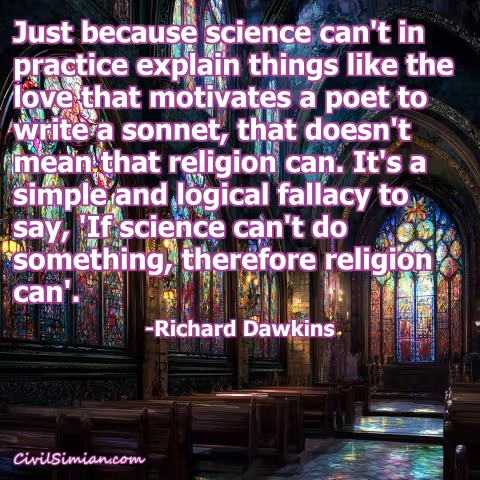
Natural selection is like artificial selection, but without the human chooser. Instead of a human deciding which offspring shall die in which shall reproduce, nature 'decides'. The quotation marks are vital because nature doesn't consciously decide. This might seem too obvious to emphasize, but you'd be surprised by the number of people who think natural selection implies some kind of personal choice. They couldn't be more wrong. It just is the case that some offspring are more likely to die while others have what it takes to survive and reproduce. Therefore, as the generations go by, the average, typical creature in the population becomes ever better at the arts of surviving and reproducing. Ever better, I should specify, when, when measured against some absolute standard.
▼
Source
source
Chapter 1, "Facing Mount Rushmore" (p. 34)

4 months 3 weeks ago
You have already grasped that Sisyphus is the absurd hero. He is, as much through his passions as through his torture. His scorn of the gods, his hatred of death, and his passion for life won him that unspeakable penalty in which the whole being is exerted toward accomplishing nothing. This is the price that must be paid for the passions of this earth. Nothing is told us about Sisyphus in the underworld. Myths are made for the imagination to breathe life into them.


2 weeks 5 days ago
Most of our literature and social philosophy after 1850 was the voice of freedom against authority, of the child against the parent, of the pupil against the teacher. Through many years I shared in that individualistic revolt. I do not regret it; it is the function of youth to defend liberty and innovation, of the old to defend order and tradition, and of middle age to find a middle way. But now that I too am old, I wonder whether the battle I fought was not too completely won. Let us say humbly but publicly that we resent corruption in politics, dishonesty in business, faithlessness in marriage, pornography in literature, coarseness in language, chaos in music, meaninglessness in art.
▼
Source
source
"The Second Sexual Revolution", Time magazine,

1 month 4 weeks ago
The attitude of the ruling classes to the laborers is that of a man who has felled his adversary to the earth and holds him down, not so much because he wants to hold him down, as because he knows that if he let him go, even for a second, he would himself be stabbed, for his adversary is infuriated and has a knife in his hand. And therefore, whether their conscience is tender or the reverse, our rich men cannot enjoy the wealth they have filched from the poor as the ancients did who believed in their right to it. Their whole life and all their enjoyments are embittered either by the stings of conscience or by terror.
▼
Source
source
Chapter V, Contradiction Between our Life and our Christian Conscience

4 months 3 days ago
The universal propensity to believe in invisible, intelligent power, if not an original instinct, being at least a general attendant of human nature, may be considered as a kind of mark or stamp, which the divine workman has set upon his work; and nothing surely can more dignify mankind, than to be thus selected from all other parts of the creation, and to bear the image or impression of the universal Creator. But consult this image, as it appears in the popular religions of the world. How is the deity disfigured in our representations of him! What caprice, absurdity, and immorality are attributed to him! How much is he degraded even below the character, which we should naturally, in common life, ascribe to a man of sense and virtue!
▼
Source
source
Part XV - General corollary

4 months 1 week ago
At the very beginning of my fevers and sicknesses that cast me down, whilst still entire, and but little, disordered in health, I reconcile myself to Almighty God by the last Christian, offices, and find myself by so doing less oppressed and more easy, and have got, methinks, so much the better of my disease. And I have yet less need of a notary or counsellor than of a physician.
▼
Source
source
Ch. 9
3 months 4 weeks ago
It was mathematics, the non-empirical science par excellence, wherein the mind appears to play only with itself, that turned out to be the science of sciences, delivering the key to those laws of nature and the universe that are concealed by appearances.
▼
Source
source
p. 7

3 months 4 days ago
Impenetrable in their dissimulation, cruel in their vengeance, tenacious in their purposes, unscrupulous as to their methods, animated by profound and hidden hatred for the tyranny of man - it is as though there exists among them an ever-present conspiracy toward domination, a sort of alliance like that subsisting among the priests of every country.
▼
Source
source
"On Women" (1772), as translated in Selected Writings (1966) edited by Lester G. Crocker
4 months 3 days ago
In every part of the universe we observe means adjusted with the nicest artifice to the ends which they are intended to produce; and in the mechanism of a plant, or animal body, admire how every thing is contrived for advancing the two great purposes of nature, the support of the individual, and the propagation of the species.
▼
Source
source
Section II, Chap. III.
1 month 4 weeks ago
All our problems are caused by forgetting what lives within us, and we sell our souls for the "bowl of stew" of bodily satisfactions.
▼
Source
source
p. 17

2 months 2 weeks ago
We do not require elaborate training merely in order to refrain from embarking upon intricate trains of inference. Such abstinence is only too easy.
▼
Source
source
Symbolism: Its Meaning and Effect (1927).
2 months 3 weeks ago
I know that my birth is fortuitous, a laughable accident, and yet, as soon as I forget myself, I behave as if it were a capital event, indispensable to the progress and equilibrium of the world.
2 weeks 5 days ago
When the British came there was, throughout India, a system of communal schools, managed by the village communities. The agents of the East India Company destroyed these village communities, and took steps to replace the schools; even today, after a century of effort to restore them, they stand at only 66% of their number a hundred years ago. Hence, the 93 % illiteracy of India.
▼
Source
source
(source: The Case for India - By Will Durant Simon and Schuster, New York. 1930 p.44).

2 months 1 week ago
The American who first discovered Columbus made a bad discovery.
▼
Source
source
G 42
3 months 2 weeks ago
To protest about bullfighting in Spain, the eating of dogs in South Korea, or the slaughter of baby seals in Canada while continuing to eat eggs from hens who have spent their lives crammed into cages, or veal from calves who have been deprived of their mothers, their proper diet, and the freedom to lie down with their legs extended, is like denouncing apartheid in South Africa while asking your neighbors not to sell their houses to blacks.
▼
Source
source
Ch. 4: Becoming a Vegetarian

2 weeks ago
No one is able to rule unless he is also able to be ruled.
▼
Source
source
De Ira (On Anger): Book 2, cap. 15, line 4

4 months ago
First of all: what is work? Work is of two kinds: first, altering the position of matter at or near the earth's surface relatively to other such matter; second, telling other people to do so. The first kind is unpleasant and ill paid; the second is pleasant and highly paid.
▼
Source
source
Ch. 1: In Praise of Idleness
1 month 1 week ago
I kept looking at the flowers in a vase near me: lavender sweet peas, fragile winged and yet so still, so perfectly poised, apart, and complete. They are self-sufficient, a world in themselves, a whole - perfect. Is that then, perfection? Is what those sweet peas had what I have, occasionally in moments like that? But flowers always have it - poise, completion, fulfillment, perfection; I only occasionally, like that moment. For that moment I and the sweet peas had an understanding.
2 months 3 weeks ago
I feel effective, competent, likely to do something positive only when I lie down and abandon myself to an interrogation without object or end.
2 months 2 weeks ago
Every peasant has a lawyer inside of him, just as every lawyer, no matter how urbane he may be, carries a peasant within himself.
▼
Source
source
Civilization is Civilism
Just now
With clarity and quiet, I look upon the world and say: All that I see, hear, taste, smell, and touch are the creations of my mind. The sun comes up and the sun goes down in my skull. Out of one of my temples the sun rises, and into the other the sun sets. The stars shine in my brain; ideas, men, animals browse in my temporal head; songs and weeping fill the twisted shells of my ears and storm the air for a moment.
2 months 2 weeks ago
Man is always something more than what he knows of himself. He is not what he is simply once and for all, but is a process...
5 months 2 days ago
In Germany there is much complaining about my "eccentricities." But since it is not known where my center is, it won't be easy to find out where or when I have thus far been "eccentric." That I was a philologist, for example, meant that I was outside my center (which fortunately does not mean that I was a poor philologist). Likewise, I now regard my having been a Wagnerian as eccentric. It was a highly dangerous experiment; now that I know it did not ruin me, I also know what significance it had for me — it was the most severe test of my character.

4 months 3 weeks ago
By 1204, the only place where the entire body of Greek learning existed, still intact, was Constantinople. As a result of the crusaders' conquest, however, Constantinople was ruthlessly pillaged and destroyed and almost all the great treasures of ancient Greek learning were lost forever. It is because of that sack, for instance, that we have only seven plays left out of the better than one hundred written by Sophocles. The tragedy of 1204 can never be undone and for all of time, only bits and pieces of the marvelous Greek world can be known to us.
1 week 2 days ago
I think he who knows himself will know accurately, not the opinion of others about him, but what he is in reality... he ought to discover within himself what is right for him to do and not learn it from without...
▼
Source
source
Oration to the Cynic Heracleios

3 months 2 weeks ago
Follow your desire as long as you live and do not perform more than is ordered; do not lessen the time of following desire, for the wasting of time is an abomination to the spirit... When riches are gained, follow desire, for riches will not profit if one is sluggish.
▼
Source
source
Maxim no. 11.
2 weeks 6 days ago
All great peoples are conservative; slow to believe in novelties; patient of much error in actualities; deeply and forever certain of the greatness that is in law, in custom once solemnly established, and now long recognized as just and final.
1 week 3 days ago
After Riemann had made known his discoveries, mathematicians busied themselves with working out his system of geometrical ideas formally; chief among these were Christoffel, Ricci, and Levi-Civita. Riemann... clearly left the real development of his ideas in the hands of some subsequent scientist whose genius as a physicist could rise to equal flights with his own as a mathematician. After a lapse of seventy years this mission has been fulfilled by Einstein.
▼
Source
source
Ch. 2 "The Metrical Continuum"

1 month 3 weeks ago
No man is happy who does not think himself so.
▼
Source
source
Maxim 584
CivilSimian.com created by AxiomaticPanic, CivilSimian, Kalokagathia