


2 months 4 days ago
In the most secret chamber of the spirit of him who believes himself convinced that death puts an end to his personal consciousness, his memory, for ever, and all unknown to him perhaps, there lurks a shadow, a vague shadow, a shadow of uncertainty, and while he says within himself, "Well, let us live this life that passes away, for there is no other!" the silence of this secret chamber speaks to him and murmurs, "Who knows!... " These voices are like the humming of a mosquito when the south-west wind roars through the trees in the wood; we cannot distinguish this faint humming, yet nevertheless, merged in the clamor of the storm, it reaches the ear.
1 week 4 days ago
I think I have already said somewhere that mathematics is the art of giving the same name to different things.
▼
Source
source
Part I. Ch. 2 : The Future of Mathematics, p. 31

3 months 2 weeks ago
Our island is this earth; and the most striking object we behold is the sun. As soon as we pass beyond our immediate surroundings, one or both of these must meet our eye. Thus the philosophy of most savage races is mainly directed to imaginary divisions of the earth or to the divinity of the sun.


3 months 2 weeks ago
A dog cannot relate his autobiography; however eloquently he may bark, he cannot tell you that his parents were honest but poor.
▼
Source
source
Human Knowledge: Its Scope and Limits (1948), part II, chapter 1, p. 74
2 months ago
In fact, the real problem with the thesis of A Genealogy of Morals is that the noble and the aristocrat are just as likely to be stupid as the plebeian. I had noted in my teens that major writers are usually those who have had to struggle against the odds -- to "pull their cart out of the mud," as I put it -- while writers who have had an easy start in life are usually second rate -- or at least, not quite first-rate. Dickens, Balzac, Dostoevsky, Shaw, H. G. Wells, are examples of the first kind; in the twentieth century, John Galsworthy, Graham Greene, Evelyn Waugh, and Samuel Beckett are examples of the second kind. They are far from being mediocre writers; yet they tend to be tinged with a certain pessimism that arises from never having achieved a certain resistance against problems.
▼
Source
source
p. 188
3 weeks 5 days ago
It is easy to romanticise, say, tigers or lions and cats. We admire their magnificent beauty, strength and agility. But we would regard their notional human counterparts as wanton psychopaths of the worst kind.
▼
Source
source
1.10 On the Misguided Romanticisation of Feline Psychopaths
3 months 1 week ago
To protest about bullfighting in Spain, the eating of dogs in South Korea, or the slaughter of baby seals in Canada while continuing to eat eggs from hens who have spent their lives crammed into cages, or veal from calves who have been deprived of their mothers, their proper diet, and the freedom to lie down with their legs extended, is like denouncing apartheid in South Africa while asking your neighbors not to sell their houses to blacks.
▼
Source
source
Ch. 4: Becoming a Vegetarian
4 months 1 week ago
When the Great Dao (Tao, perfect order) prevails, the world is like a Commonwealth State shared by all, not a dictatorship.
2 days ago
Mucius put his hand into the fire. It is painful to be burned; but how much more painful to inflict such suffering upon oneself!
2 months 1 week ago
Even the most elevated psychological understanding is not a loving understanding.
3 months 3 weeks ago
A wise man sees as much as he ought, not as much as he can.
2 months ago
What so impressed me on that first reading was the self-containedness of Tolkien's world. I suppose there are a few novelists who have created worlds that are uniquely their own -- Faulkner, for example, or Dickens. But since their world is fairly close to the actual world, it cannot really be called a unique creation. The only parallel that occurs to me is the Wagner Ring cycle, that one can only enter as if taking a holiday on a strange planet.
▼
Source
source
pp. 8-9

3 months 3 weeks ago
The necessaries of life occasion the great expense of the poor. They find it difficult to get food, and the greater part of their little revenue is spent in getting it. The luxuries and vanities of life occasion the principal expense of the rich, and a magnificent house embellishes and sets off to the best advantage all the other luxuries and vanities which they possess. A tax upon house-rents, therefore, would in general fall heaviest upon the rich; and in this sort of inequality there would not, perhaps, be anything very unreasonable. It is not very unreasonable that the rich should contribute to the public expense, not only in proportion to their revenue, but something more than in that proportion.
▼
Source
source
Chapter II, Part II, Article I, p. 911.
3 months 3 weeks ago
I speak the truth, not my fill of it, but as much as I dare speak; and I dare to do so a little more as I grow old.
▼
Source
source
Ch. 2
4 months 2 weeks ago
Zeno: The many do not know that except by this devious passage through all things the mind cannot attain to the truth. Zeno: Most people are not aware that this roundabout progress through all things is the only way in which the mind can attain truth and wisdom.
2 months 1 week ago
The introduction of free competition is thus public declaration that from now on the members of society are unequal only to the extent that their capitals are unequal, that capital is the decisive power, and that therefore the capitalists, the bourgeoisie, have become the first class in society. Free competition is necessary for the establishment of big industry, because it is the only condition of society in which big industry can make its way.
2 months 1 week ago
It is as if thinking itself had been reduced to the level of industrial processes, subjected to a close schedule-in short, made part and parcel of production.
▼
Source
source
p. 21.
3 months 3 weeks ago
What is prudence in the conduct of every private family, can scarce be folly in that of a great kingdom.
▼
Source
source
Chapter II, p. 490.

3 months 1 week ago
Wisdom is passionless. But faith by contrast is what Kierkegaard calls a passion.
▼
Source
source
p. 53e
1 week 4 days ago
Have we really the right to speak of the cause of a phenomenon?
3 months 2 weeks ago
A book can never be anything more than the impression of its author's thoughts [Ein Buch kann nie mehr seyn, als der Abdruck der Gedanken des Verfassers]. The value of these thoughts lies either in the matter about which he has thought, or in the form in which he develops his matter - that is to say, what he has thought about it.
3 months 2 weeks ago
Drunkenness is temporary suicide.
2 months 2 weeks ago
Now to Some it appears not at all worth while to follow out the endless divisions of Nature; and moreover a dangerous undertaking, without fruit and issue. As we can never reach, say they, the absolutely smallest grain of material bodies, never find their simplest compartments, since all magnitude loses itself, forwards and backwards, in infinitude; so likewise is it with the species of bodies and powers; here too one comes on new species, new combinations, new appearances, even to infinitude. These seem only to stop, continue they, when our diligence tires; and so it is spending precious time with idle contemplations and tedious enumerations; and this becomes at last a true delirium, a real vertigo over the horrid Deep.
4 months 2 days ago
To the rational being only the irrational is unendurable, but the rational is endurable.
▼
Source
source
Variant translation: To a reasonable creature, that alone is insupportable which is unreasonable; but everything reasonable may be supported. Book I, ch. 2,1.
3 months 3 weeks ago
Human knowledge and human power meet in one; for where the cause is not known the effect cannot be produced. Nature to be commanded must be obeyed; and that which in contemplation is as the cause is in operation as the rule.
▼
Source
source
Aphorism 3
4 months 2 weeks ago
Great novelists are philosopher novelists, that is, the contrary of thesis-writers.
3 months 1 week ago
For joys fall not to the rich alone, nor has he lived ill, who from birth to death has passed unknown.
▼
Source
source
Book I, epistle xvii, line 9

3 months 1 week ago
I remind young people everywhere I go, one of the worst things the older generation did was to tell them for twenty-five years "Be successful, be successful, be successful" as opposed to "Be great, be great, be great". There's a qualitative difference.
▼
Source
source
Speech in San Francisco: Democracy Matters
4 months 2 weeks ago
Earth governments in moments of stress are not famous for being reasonable.
3 months 2 weeks ago
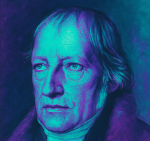
The force of mind is only as great as its expression; its depth only as deep as its power to expand and lose itself.
▼
Source
source
Preface (J. B. Baillie translation), § 10
3 months 3 weeks ago
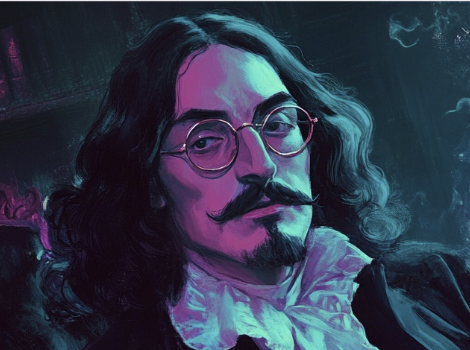
M. Desargues puts me under obligations on account of the pains that it has pleased him to have in me, in that he shows that he is sorry that I do not wish to study more in geometry, but I have resolved to quit only abstract geometry, that is to say, the consideration of questions which serve only to exercise the mind, and this, in order to study another kind of geometry, which has for its object the explanation of the phenomena of nature... You know that all my physics is nothing else than geometry.
▼
Source
source
Letter to Marin Mersenne (July 27, 1638) as quoted by Florian Cajori, A History of Mathematics (1893) letter dated in The Philosophical Writings of Descartes Vol. 3, The Correspondence (1991) ed. John Cottingham, Robert Stoothoff, Dugald Murdoch
1 month 2 weeks ago
We look at the present through a rear-view mirror. We march backwards into the future.
3 months 2 weeks ago
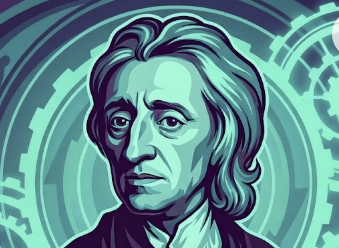
A criminal who, having renounced reason ... hath, by the unjust violence and slaughter he hath committed upon one, declared war against all mankind, and therefore may be destroyed as a lion or tyger, one of those wild savage beasts with whom men can have no society nor security. And upon this is grounded the great law of Nature, "Whoso sheddeth man's blood, by man shall his blood be shed."
▼
Source
source
Second Treatise of Civil Government, Ch. II, sec. 11

3 months 2 weeks ago
The bluebird carries the sky on his back.
▼
Source
source
April 3, 1852
1 month 2 weeks ago
It is the medium that shapes and controls the scale and form of human association and action.
▼
Source
source
(p. 9)
3 months 3 weeks ago
Such taxes [upon the necessaries of life], when they have grown up to a certain height, are a curse equal to the barrenness of the earth and the inclemency of the heavens; and yet it is in the richest and most industrious countries that they have been most generally imposed. No other countries could support so great a disorder.
▼
Source
source
Chapter II, paragraph 36, p. 500.
1 month 3 weeks ago
Before a science can develop principles, it must possess concepts. Before a law of gravitation could be formulated, it was necessary to have the notions of "acceleration" and "weight."
▼
Source
source
p. 43.
2 months 3 days ago
What one needs to do at every moment of one's life is to put an end to the old world and to begin a new world.
3 months 3 weeks ago
The trade of insurance gives great security to the fortunes of private people, and by dividing among a great many that loss which would ruin an individual, makes it fall light and easy upon the whole society.
▼
Source
source
Chapter I, Part III, p. 821.
3 months 2 weeks ago
I respect orders but I respect myself too and I do not obey foolish rules made especially to humiliate me.
▼
Source
source
Hugo to Slick and Georges, Act 3, sc. 2
3 months 3 weeks ago
Through faith we are restored to paradise and created anew.
▼
Source
source
p. 74
3 months 1 week ago
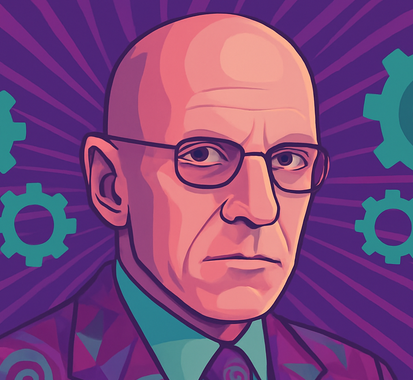
To sum up all these steps, each of which is very lengthy and complex, we will have put the game of truth back in the network of constraints and dominations. Truth, I should say rather, the system of truth and falsity, will have revealed the face it turned away from us for so long and which is that of its violence.
▼
Source
source
p. 4
2 months 4 days ago
But if ether is nothing but an hypothesis explanatory of light, air on the other hand, is a thing that is directly felt; and even if it did not enable us to explain the phenomenon of sound, we should nevertheless always be directly aware of it, and above all, of the lack of it in moments of suffocation or air-hunger. And in the same way God Himself, not the idea of God, may become a reality that is immediately felt; and even though the idea of God does not enable us to explain either the existence or essence of the Universe, we have at times the direct feeling of God, above all in moments of spiritual suffocation. And the feeling, mark it well, for all that is tragic in it and the whole tragic sense of life is founded upon this - this feeling is a feeling of hunger for God, of the lack of God. To believe in God is, in the first instance... to wish that there may be a God, to be unable to live without Him.
3 months 2 weeks ago
No man treats a motorcar as foolishly as he treats another human being. When the car will not go, he does not attribute its annoying behaviour to sin; he does not say, "You are a wicked motorcar, and I shall not give you any more petrol until you go." He attempts to find out what is wrong and to set it right. An analogous way of treating human beings is, however, considered to be contrary to the truths of our holy religion.
▼
Source
source
"The Doctrine of Free Will"
3 months 3 weeks ago
No fixed capital can yield any revenue but by means of a circulating capital.
▼
Source
source
Chapter I, p. 311.

2 months 1 week ago
Illusion begets and sustains the world; we do not destroy one without destroying the other. Which is what I do every day. An apparently ineffectual operation, since I must begin all over again the next day.
2 months 2 weeks ago
If there is anything that we wish to change in the child, we should first examine it and see whether it is not something that could better be changed in ourselves.
▼
Source
source
p. 285
2 months 1 week ago
The mind that puts everything in question, reaches, after a thousand interrogations, an almost total inertia, a situation which the inert, in fact, knows from the start, by instinct. For what is inertia but a congenital perplexity?
CivilSimian.com created by AxiomaticPanic, CivilSimian, Kalokagathia