
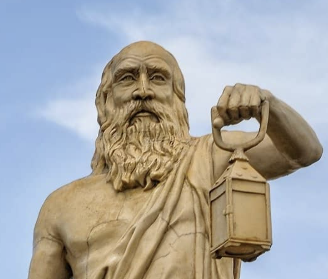
Diogenes of Sinope — The Philosopher Who Refused to Behave (c. 412–323 BCE)
Diogenes did not write treatises, found schools, or systematize metaphysics. He performed philosophy. His classroom was the street, his arguments were gestures, and his conclusions were often delivered with a grin sharp enough to draw blood. If philosophy is meant to challenge how we live, Diogenes took it personally.
Exile and Radical Freedom
Diogenes was born in Sinope, on the Black Sea. After being exiled — allegedly for defacing currency — he arrived in Athens with nothing and treated this loss as liberation. Where others sought status, safety, or recognition, Diogenes pursued freedom through absolute self-sufficiency.
He owned almost nothing. When he saw a child drinking water with his hands, he threw away his cup. Possessions, he argued, are chains disguised as comforts.
“He has the most who is content with the least.”
Life in a Barrel
Diogenes famously lived in a large ceramic jar — often misreported as a barrel — in the Athenian marketplace. This was not poverty as misfortune, but poverty as philosophy. By living in public, he erased the boundary between private virtue and public display.
He ate, slept, argued, and mocked conventions in full view. If something was shameful only because society said so, Diogenes treated it as a lie worth exposing.
“If I am not ashamed to eat, I am not ashamed to eat in public.”
Cynicism — Living Against the Grain
Diogenes was the most extreme figure of the Cynic tradition. Cynic comes from the Greek word for dog — and Diogenes embraced the label. Dogs live simply, freely, and honestly. Humans, he believed, bury themselves under custom, luxury, and false needs.
He trained himself to endure cold, hunger, and ridicule, not out of masochism, but to prove how little is actually required to live well. Civilization, he thought, was often a sophisticated way of being miserable.
“The foundation of every state is the education of its youth.”
The Lantern and the Honest Man
One of Diogenes’ most enduring images shows him walking through Athens in daylight carrying a lit lantern. When asked what he was doing, he replied that he was searching for an honest man.
The joke cuts deep. It is not that honesty does not exist, but that social roles, ambition, and flattery make sincerity rare. The lantern exposes pretense by pretending to look for virtue.
“I am looking for a human being.”
Alexander the Great Meets a Dog
When Alexander the Great visited Diogenes and offered to grant him any wish, Diogenes replied, “Stand out of my sunlight.” Power, glory, and empire meant nothing to a man who already owned himself.
Alexander reportedly said, “If I were not Alexander, I would wish to be Diogenes.” To which Diogenes might have replied: exactly.
“Stand out of my light.”
Cosmopolitan Before Cosmopolitanism
Asked where he came from, Diogenes replied, “I am a citizen of the world.” This was not sentimentality. It was a rejection of tribal identity, political loyalty, and inherited status.
To Diogenes, moral worth did not depend on birthplace, office, or reputation. It depended on how little you needed and how honestly you lived.
“I am not an Athenian or a Greek, but a citizen of the world.”
Legacy — Philosophy as a Provocation
Diogenes left no writings, only stories — and that may have been the point. His influence runs through Stoicism, political dissent, performance art, and every philosopher who suspects that society might be lying about what matters.
He reminds us that wisdom is not always polite, that virtue does not need permission, and that sometimes the most serious philosophy arrives wearing rags and laughing at kings.
CivilSimian.com created by AxiomaticPanic, CivilSimian, Kalokagathia