
3 months 1 week ago
When Alexander the Great addressed him with greetings, and asked if he wanted anything, Diogenes replied "Yes, stand a little out of my sunshine."
▼
Source
source
From Plutarch, Alexander, 14. Cf. Diogenes Laërtius, vi. 38, Cicero, Tusculan Disputations, v. 32
3 months 1 week ago
To the question what wine he found pleasant to drink, he replied, "That for which other people pay."
▼
Source
source
Diogenes Laërtius, vi. 54
3 months 1 week ago
When asked why people give to beggars but not to philosophers, he replied, 'Because they expect they may become lame and blind, but never that they will become philosophers.'
▼
Source
source
Diogenes Laërtius, vi. 56, as reported in Diogenes the Cynic: Sayings and Anecdotes as translated by Robin Hard (Oxford: 2012), p. 18
3 months 1 week ago
He was breakfasting in the marketplace, and the bystanders gathered round him with cries of "dog." "It is you who are dogs," cried he, "when you stand round and watch me at my breakfast."
▼
Source
source
Diogenes Laërtius, vi. 61
3 months 1 week ago
Asked where he came from, he said, "I am a citizen of the world."
▼
Source
source
Diogenes Laërtius, vi. 63
3 months 1 week ago
He was going into a theatre, meeting face to face those who were coming out, and being asked why, "This," he said, "is what I practise doing all my life."
▼
Source
source
Diogenes Laërtius, vi. 64
3 months 1 week ago
When the slave auctioneer asked in what he was proficient, he replied, "In ruling people."
▼
Source
source
Diogenes Laërtius, vi. 74
3 months 1 week ago
It is not that I am mad, it is only that my head is different from yours.
▼
Source
source
Stobaeus, iii. 3. 51
3 months 1 week ago
When people laughed at him because he walked backward beneath the portico, he said to them: "Aren't you ashamed, you who walk backward along the whole path of existence, and blame me for walking backward along the path of the promenade?"
▼
Source
source
Stobaeus, iii. 4. 83
3 months 1 week ago
Other dogs bite only their enemies, whereas I bite also my friends in order to save them.
▼
Source
source
Stobaeus, iii. 13. 44
3 months 1 week ago
Boasting, like gilded armour, is very different inside from outside.
▼
Source
source
Stobaeus, iii. 22. 40
3 months 1 week ago
The noblest people are those despising wealth, learning, pleasure and life; esteeming above them poverty, ignorance, hardship and death.
▼
Source
source
Stobaeus, iv. 29a. 19
3 months 1 week ago
Virtue cannot dwell with wealth either in a city or in a house.
▼
Source
source
Stobaeus, iv. 31c. 88
3 months 1 week ago
Self-taught poverty is a help toward philosophy, for the things which philosophy attempts to teach by reasoning, poverty forces us to practice.
▼
Source
source
Stobaeus, iv. 32a. 11
3 months 1 week ago
He once begged alms of a statue, and, when asked why he did so, replied, "To get practice in being refused."
▼
Source
source
Diogenes Laërtius, vi. 49
3 months 1 week ago
When some one reminded him that the people of Sinope had sentenced him to exile, he said, "And I sentenced them to stay at home."
▼
Source
source
Diogenes Laërtius, vi. 49
3 months 1 week ago
When scolded for masturbating in public, he said "I wish it were as easy to banish hunger by rubbing my belly."
▼
Source
source
Diogenes Laërtius, vi. 46, 69
3 months 1 week ago
If you are to be kept right, you must possess either good friends or red-hot enemies. The one will warn you, the other will expose you.
▼
Source
source
Plutarch, Moralia, 74C
3 months 1 week ago
On reaching Athens he fell in with Antisthenes. Being repulsed by him, because he never welcomed pupils, by sheer persistence Diogenes wore him out. Once when he stretched out his staff against him, the pupil offered his head with the words, "Strike, for you will find no wood hard enough to keep me away from you, so long as I think you've something to say."
▼
Source
source
Diogenes Laërtius, vi. 21,
3 months 1 week ago
Being asked where in Greece he saw good men, he replied, "Good men nowhere, but good boys at Sparta."
▼
Source
source
Diogenes Laërtius, vi. 27
3 months 1 week ago
When some one boasted that at the Pythian games he had vanquished men, Diogenes replied, "Nay, I defeat men, you defeat slaves."
▼
Source
source
Diogenes Laërtius, vi. 33, 43
3 months 1 week ago
To Xeniades, who had purchased Diogenes at the slave market, he said, "Come, see that you obey orders."
▼
Source
source
Diogenes Laërtius, vi. 36
3 months 1 week ago
One day, observing a child drinking out of his hands, he cast away the cup from his wallet with the words, "A child has beaten me in plainness of living."
▼
Source
source
Diogenes Laërtius, vi. 37
3 months 1 week ago
He used to reason as follows: 'Everything belongs to the gods; the wise are friends of the gods; friends hold all things in common; ergo, everything belongs to the wise.'
▼
Source
source
Diogenes Laërtius, vi. 37, as reported in Diogenes the Cynic: Sayings and Anecdotes as translated by Robin Hard (Oxford: 2012), p. 13
3 months 1 week ago
Plato had defined Man as an animal, biped and featherless, and was applauded. Diogenes plucked a fowl and brought it into the lecture-room with the words, "Behold Plato's man!"
▼
Source
source
Diogenes Laërtius, vi. 40
3 months 1 week ago
To one who asked what was the proper time for lunch, he said, "If a rich man, when you will; if a poor man, when you can." Diogenes Laërtius, vi. 40
3 months 1 week ago
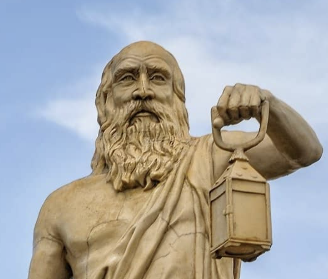
He lit a lamp in broad daylight and said, as he went about, "I am looking for a human."
▼
Source
source
Diogenes Laërtius, vi. 41. This line is frequently translated as "I am looking for an honest man."
3 months 1 week ago
He was seized and dragged off to King Philip, and being asked who he was, replied, "A spy upon your insatiable greed."
▼
Source
source
Diogenes Laërtius, vi. 43. Cf. Plutarch, Moralia, 70CD.
3 months 1 week ago
Perdiccas threatened to put him to death unless he came to him, "That's nothing wonderful," Diogenes said, "for a beetle or a tarantula would do the same."
▼
Source
source
Diogenes Laërtius, vi. 44
3 months 1 week ago
Once he saw the officials of a temple leading away some one who had stolen a bowl belonging to the treasurers, and said, "The great thieves are leading away the little thief."
▼
Source
source
Diogenes Laërtius, vi. 45
3 months 1 week ago
Poverty is a virtue which one can teach oneself.
▼
Source
source
Stobaeus, iv. 32a. 19
CivilSimian.com created by AxiomaticPanic, CivilSimian, Kalokagathia