


3 months 2 weeks ago
A wise man never loses anything, if he has himself.
▼
Source
source
Ch. 38. Of Solitude, tr. Cotton, rev. W. Hazlitt, 1842


2 months 2 weeks ago
Indeed, the drunken man while in that condition does not know the definition of drunkenness nor the scientific account of it; he has not the very least scientific knowledge of it. The sober man, on the other hand, knows the definition of drunkenness and its basis, yet he is not drunk in the very least. Again the doctor, when he is himself ill, knows the definition and causes of health and the remedies which restore it, and yet is lacking in health. Similarly there is a difference between knowing the true nature and causes and conditions of the ascetic life and actually leading such a life and forsaking the world.
▼
Source
source
III. The Classes of Seekers, p. 47.
1 month 4 weeks ago
Fanaticism consists in redoubling your efforts when you have forgotten your aim.
1 month 4 weeks ago
The ideal of strictly scientific method in mathematics which I have tried to realise here, and which perhaps might be named after Euclid I should like to describe in the following way... The novelty of this book does not lie in the content of the theorems but in the development of the proofs and the foundations on which they are based... With this book I accomplish an object which I had in view in my Begriffsschrift of 1879 and which I announced in my Grundlagen der Arithmetik. I am here trying to prove the opinion on the concept of number that I expressed in the book last mentioned.
▼
Source
source
Vol. 1. pp. 137-140, as cited in: Ralph H. Johnson (2012), Manifest Rationality: A Pragmatic Theory of Argument, p. 87

2 months 3 days ago
Of all that makes us suffer, nothing - so much as disappointment - gives us the sensation of at last touching Truth.

1 month 2 weeks ago
The history of the American kings of capital and authority is the history of repeated crimes, injustice, oppression, outrage, and abuse, all aiming at the suppression of individual liberties and the exploitation of the people. A vast country, rich enough to supply all her children with all possible comforts, and insure well-being to all, is in the hands of a few, while the nameless millions are at the mercy of ruthless wealth gatherers, unscrupulous lawmakers, and corrupt politicians.The reign of these kings is holding mankind in slavery, perpetuating poverty and disease, maintaining crime and corruption; it is fettering the spirit of liberty, throttling the voice of justice, and degrading and oppressing humanity. It is engaged in continual war and slaughter, devastating the country and destroying the best and finest qualities of man; it nurtures superstition and ignorance, sows prejudice and strife, and turns the human family into a camp of Ishmaelites.
3 months 2 days ago
Nevertheless, the ultimate business of philosophy is to preserve the force of the most elemental words in which Dasein expresses itself, and to keep the common understanding from levelling them off to that unintelligibility which functions in turn as a source of pseudo-problems.
▼
Source
source
Macquarrie & Robinson translation

3 months 1 week ago
Obstinacy is the result of the will forcing itself into the place of the intellect.
▼
Source
source
Vol. 2, Ch. 26, § 321

3 months 6 days ago
"Ah, Psyche," I said, "have I made you so little happy as that?"
▼
Source
source
Orual

3 months 1 week ago
The hand that rounded Peter's dome, And groined the aisles of Christian Rome, Wrought in a sad sincerity, Himself from God he could not free; He builded better than he knew, The conscious stone to beauty grew.
▼
Source
source
The Problem, st. 2

1 month 5 days ago
The business of art is no longer the communication of thoughts or feelings which are to be conceptually ordered, but a direct participation in an experience. The whole tendency of modern communication...is towards participation in a process, rather than apprehension of concepts.
▼
Source
source
Letter to Harold Adam Innis (14 March 1951), published in Essential McLuhan (1995), edited by Eric McLuhan and Frank Zingrone, p. 73

1 month 4 weeks ago
It is more blessed to give than to receive.
▼
Source
source
Acts 20:35b

3 months 3 weeks ago
For no fact is so simple we believe it at first sight, And there is nothing that exists so great or marvellous That over time mankind does not admire it less and less.
▼
Source
source
Book II, lines 1026-1029 (tr. Stallings)

3 months 1 week ago
He is happy, whose circumstances suit his temper; but he is more excellent, who can suit his temper to any circumstances.
▼
Source
source
§ 6.9 : Of Qualities Useful to Ourselves, Pt. 1

3 months 2 weeks ago
The monuments of wit survive the monuments of power.
▼
Source
source
Essex's Device

2 months 3 weeks ago
If you are well-to-do and can maintain your household, love your wife in your home according to good custom...Make her happy while you are alive, for she is land profitable to her lord.
▼
Source
source
Maxim no. 21.

2 days ago
While Trump is not going to be president, Trumpism is going to survive. ...The Democrats need to look very very carefully at those election results because ...the Republicans did well not necessarily because people love what they represent, but because they don't like what the Democrats represent... Unless they sort out what that is, they are going to continue to lose elections.
▼
Source
source
28:52:00
1 month 1 week ago
The need to speak, even if one has nothing to say, becomes more pressing when one has nothing to say, just as the will to live becomes more urgent when life has lost its meaning.
▼
Source
source
(p. 30)

2 months 1 week ago
The zealous never fail to draw political inferences from religious tenets, by which they interest the magistrate in the dispute; and then to the heat of a religious fervour is added the fury of a party zeal. All intercourse is cut off between the parties. They lose all knowledge of each other, tho' countrymen and neighbours, and are therefore easily imposed upon with the most absurd stories concerning each other's opinions and practices. They judge of the hatred of the adverse side by their own. Then fear is added to their hatred; and preventive injuries arise from their fear. The remembrance of the past, the dread of the future, the present ill, will join together to urge them forward to the most violent courses.Such is the manner of proceeding of religious parties towards each other.
▼
Source
source
Volume II, p. 147
2 months 3 weeks ago
He is a fool who lets slip a bird in the hand for a bird in the bush.
▼
Source
source
Of Garrulity (Tr. Goodwin)

3 months 1 week ago
One who believes, as I do, that the free intellect is the chief engine of human progress, cannot but be fundamentally opposed to Bolshevism, as much as to the Church of Rome.
▼
Source
source
Part I, Ch. 9: International Policy

4 months 5 days ago
They do not know the penalty of unrighteousness, which is the thing they most ought to know. For it is not what they think it is scourgings and death, which they sometimes escape entirely when they have done wrong but a penalty which it is impossible to escape. Two patterns, my friend, are set up in the world, the divine, which is most blessed, and the godless, which is most wretched, and their silliness and extreme foolishness blind them to the fact that through their unrighteous acts they are made like the one and unlike the other. They therefore pay the penalty for this by living a life that conforms to the pattern they resemble.
3 days ago
We admire people to the extent that we cannot explain what they do, and the word "admire" then means "marvel at."
▼
Source
source
Beyond Freedom and Dignity
3 months 2 weeks ago
For as when much superfluous matter has gathered in simple bodies, nature makes repeated efforts to remove and purge it away, thereby promoting the health of these bodies, so likewise as regards that composite body the human race, when every province of the world so teems with inhabitants that they can neither subsist where they are nor remove elsewhere, every region being equally crowded and over-peopled, and when human craft and wickedness have reached their highest pitch, it must needs come about that the world will purge herself in one or another of these three ways, to the end that men, becoming few and contrite, may amend their lives and live with more convenience.
▼
Source
source
Book 1 Ch. 5 (as translated by Ninian Hill Thomson)
2 months 3 weeks ago
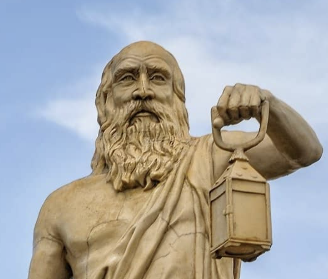
He lit a lamp in broad daylight and said, as he went about, "I am looking for a human."
▼
Source
source
Diogenes Laërtius, vi. 41. This line is frequently translated as "I am looking for an honest man."
3 months 3 weeks ago
The double meaning has been given to suit people's diverse intelligence. The apparent contradictions are meant to stimulate the learned to deeper study.
2 weeks 2 days ago
I think television has betrayed the meaning of democratic speech, adding visual chaos to the confusion of voices. What role does silence have in all this noise?
▼
Source
source
"Television"

1 month 2 weeks ago
With prophecies the commentator is often a more important man than the prophet.
▼
Source
source
H 23
3 months 6 days ago
The human imagination has seldom had before it an object so sublimely ordered as the medieval cosmos. If it has an aesthetic fault, it is perhaps, for us who have known romanticism, a shade too ordered. For all its vast spaces it might in the end afflict us with a kind of claustrophobia. Is there nowhere any vagueness? No undiscovered by-ways? No twilight? Can we never really get out of doors?
▼
Source
source
The Discarded Image: An Introduction to Medieval and Renaissance Literature, 1964
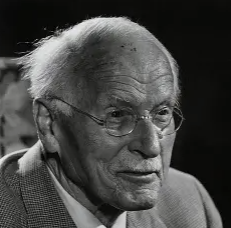
2 months 3 days ago
We Shall Naturally look round in vain the macrophysical world for acausal events, for the simple reason that we cannot imagine events that are connected non-causally and are capable of a non-causal explanation. But that does not mean that such events do not exist... The so-called "scientific view of the world" based on this can hardly be anything more than a psychologically biased partial view which misses out all those by no means unimportant aspects that cannot be grasped statistically.
▼
Source
source
p. 5
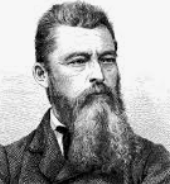
2 months 1 week ago
On the whole, Borne, Heine, Feuerbach, and such authors are the individualities who have great interest for someone who is composing an imaginary construction. They frequently are well informed about the religious-that is, they know definitely that they do not want to have anything to do with it. This is a great advantage over the systematicians, who without knowing where the religious really is located take it upon themselves to explain it-sometimes obsequiously, sometimes superciliously, but always unsuccessfully.
▼
Source
source
Soren Kierkegaard, Stages on Life's Way, 1845, Hong 1988 p. 452
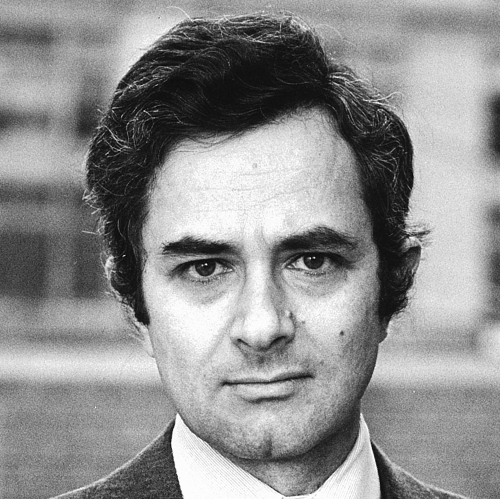
2 months 3 weeks ago
The problem is one of opposition between subjective and objective points of view. There is a tendency to seek an objective account of everything before admitting its reality. But often what appears to a more subjective point of view cannot be accounted for in this way. So either the objective conception of the world is incomplete, or the subjective involves illusions that should be rejected.
▼
Source
source
"Subjective and Objective" (1979), p. 196.
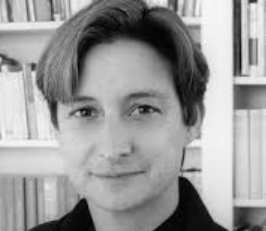
1 month 1 week ago
When the world presents as a force field of violence, the task of nonviolence is to find ways of living and acting in that world such that violence is checked or ameliorated, or its direction turned, precisely at moments when it seems to saturate that world and offer no way out.
▼
Source
source
p. 10
3 months 1 week ago
The sham cause in physical influence consists in rashly assuming that the commerce of substance and transitive forces is sufficiently knowable from their mere existence. Hence it is not so much a system as rather the neglect of all philosophical system as a superfluity in the argument. Freeing the concept from this defect, we shall have a species of commerce alone deserving to be called real, and from which the whole constituting the world merits being called real, and not ideal or imaginary.
3 months 1 week ago
The harm that is done by a religion is of two sorts, the one depending on the kind of belief which it is thought ought to be given to it, and the other upon the particular tenets believed. As regards the kind of belief: it is thought virtuous to have faith-that is to say, to have a conviction which cannot be shaken by contrary evidence. Or, if contrary evidence might induce doubt, it is held that contrary evidence must be suppressed.
▼
Source
source
preface xxiii

4 months 1 week ago
It will be easy for us once we receive the ball of yarn from Ariadne (love) and then go through all the mazes of the labyrinth (life) and kill the monster. But how many are there who plunge into life (the labyrinth) without taking that precaution?
3 weeks 1 day ago
I can assure you that there is the greatest practical benefit in making a few failures early in life. You learn that which is of inestimable importance - that there are a great many people in the world who are just as clever as you are. You learn to put your trust, by and by, in an economy and frugality of the exercise of your powers, both moral and intellectual; and you very soon find out, if you have not found it out before, that patience and tenacity of purpose are worth more than twice their weight of cleverness.
▼
Source
source
On Medical Education

3 months 1 week ago
The process is so complicated that it offers ever so many occasions for running abnormally.
▼
Source
source
Vol. II, Ch. XXI, p. 500.
1 month 3 weeks ago
The philosophical anthropologist ... can know the wholeness of the person and through it the wholeness of man only when he does not leave his subjectivity out and does not remain an untouched observer.
▼
Source
source
p. 148
2 months 1 week ago
The Crown of Great Britain cannot, in my opinion, be too magnificent. Let us see some great public works set on foot; let it never be said, that the Commons of Great Britain failed in what they owe to the first Crown in the world. Looking up to royalty, I do say, it is the oldest and one of the best parts of our constitution. I wish it should look like royalty; that it should look like a King; like a King of Great Britain.
▼
Source
source
Speech in the House of Commons (28 February 1769)
1 month 5 days ago
The new overkill is simply an extension of our nervous system into a total ecological service environment. Such a service environment can liquidate or terminate its beneficiaries as naturally as it sustains them.
▼
Source
source
(p. 152)
1 month 3 weeks ago
Although the formulations of science now offer the most advanced knowledge of nature, men continue to use obsolete forms of thought long discarded by scientific theory. In so far as these obsolete forms are superfluous for science, the fact that they persist violated the principle of the economy of thought, that characteristic trait of the bourgeois temper.
▼
Source
source
p. 133.

3 months 2 weeks ago
Faith ever says, "If Thou wilt," not "If Thou canst."
▼
Source
source
p. 241
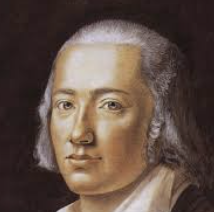
2 months 1 week ago
He who has thought most deeply loves what is most alive.

1 month 3 weeks ago
The fact of the religious vision, and its history of persistent expansion, is our one ground for optimism. Apart from it, human life is a flash of occasional enjoyments lighting up a mass of pain and misery, a bagatelle of transient experience.
▼
Source
source
Ch. 12: "Religion and Science", p. 268
3 months 2 weeks ago
Further, it will not be amiss to distinguish the three kinds and, as it were, grades of ambition in mankind. The first is of those who desire to extend their own power in their native country, a vulgar and degenerate kind. The second is of those who labor to extend the power and dominion of their country among men. This certainly has more dignity, though not less covetousness. But if a man endeavor to establish and extend the power and dominion of the human race itself over the universe, his ambition (if ambition it can be called) is without doubt both a more wholesome and a more noble thing than the other two. Now the empire of man over things depends wholly on the arts and sciences. For we cannot command nature except by obeying her.
▼
Source
source
Aphorism 129
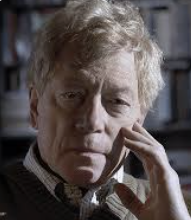
1 month ago
In argument about moral problems, relativism is the first refuge of the scoundrel.
▼
Source
source
Some More -isms, p. 32
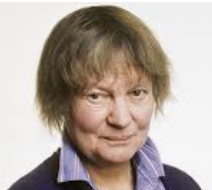
1 month 4 weeks ago
Bereavement is a darkness impenetrable to the imagination of the unbereaved.
▼
Source
source
The Sacred and Profane Love Machine (1974) p. 37.
CivilSimian.com created by AxiomaticPanic, CivilSimian, Kalokagathia