
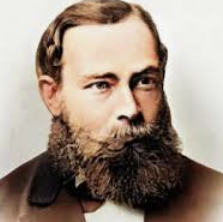
Gottlob Frege — The Inventor of Modern Logic and the Hidden Architect of Analytic Philosophy (1848–1925)
Gottlob Frege was a revolutionary who never sounded like one. Working in near isolation, with little recognition during his lifetime, he quietly rebuilt logic from the ground up. In doing so, he transformed mathematics, philosophy of language, and the very idea of what philosophical rigor should look like. Nearly every major figure in analytic philosophy stands on foundations Frege laid — often without realizing how deep they run.
A Life of Isolation and Precision
Born in Wismar, Germany, Frege was trained as a mathematician. He spent most of his career teaching at the University of Jena, far from the intellectual centers of Europe. Unlike many philosophers of his era, he avoided grand cultural commentary, political engagement, or literary flourish.
Frege lived for clarity. He wrote slowly, carefully, and with a severity that made his work difficult to read and easy to overlook. During his lifetime, his ideas attracted little attention. Their importance would only be recognized after others built entire traditions upon them.
“I have made it a rule to distrust language.”
The Invention of Modern Logic
Before Frege, logic had barely advanced since Aristotle. Syllogisms dominated, and mathematics lacked a precise logical foundation. Frege saw this as a scandal.
In his 1879 work Begriffsschrift, Frege introduced a formal system capable of expressing complex logical relations. He created quantifiers, variables, functions, and predicates — the core machinery of modern symbolic logic.
This was not a technical tweak. It was a conceptual earthquake. Logic became expressive enough to analyze mathematics itself.
“Logic must be rigorous if mathematics is to be rigorous.”
Logicism — Mathematics as Logic
Frege believed that arithmetic could be derived entirely from logic. Numbers, he argued, are not psychological constructs, nor abstractions from experience, but logical objects.
His monumental work The Basic Laws of Arithmetic attempted to show that numbers could be defined purely through logical principles. If successful, mathematics would rest on absolute certainty.
The project collapsed when Bertrand Russell discovered a contradiction within Frege’s system — a flaw now known as Russell’s Paradox. Frege acknowledged the problem with devastating honesty. The blow ended his logicist dream.
“Arithmetic is not empirical; it is analytic.”
Sense and Reference — Meaning Under the Microscope
Frege’s most enduring philosophical contribution lies in his theory of meaning. He distinguished between reference (the object a term points to) and sense (the mode of presentation of that object).
The morning star and the evening star refer to the same object — Venus — but they differ in sense. This distinction explained how identity statements can be informative rather than trivial.
With this move, Frege founded modern philosophy of language. Meaning was no longer a vague psychological notion, but something structured, analyzable, and public.
“The sense of an expression is what determines its reference.”
Anti-Psychologism
Frege fiercely opposed the idea that logic or mathematics are grounded in human psychology. Thoughts are not private mental events, he argued, but objective entities accessible to many thinkers.
Truth does not depend on how people think. Logic does not change with culture. This anti-psychologism became a defining principle of analytic philosophy.
Influence Without Recognition
Frege’s work directly shaped Bertrand Russell, Ludwig Wittgenstein, and the rise of analytic philosophy. Yet Frege himself remained obscure, embittered, and increasingly isolated.
Late in life, he retreated into reactionary political views, a tragic contrast to the intellectual purity of his earlier work. These views do not define his legacy, but they complicate it.
Legacy — The Silent Founder
Frege did not found a school. He founded a framework. Modern logic, analytic philosophy, philosophy of language, and philosophy of mathematics all begin with him.
His work reminds us that revolutions do not always arrive loudly. Sometimes they appear as symbols on a page, waiting for the world to catch up.
“Logic has much to say about thinking, but nothing about psychology.”
CivilSimian.com created by AxiomaticPanic, CivilSimian, Kalokagathia