


3 months 4 weeks ago
If a man walk in the woods for love of them half of each day, he is in danger of being regarded as a loafer; but if he spends his whole day as a speculator, shearing off those woods and making earth bald before her time, he is esteemed an industrious and enterprising citizen. As if a town had no interest in its forests but to cut them down!
▼
Source
source
p. 485

3 weeks 2 days ago
The groups are not unified under any single authority but rather relate to each other in a network structure. Social forums, affinity groups, and other forms of democratic decision-making are the basis of the movements, and they manage to act together based on what they have in common. ... These globalization protest movements are obviously limited in many regards. First of all, although their vision and desire is global in scope, they have thus far only involved significant numbers in North America and Europe. Second, so long, as they remain merely protests movements, traveling from one summit meeting to the next, they will be incapable of becoming a foundational struggle and of articulating an alternative to social relations. These limitations may only be temporary obstacles, and the movements may discover ways to overcome them.
▼
Source
source
86-87

2 weeks 4 days ago
Who is there that can recognize real intellect, and do reverence to it; and discriminate it well from sham intellect, which is so much more abundant, and deserves the reverse of reverence? He that himself has it!-One really human Intellect, invested with command, and charged to reform Downing Street for us, would continually attract real intellect to those regions, and with a divine magnetism search it out from the modest corners where it lies hid. And every new accession of intellect to Downing Street would bring to it benefit only, and would increase such divine attraction in it, the parent of all benefit there and elsewhere!

3 months 4 weeks ago
Wherever the want of clothing forced them to it, the human race made clothes for thousands of years, without a single man becoming a tailor.
▼
Source
source
Vol. I, Ch. 1, Section 2, pg. 49.

4 months 1 day ago
Thus it may be said that not only the soul, the mirror of an indestructible universe, is indestructible, but also the animal itself, though its mechanism may often perish in part and take off or put on an organic slough.
▼
Source
source
La monadologie (77). Sometimes paraphrased as: The soul is the mirror of an indestructible universe.

4 months 1 day ago
The world neither ever saw, nor ever will see, a perfectly fair lottery.
▼
Source
source
Chapter X, Part I.

2 months 3 weeks ago
The world begins and ends with us. Only our consciousness exists, it is everything, and this everything vanishes with it. Dying, we leave nothing. Then why so much fuss around an event that is no such thing?
3 months 4 weeks ago
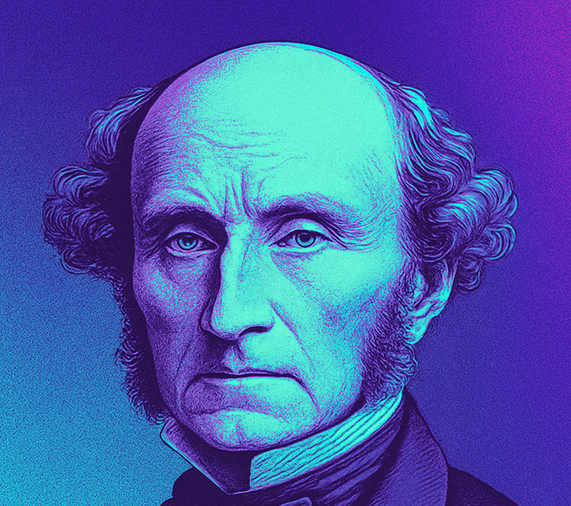
Conformity to nature has no connection whatever with right and wrong. The idea can never be fitly introduced into ethical discussions at all, except, occasionally and partially, into the question of degrees of culpability. To illustrate this point, let us consider the phrase by which the greatest intensity of condemnatory feeling is conveyed in connection with the idea of nature - the word "unnatural." That a thing is unnatural, in any precise meaning which can be attached to the word, is no argument for its being blamable; since the most criminal actions are to a being like man not more unnatural than most of the virtues.
▼
Source
source
page 62; Broadview Press, page 102
3 months 2 weeks ago
Dionysius the Elder, being asked whether he was at leisure, he replied, "God forbid that it should ever befall me!"
▼
Source
source
32 Dionysius

2 months 2 weeks ago
If your brother sins against you, go and show him his fault, just between the two of you. If he listens to you, you have won your brother over.
▼
Source
source
(Matthew 18:15) (NIV)
2 weeks 4 days ago
If Governments neglect to invite what noble intellect there is, then too surely all intellect, not omnipotent to resist bad influences, will tend to become beaverish ignoble intellect; and quitting high aims, which seem shut up from it, will help itself forward in the way of making money and such like; or will even sink to be sham intellect, helping itself by methods which are not only beaverish but vulpine, and so "ignoble" as not to have common honesty.
2 months 3 weeks ago
The true object of moral and political disquisition is pleasure or happiness.The primary, or earliest, class of human pleasure is the pleasures of external senses.In addition to these, man is susceptible of certain secondary pleasures, as the pleasures of intellectual feeling, the pleasures of sympathy, and the pleasures of self-approbation. The secondary pleasures are probably more exquisite than the primary; Or, at least,The most desirable state of man is that in which he has access to all these sources of pleasure, and is in possession of a happiness the most varied and uninterrupted. This state is a state of high civilization.
▼
Source
source
Summary of Principles 1.1
4 months 5 days ago
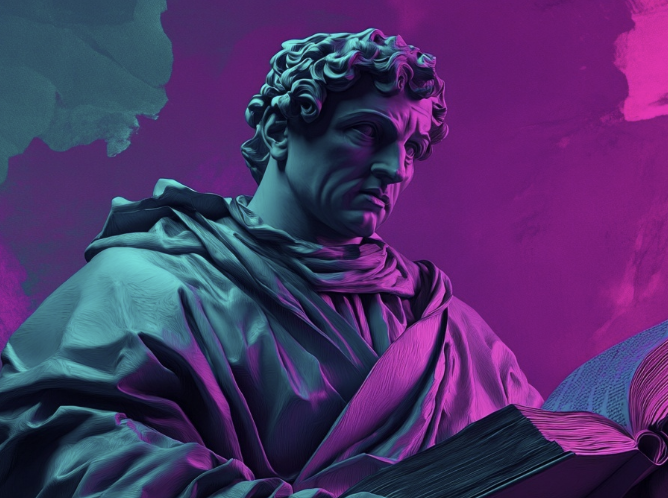
Is Christ only to be adored? Or is the holy Mother of God rather not to be honoured? This is the woman who crushed the Serpent's head. Hear us. For your Son denies you nothing.
▼
Source
source
Weimar edition of Martin Luther's Works, English translation edited by J. Pelikan [Concordia: St. Louis], Vol. 51, 128-129

3 months 4 weeks ago
There is a connected set of events (light-waves) travelling outward from a centre... there are some respects in which all events are alike, and others in which they differ... We must not think of a light-wave as a 'thing', but as a connected group of rhythmical events. The mathematical characteristics of such a group can be inferred by physics, but the intrinsic character of the component events cannot be inferred.
▼
Source
source
An Outline of Philosophy Ch.15 The Nature of our Knowledge of Physics, 1927
2 months 5 days ago
We favor hypotheses for their simplicity and explanatory power, much as the architect of the world might have done in choosing which possibility to create.
▼
Source
source
Chapter 15, Inductive Logic, p. 142.

3 months 3 weeks ago
The Ideal Man of the eighteenth century was the Rationalist; of the seventeenth, the Christian Stoic; of the Renaissance, the Free Individual; of the Middle Ages, the Contemplative Saint. And what is our Ideal Man? On what grand and luminous mythological figure does contemporary humanity attempt to model itself? The question is embarrassing. Nobody knows. And, in spite of all the laudable efforts of the Institute for Intellectual Co-operation to fabricate an acceptable Ideal Man for the use of Ministers of Education, nobody, I suspect, will know until such time as a major poet appears upon the scene with the unmistakable revelation. Meanwhile, one must be content to go on piping up for reason and realism and a certain decency.
▼
Source
source
p. 5
2 months 3 weeks ago
The study of Ethics would, no doubt, be far more simple, and its results far more "systematic," if, for instance, pain were an evil of exactly the same magnitude as pleasure is a good; but we have no reason whatever to assume that the Universe is such that ethical truths must display this kind of symmetry ... .
▼
Source
source
Principia Ethica (1903), ch. VI.
3 months 3 weeks ago
Essentially the fault lies in the fact that the democratic political process is at best regulated rivalry; it does not even in theory have the desirable properties that price theory ascribes to truly competitive markets.
▼
Source
source
Chapter IV, Section 36, p. 226

4 months 3 weeks ago
The absurd is the essential concept and the first truth.
4 months 3 weeks ago
Nothing can discourage the appetite for divinity in the heart of man.
2 months 5 days ago
Even though the model referred to satisfies the theory, etc., it is 'unintended'; and we recognize that it is unintended from the description through which it is given (as in the intuitionist case). Models are not lost noumenal waifs looking for someone to name them; they are constructions within our theory itself. and they have names from birth.
▼
Source
source
Models and Reality
2 months 2 weeks ago
Prosperity, both for individuals and for states, means possessions; and possessions mean burdens and harness and slavery; and slavery for the mind, too, because it is not only the rich man's time that is pre-empted, but his affections, his judgement, and the range of his thoughts.
▼
Source
source
"The Irony of Liberalism"
2 months 1 week ago
One cannot be deeply responsive to the world without being saddened very often.
▼
Source
source
ABC TV
2 months 1 week ago
Bourgeois norms are experienced as the evident laws of a natural order-the further the bourgeois class propagates its representations, the more naturalized they become.
▼
Source
source
p. 140

2 months 2 weeks ago
May we not imagine that possibly this earthly life of ours is to the other life what sleeping is to waking? May not all our life be a dream and death an awakening? But an awakening to what? And supposing that everything is but the dream of God and that God one day will awaken? Will He remember His dream?
3 months 3 weeks ago
My difficulty is only an - enormous - difficulty of expression.
▼
Source
source
Journal entry (8 March 1915) p. 40

2 months 4 weeks ago
The most obvious division of society is into rich and poor; and it is no less obvious, that the number of the former bear a great disproportion to those of the latter. The whole business of the poor is to administer to the idleness, folly, and luxury of the rich; and that of the rich, in return, is to find the best methods of confirming the slavery and increasing the burdens of the poor. In a state of nature, it is an invariable law, that a man's acquisitions are in proportion to his labours. In a state of artificial society, it is a law as constant and as invariable, that those who labour most enjoy the fewest things; and that those who labour not at all have the greatest number of enjoyments. A constitution of things this, strange and ridiculous beyond expression! We scarce believe a thing when we are told it, which we actually see before our eyes every day without being in the least surprised.
1 week 6 days ago
It is, they say, not Russia that plans aggression but, on the contrary, the decaying capitalist democracies. Russia wants merely to defend its own independence. This is an old and well-tried method of justifying aggression. Louis XIV and Napoleon I, Wilhelm II and Hitler were the most peace-loving of all men. When they invaded foreign countries, they did so only in just self-defence. Russia was as much menaced by Estonia or Latvia as Germany was by Luxemburg or Denmark.
3 months 4 weeks ago
Is there any knowledge in the world which is so certain that no reasonable man could doubt it?
3 months 3 weeks ago
Our language can be seen as an ancient city: a maze of little streets and squares, of old and new houses, and of houses with additions from various periods; and this surrounded by a multitude of new boroughs with straight regular streets and uniform houses.
▼
Source
source
§ 18
2 months 3 weeks ago
You have dreamed of setting the world ablaze, and you have not even managed to communicate your fire to words, to light up a single one!
1 week 1 day ago
Bacon, Locke, Descartes, Hume, and all the others knew they were giving rights to vulgarity. But in so doing-in addition to caring for man's well-being-they were providing rights for themselves.
▼
Source
source
"Commerce and Culture," p. 289.
3 months 2 days ago
To prove the Gospels by a miracle is to prove an absurdity by something contrary to nature.
▼
Source
source
As quoted in The Anchor Book of French Quotations with English Translations (1963) by Norbert Gutermam

3 months 3 weeks ago
In some places the metropolis makes do with paying a clique of feudal overlords; in others, it has fabricated a fake bourgeoisie of colonized subjects in a system of divide and rule; elsewhere, it has killed two birds with one stone: the colony is both settlement and exploitation.
▼
Source
source
p. xlvi
4 months 4 weeks ago
Rhetoric is the counterpart of Dialectic. Both alike are concerned with such things as come, more or less, within the general ken of all men and belong to no definite science. Accordingly, all men make use, more or less, of both; for to a certain extent all men attempt to discuss statements and to maintain them, to defend themselves and to attack others.

1 month 4 days ago
In ancient Europe, Stoics asserted that a slave could be freer than a master who suffers from self-division. In China, Daoists imagined a type of sage who responded to the flow of events without weighing alternatives. Disciples of monotheistic faiths have believed something similar: freedom, they say, is obeying God's will. What those who follow these traditions want most is not any kind of freedom of choice. Instead, what they long for is freedom from choice.
▼
Source
source
The Faith of Puppets: The Freedom of the Marionette (p. 6-7)

3 weeks 1 day ago
On the left you had a different aspect of individual autonomy that was pushed to an extreme, which really had to do with the autonomy that individuals have to create their own lifestyles. ...The basic concept of liberal autonomy has to do with your ability to make moral choices, but as time went on the emphasis came to be not on making the right moral choices within an existing moral framework, but rather to be able to make up that framework on your own, that that was the ultimate expression of individual human freedom, and it has obvious problems for a society because all societies have to be based on shared norms that allow people to coordinate their actions, to communicate, and the like... If you believe that the rules can be... set by anybody and that transgressing existing rules is automatically a good thing, you're not going to have... a stable society.
▼
Source
source
15:05
1 month 1 week ago
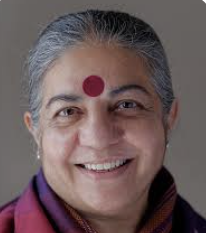
Nuclear power started in weaponry. It was designed for war. And any instrument that has its origins in war always has the potential for war. First because the material you need to make bombs, you're multiplying it though nuclear power, you're taking uranium and turn it into plutonium. Second by equipping governments and private companies with this potential, in society you spread this potential, that here is a weapon of mass destruction available. This is exactly what happened with fertilizers. Chemical fertilizers came from explosive factories are increasingly used in terrorist attacks.
▼
Source
source
On nuclear power, as quoted in "Koodankulam Must Be Stopped: Vandana Shiva", DiaNuke
4 months 5 days ago
Religion is not 'doctrinal knowledge,' but wisdom born of personal experience.
▼
Source
source
Holborn, Hajo; A HISTORY OF MODERN GERMANY: The Reformation; 1959/1982 Princeton university Press
3 months 3 weeks ago
An unexciting truth may be eclipsed by a thrilling falsehood.
▼
Source
source
Chapter 11 (p. 104)
1 month 4 days ago
Humanists today, who claim to take a wholly secular view of things, scoff at mysticism and religion. But the unique status of humans is hard to defend, and even to understand, when it is cut off from any idea of transcendence. In a strictly naturalistic view - one in which the world is taken on its own terms, without reference to a creator or any spiritual realm - there is no hierarchy of value with humans at the top. There are simply multifarious animals, each with their own needs. Human uniqueness is a myth inherited from religion, which humanists have recycled into science.
▼
Source
source
An Old Chaos: Humanism and Flying Saucers (p. 77)
3 months 3 weeks ago
All testing, all confirmation and disconfirmation of a hypothesis takes place already within a system. And this system is not a more or less arbitrary and doubtful point of departure for all our arguments; no it belongs to the essence of what we call an argument. The system is not so much the point of departure, as the element in which our arguments have their life.
2 months 2 weeks ago
And if it is grievous to be doomed one day to cease to be, perhaps it would be more grievous still to go on being always oneself, and no more than oneself, without being able to be at the same time other, without being able to be at the same time everything else, without being able to be all.
3 months 4 weeks ago
The bluebird carries the sky on his back.
▼
Source
source
April 3, 1852

1 month 1 week ago
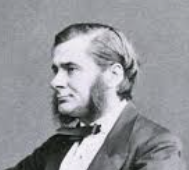
From the point of view of the moralist the animal world is on about the same level as a gladiator's show. The creatures are fairly well treated, and set to fight-whereby the strongest, the swiftest and the cunningest live to fight another day. The spectator has no need to turn his thumbs down, as no quarter is given.
▼
Source
source
(February 1888) "The Struggle for Existence: A Programme". The Nineteenth Century 23: 161-180. (quote from p. 163)
2 months 1 day ago
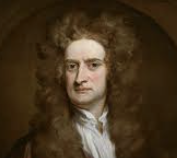
It is the perfection of God's works that they are all done with the greatest simplicity. He is the God of order and not of confusion. And therefore as they would understand the frame of the world must endeavor to reduce their knowledge to all possible simplicity, so must it be in seeking to understand these visions.
▼
Source
source
Cited in Rules for methodizing the Apocalypse, Rule 9, from a manuscript published in The Religion of Isaac Newton (1974) by Frank E. Manuel

4 months 5 days ago
One may be humble out of pride.
▼
Source
source
Book II, Ch. 17. Of Presumption

4 months 2 weeks ago
A true friend will partake of the wants and sorrows of his friend, as if they were his own; if he be in want, he will relieve him; if he be in prison, he will visit him; if he be sick, he will come to him; nay-situations may occur, in which he would not scruple to die for him. It cannot then be doubted, that friendship is one of the most useful means of procuring a secure, tranquil, and happy life.
4 months 3 weeks ago
The world evades us because it becomes itself again. That stage scenery masked by habit becomes what it is. It withdraws at a distance from us.
CivilSimian.com created by AxiomaticPanic, CivilSimian, Kalokagathia