

2 months 1 week ago
But Aversion wee have for things, not only which we know have hurt us; but also that we do not know whether they will hurt us, or not.
▼
Source
source
The First Part, Chapter 6, p. 24
1 month 4 weeks ago
Once the good man was dead, one wore his hat and another his sword as he had worn them, a third had himself barbered as he had, a fourth walked as he did, but the honest man that he was - nobody any longer wanted to be that.
▼
Source
source
C 36
3 months 3 weeks ago
A mind of slow apprehension is therefore not necessarily a weak mind. The one who is alert with abstractions is not always profound, he is more often very superficial.
▼
Source
source
Kant, Immanuel (1996), page 99

3 months 3 weeks ago
We may search long to find where God is, but we shall find Him in those who keep the words of Christ. For the Lord Christ saith, " If any man love me, he will keep my words; and we will make our abode with him."
▼
Source
source
p. 278

3 months 2 weeks ago
You, your families, your friends and your countries are to be exterminated by the common decision of a few brutal but powerful men. To please these men, all the private affections, all the public hopes, all that has been achieved in art, and knowledge and thought and all that might be achieved hereafter is to be wiped out forever. Our ruined lifeless planet will continue for countless ages to circle aimlessly round the sun unredeemed by the joys and loves, the occasional wisdom and the power to create beauty which have given value to human life.
▼
Source
source
Leaflet issued while Russell was in Brixton Prison, 1961

4 months 2 weeks ago
Irony is a qualification of subjectivity.



3 months 3 weeks ago
They [theologians] will explain to you how Christ was formed in the Virgin's womb; how accident subsists in synaxis without domicile in place. The most ordinary of them can do this. Those more fully initiated explain further whether there is an instans in Divine generation; whether in Christ there is more than a single filiation; whether 'the Father hates the Son' is a possible proposition; whether God can become the substance of a woman, of an ass, of a pumpkin, or of the devil, and whether, if so, a pumpkin could preach a sermon, or work miracles, or be crucified. And they can discover a thousand other things to you besides these. They will make you understand notions, and instants, formalities, and quiddities, things which no eyes ever saw, unless they were eyes which could see in the dark what had no existence.
▼
Source
source
as quoted by Froude ibid.,
1 month 3 weeks ago
The real significance of the Russell paradox, from the standpoint of the modal-logic picture, is this: it shows that no concrete structure can be a standard model for the naive conception of the totality of all sets; for any concrete structure has a possible extension that contains more 'sets'. (If we identify sets with the points that represent them in the various possible concrete structures, we might say: it is not possible for all possible sets to exist in any one world!) Yet set theory does not become impossible. Rather, set theory becomes the study of what must hold in, e.g. any standard model for Zermelo set theory.
▼
Source
source
Mathematics without foundations
1 week 1 day ago
It is a mistake to think that the past is dead. Nothing that has ever happened is quite without influence at this moment. The present is merely the past rolled up and concentrated in this second of time. You, too, are your past; often your face is your autobiography; you are what you are because of what you have been; because of your heredity stretching back into forgotten generations; because of every element of environment that has affected you, every man or woman that has met you, every book that you have read, every experience that you have had; all these are accumulated in your memory, your body, your character, your soul. So with a city, a country, and a race; it is its past, and cannot be understood without it.
▼
Source
source
As quoted in "The Gentle Philosopher" (2006) by John Little at the Will Durant Foundation

3 months 3 weeks ago
The Hudson's Bay Company, before their misfortunes in the late war, had been much more fortunate than the Royal African Company.
▼
Source
source
Chapter I, Part III, p. 806.
3 months 1 week ago
At one level, this movement on behalf of oppressed farm animals is emotional...Yet the movement is also the product of a deep intellectual ferment pioneered by the Princeton scholar Peter Singer...This idea popularized by Professor Singer - that we have ethical obligations that transcend our species - is one whose time appears to have come...What we're seeing now is an interesting moral moment: a grass-roots effort by members of one species to promote the welfare of others...animal rights are now firmly on the mainstream ethical agenda.
▼
Source
source
Nicholas Kristof, "Humanity Even for Nonhumans," in The New York Times (8 April 2009).
7 months 3 weeks ago
It is also crucial to bear in mind the interconnection between the Decalogue... and its modern obverse, the celebrated 'human Rights'. As the experience of our post-political liberal-permissive society amply demonstrates, human Rights are ultimately, at their core, simply Rights to violate the Ten Commandments. 'The right to privacy' — the right to adultery, in secret, where no one sees me or has the right to probe my life. 'The right to pursue happiness and to possess private property' -- the right to steal (to exploit others). 'Freedom of the press and of the expression of opinion' -- the right to lie. 'The right of free citizens to possess weapons' -- the right to kill. And, ultimately, 'freedom of religious belief' — the right to worship false gods.

3 months 2 weeks ago
Farewell to the monsters, farewell to the saints. Farewell to pride. All that is left is men.
▼
Source
source
Act 10, sc. 4


3 months 1 week ago
Free-market fundamentalism trivializes the concern for public interest. It puts fear and insecurity in the hearts of anxiety-ridden workers. It also makes money-driven, poll-obsessed elected officials deferential to corporate goals of profit - often at the cost of the common good. ... The free-market fundamentalism that prevails in the United States today promotes the pervasive sleepwalking of the populace. People see that the false prophets are handsomely rewarded - with money, status and access to more power. ... We are experiencing the sad gangsterization of America - an unbridled grasp at power, wealth and status.
▼
Source
source
Cornel West: Democracy Matters in The Globalist

1 week 2 days ago
Can the man say, Fiat lux, Let there be light; and out of chaos make a world? Precisely as there is light in himself, will he accomplish this.
3 months 2 weeks ago
Virtue is the death of conscience because it is the habit of Good, and yet the ethic of the honest man infinitely prefers virtue to the noblest agonies of conscience. Thus, being poses nonbeing and eliminates it. There is only being.
▼
Source
source
p. 402
1 month 3 weeks ago
Until the seventeenth century there was no concept of evidence with which to pose the problem of induction!
▼
Source
source
Chapter 4, Evidence, p. 31.
2 months 4 days ago
If philosophy is still necessary, it is so only in the way it has been from time immemorial: as critique, as resistance to the expanding heteronomy, even if only as thought's powerless attempt to remain its own master and to convict of untruth, by their own criteria, both a fabricated mythology and a conniving, resigned acquiescence. ... It is incumbent upon philosophy ... to provide a refuge for freedom. Not that there is any hope that it could break the political tendencies that are throttling freedom throughout the world both from within and without and whose violence permeates the very fabric of philosophical argumentation.
▼
Source
source
p. 10

3 days ago
The one loves to do good, the other to do harm; the one to help even strangers, the other to attack even its dearest friends.
1 week 2 days ago
Normal science, the puzzle-solving activity we have just examined, is a highly cumulative enterprise, eminently successful in its aim, the steady extension of the scope and precision of scientific knowledge. In all these respects it fits with great precision the most usual image of scientific work. Yet one standard product of the scientific enterprise is missing. Normal science does not aim at novelties of fact or theory and, when successful, finds none.
▼
Source
source
p. 52
3 months 3 weeks ago
In Matthew 12:23 Christ says: "Either make the tree good, and its fruit good; or make the tree bad and its fruit bad," as if to say: "Let the one who wishes to have good fruit begin by planting a good tree." Therefore, let the person who wishes to do good works being not with the works but with the believing, for this alone makes a person good.
▼
Source
source
p. 76

2 months 3 weeks ago
I could never divide myself from any man upon the difference of an opinion, or be angry with his judgement for not agreeing with me in that, from which perhaps within a few days I should dissent myself.
▼
Source
source
Section 6
4 months 6 days ago
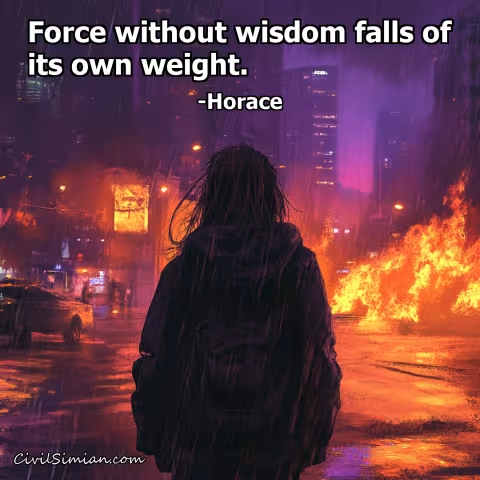
Force overcome by force.
▼
Source
source
Pro Milone, Chapter XI, section 30 Variant translation: Violence conquered by violence.
1 week 4 days ago
In 1903 there appeared Problems of Idealism, a collection of essays many of whose authors had recently been Marxists, but which condemned Marxism and materialism for their moral nihilism, contempt of personality, determinism, and fanatical pursuit of social values regardless of the individuals who made up society; they also attacked Marxism for its uncritical worship of progress and sacrifice of the present to the future.
▼
Source
source
(pp. 420-1)

2 months 1 week ago
There is no cure for birth and death save to enjoy the interval.
▼
Source
source
"War Shrines"

3 months 2 weeks ago
By quarrelling amongst themselves, instead of confederating, Germans and Scandinavians, both of them belonging to the same great race, only prepare the way for their hereditary enemy, the Slav.
▼
Source
source
The Eastern Question: A Reprint of Letters written 1853 -1856 dealing with the events of the Crimean War, edit., Eleanor Marx Aveling, London, Swan Sonnenschein & Co. (1897) p. 90
3 months 2 weeks ago
Inuring children gently to suffer some degrees of pain without shrinking, is a way to gain firmness to their minds, and lay a foundation for courage and resolution in the future part of their lives.
▼
Source
source
Sec. 115

2 months 2 weeks ago
Yes, I dreamed a dream, my dream of the third of November. They tease me now, telling me it was only a dream. But does it matter whether it was a dream or reality, if the dream made known to me the truth? If once one has recognized the truth and seen it, you know that it is the truth and that there is no other and there cannot be, whether you are asleep or awake. Let it be a dream, so be it, but that real life of which you make so much I had meant to extinguish by suicide, and my dream, my dream - oh, it revealed to me a different life, renewed, grand and full of power!

3 months 2 weeks ago
When they have really learned to love their neighbours as themselves, they will be allowed to love themselves as their neighbours.
▼
Source
source
Letter XIV

2 months 2 weeks ago
The same feeling of not belonging, of futility, wherever I go: I pretend interest in what matters nothing to me, I bestir myself mechanically or out of charity, without ever being caught up, without ever being somewhere. What attracts me is elsewhere, and I don't know where that elsewhere is.
2 months 1 week ago
The vicious circle of dread of war which leads the nations to arm themselves for self-protection, with the result that bloated armaments ultimately lead to the war which they were intended to avert, can be broken in either of two conceivable ways. There might arise a unique world power, brought into being by the unification of all those now in possession of weapons, and equipped with the capacity to forbid the lesser and unarmed nations to make war. On the other hand, it may arise by the working of a fate to us still inscrutable which, out of ruin, will disclose a way towards the development of a new human being. To will the discovery of this way would be blind impotence, but those who do not wish to deceive themselves will be prepared for the possibility.
3 months 2 weeks ago
What I see is teeming cohesion, contained dispersal.... For him, to sculpt is to take the fat off space.
▼
Source
source
On Alberto Giacometti's work, Situations, in Braziller

1 month 2 weeks ago
Government is violence, Christianity is meekness, non-resistance, love. And, therefore, government cannot be Christian, and a man who wishes to be a Christian must not serve government.
▼
Source
source
Letter to Dr. Eugen Heinrich Schmitt (October 12, 1896), translated by Nathan Haskell Dole
1 month 1 week ago
It may be that the public mind of India may expand under our system till it has outgrown that system; that by good government we may educate our subjects into a capacity for better government, that, having become instructed in European knowledge, they may, in some future age, demand European institutions. Whether such a day will ever come I know not. But never will I attempt to avert or to retard it. Whenever it comes, it will be the proudest day in English history.
▼
Source
source
Speech in the House of Commons

2 months 2 weeks ago
I decline the election. - It has ever been my rule through life, to observe a proportion between my efforts and my objects. I have never been remarkable for a bold, active, and sanguine pursuit of advantages that are personal to myself.
▼
Source
source
Speech at Bristol on declining the poll (9 September 1780), quoted in The Works of the Right Honourable Edmund Burke, Vol. II (1855), p. 170
3 months 3 weeks ago
...so it is with human reason, which strives not against faith, when enlightened, but rather furthers and advances it.
▼
Source
source
On Justification CCXCIV
2 months 1 week ago
The specialist serves as a striking concrete example of the species, making clear to us the radical nature of the novelty. For, previously, men could be divided simply into the learned and the ignorant, those more or less the one, and those more or less the other. But your specialist cannot be brought in under either of these two categories. He is not learned , for he is formally ignorant of all that does not enter into his speciality; but neither is he ignorant, because he is "a scientist," and "knows" very well his own tiny portion of the universe. We shall have to say that he is a learned ignoramus, which is a very serious matter, as it implies that he is a person who is ignorant, not in the fashion of the ignorant man, but with an the petulance of one who is learned in his own special line.
▼
Source
source
Chapter XII: The Barbarism Of "Specialisation"

2 months 4 days ago
The aim is to replace economic oligarchies by the State, which has a will-to-power of its own and is quite as little concerned with the public good; and a will-to-power, moreover, which is not economic but military and therefore much more dangerous to any good folk who have a taste for staying alive. And on the bourgeois side what on earth is the sense of objecting to State control in economic affairs if one accepts private monopolies which have all the economic and technical disadvantages of State monopolies and possibly some others as well?
▼
Source
source
p. 230
3 months 2 weeks ago
How every line is of such strong, determined, and consistent meaning! And on every page we encounter deep, original, lofty thoughts, while the whole world is suffused with a high and holy seriousness.
▼
Source
source
About Indian sacred scriptures. quoted in Londhe, S. (2008).
2 months 2 weeks ago
After all, why should ordinary people want to contemplate the End, especially when we see the condition of those who do?
2 months 2 weeks ago
On our earth we can only love with suffering and through suffering. We cannot love otherwise, and we know of no other sort of love. I want suffering in order to love. I long, I thirst, this very instant, to kiss with tears the earth that I have left, and I don't want, I won't accept life on any other!"
3 weeks 6 days ago
The biology of suffering in intelligent agents is a deep underlying source of existential risk - and one that can potentially be overcome.
▼
Source
source
"Unsorted Postings", pre-2014

4 months 2 weeks ago
Korell is that frequent phenomenon in history: the republic whose ruler has every attribute of the absolute monarch but the name. It therefore enjoyed the usual despotism unrestrained even by those two moderating influences in the legitimate monarchies: regal, honor and court etiquette.
4 months 3 days ago
Whatever moral rules you have deliberately proposed to yourself abide by them as they were laws, and as if you would be guilty of impiety by violating any of them. Don't regard what anyone says of you, for this, after all, is no concern of yours. How long, then, will you put off thinking yourself worthy of the highest improvements and follow the distinctions of reason? You have received the philosophical theorems, with which you ought to be familiar, and you have been familiar with them. What other master, then, do you wait for, to throw upon that the delay of reforming yourself?... Let whatever appears to be the best be to you an inviolable law.
▼
Source
source
(50).

2 months 3 weeks ago
Among these widely differing families of men, the first that attracts attention, the superior in intelligence, in power, and in enjoyment, is the white, or European, the MAN pre-eminently so called, below him appear the Negro and the Indian.
▼
Source
source
Chapter XVIII.
3 weeks 6 days ago
Some days will be sublime. Others will be merely wonderful. But critically, there will be one particular texture ("what it feels like") of consciousness that will be missing from our lives; and that will be the texture of nastiness.
▼
Source
source
"Feeling Groovy, Forever", Institute for Ethics and Emerging Technologies, 14 Mar. 2012
CivilSimian.com created by AxiomaticPanic, CivilSimian, Kalokagathia