


1 month 3 weeks ago
God's love for us is not the reason for which we should love him. God's love for us is the reason for us to love ourselves.
▼
Source
source
p. 270

2 months 3 weeks ago
Placing your stick at the end of the shadow of the pyramid, you made by the sun's rays two triangles, and so proved that the pyramid [height] was to the stick [height] as the shadow of the pyramid to the shadow of the stick.
▼
Source
source
W. W. Rouse Ball, A Short Account of the History of Mathematics

3 months 1 week ago
Every crusader is apt to go mad. He is haunted by the wickedness which he attributes to his enemies; it becomes in some sort a part of him.
▼
Source
source
Aldous Huxley, The Devils of Loudon Chatto & Windus, London, (1951), ch. 9, p. 274
3 months 1 week ago
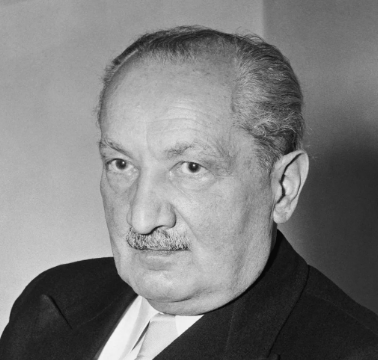
We ourselves are the entities to be analyzed.
▼
Source
source
Macquarrie & Robinson translation

3 months 2 weeks ago
We are brought to a belief of God either by reason or by force. Atheism being a proposition as unnatural as monstrous, difficult also and hard to establish in the human understanding, how arrogant soever, there are men enough seen, out of vanity and pride, to be the authors of extraordinary and reforming opinions, and outwardly to affect the profession of them; who, if they are such fools, have, nevertheless, not the power to plant them in their own conscience. Yet will they not fail to lift up their hands towards heaven if you give them a good thrust with a sword in the breast, and when fear or sickness has abated and dulled the licentious fury of this giddy humour they will easily re-unite, and very discreetly suffer themselves to be reconciled to the public faith and examples.
▼
Source
source
Ch. 12

3 months 2 weeks ago
The directors of such [joint-stock] companies, however, being the managers rather of other people's money than of their own, it cannot well be expected, that they should watch over it with the same anxious vigilance with which the partners in a private copartnery frequently watch over their own.... Negligence and profusion, therefore, must always prevail, more or less, in the management of the affairs of such a company.
▼
Source
source
Chapter I, Part III, Article I, orig.p. 233.

3 months 1 week ago
I don't know why we are here, but I'm pretty sure that it is not in order to enjoy ourselves.
▼
Source
source
As quoted in The Beginning of the End (2004) by Peter Hershey, p. 109 Also, as quoted in "The Relentless Rise of Science as Fun", by Jeremy Burgess, in New Scientist, Volume 143, Issues 1932-1945, originally published 1994.

2 months 2 weeks ago
The First thing that strikes a traveler in the United States is the innumerable multitude of those who seek to emerge from their original condition; and the second is the rarity of lofty ambition to be observed in the midst of the universally ambitious stir of society. No Americans are devoid of a yearning desire to rise, but hardly any appear to entertain hopes of great magnitude or to pursue very lofty aims. All are constantly seeking to acquire property, power, and reputation.
▼
Source
source
Book Three, Chapter XIX.

4 months 1 week ago
Scientists have pushed back the horizon of time from the biblical 6,000 years to 4,600,000,000 years for the age of Earth a 760,000-fold increase.
2 months 1 week ago
...for stones, plants, and animals there is no God, but only for man.

2 months 1 week ago
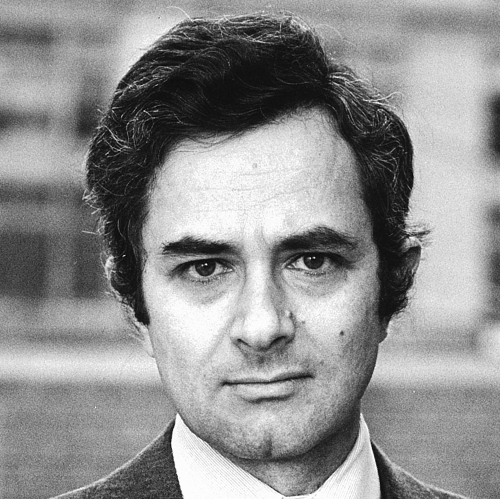
Your suffering like your fate is without motive. To suffer, truly to suffer, is to accept the invasion of ills without the excuse of causality, as a favor of demented nature, as a negative miracle...

3 months 2 days ago
Philosophy is the childhood of the intellect, and a culture that tries to skip it will never grow up.
▼
Source
source
p. 12.

3 days ago
He who takes not counsel of the Unseen and Silent, from him will never come real visibility and speech.
▼
Source
source
Bk. III, ch. 11.
3 months 1 day ago
People are enticed by a desire which continually cheats them.'Nothing is enough,' they say, 'for you're only worth what you have.'
▼
Source
source
Book I, satire i, lines 61-62, as translated by N. Rudd

1 month 3 weeks ago
You cannot conduct war with equals; you cannot have militarism with free born men; you must have slaves, automatons, machines, obedient disciplined creatures, who will move, act, shoot and kill at the command of their superiors. That is preparedness, and nothing else.

3 months 3 weeks ago
Nothing can be produced from nothing.
▼
Source
source
Book I, lines 156-157 (tr. Munro) Variant translations: Nothing can be created from nothing. Nothing can be created out of nothing.

1 month 4 weeks ago
Reason perhaps teaches certain bourgeois virtues, but it does not make either heroes or saints.

1 month 1 week ago
War is not a courtesy but the most horrible thing in life; and we ought to understand that, and not play at war. We ought to accept this terrible necessity sternly and seriously. It all lies in that: get rid of falsehood and let war be war and not a game. As it is now, war is the favourite pastime of the idle and frivolous.
▼
Source
source
Bk. X, ch. 25

3 months 6 days ago
We are aware of all the inconveniences of prison, and that it is dangerous when it is not useless. And yet one cannot 'see' how to replace it. It is the detestable solution, which one seems unable to do without.
▼
Source
source
Part Four, Complete and austere institutions
1 month 1 week ago
Fortune is not satisfied with inflicting one calamity.
▼
Source
source
Maxim 274
1 month 3 weeks ago
The art of progress is to preserve order amid change, and to preserve change amid order.

3 months 1 week ago
So our self-feeling in this world depends entirely on what we back ourselves to be and do.
▼
Source
source
Ch. 10
1 month 3 weeks ago
The spirit of militarism has already permeated all walks of life. Indeed, I am convinced that militarism is a greater danger here than anywhere else, because of the many bribes capitalism holds out to those whom it wishes to destroy.

2 months 1 week ago
Magnanimity in politics is not seldom the truest wisdom; and a great empire and little minds go ill together.
4 days ago
Communism was not the crazy fantasy of a few fanatics, nor the result of human stupidity and baseness; it was a real, very real part of the history of the twentieth century, and we cannot understand this history of ours without understanding communism. We cannot get rid of this specter by saying it was just "human stupidity," or "human corruptibility." The specter is stronger than the spells we cast on it. It might come back to life.
▼
Source
source
Introduction to My Correct Views on Everything
3 days ago
Every toiling Manchester, its smoke and soot all burnt, ought it not, among so many world-wide conquests, to have a hundred acres or so of free greenfield, with trees on it, conquered, for its little children to disport in; for its all-conquering workers to take a breath of twilight air in? You would say so! A willing Legislature could say so with effect. A willing Legislature could say very many things! And to whatsoever 'vested interest,' or such like, stood up, gainsaying merely, "I shall lose profits,"-the willing Legislature would answer, "Yes, but my sons and daughters will gain health, and life, and a soul."-

2 months 2 weeks ago
The man who makes his religion a means to the gaining of this world, will lose both worlds alike; whereas the man who gives up this world for the sake of religion, will get both worlds alike.
▼
Source
source
The Faith and Practice of Al-Ghazali, Allen & Unwin (1963), p. 152.
3 months 1 week ago
The circumstances of justice may be described as the normal conditions under which human cooperation is both possible and necessary.
▼
Source
source
Chapter III, Section 22, pg. 126
2 months 1 week ago
You women could make someone fall in love even with a lie.
▼
Source
source
Act I.

3 months 1 week ago
I found one day in school a boy of medium size ill-treating a smaller boy. I expostulated, but he replied: "The bigs hit me, so I hit the babies; that's fair." In these words he epitomized the history of the human race.
▼
Source
source
p. 31

3 months 3 weeks ago
Only charity admitteth no excess. For so we see, aspiring to be like God in power, the angels transgressed and fell.
▼
Source
source
Book II, xxii

1 month 1 week ago
African audiences cannot accept our passive consumer role in the presence of film.
▼
Source
source
(p. 44)
3 months 1 week ago
The writers by whom, more than by any others, a new mode of political thinking was brought home to me, were those of the St. Simonian school in France. In 1829 and 1830 I became acquainted with some of their writings. They were then only in the earlier stages of their speculations. They had not yet dressed out their philosophy as a religion, nor had they organized their scheme of Socialism. They were just beginning to question the principle of hereditary property. I was by no means prepared to go with them even this length; but I was greatly struck with the connected view which they for the first time presented to me, of the natural order of human progress; and especially with their division of all history into organic periods and critical periods.
▼
Source
source
(p. 163)

3 months 1 week ago
Hegel once observed that comedy is in act superior to tragedy and humourous reasoning superior to grandiloquent reasoning. Although Lincoln does not possess the grandiloquence of historical action, as an average man of the people he has its humour.

4 months 1 week ago
[B]ecause that which is finite is always bounded with reference to something... it is necessary that there should be no end... [N]umber also appears to be infinite, and mathematical magnitudes, and that which is beyond the heavens. And since that which is beyond is infinite, body also appears to be infinite, and it would seem that there are infinite worlds; for why is there rather void here than there? ...If also there is a vacuum, and an infinite place, it is necessary that there should be an infinite body: for in things which have a perpetual subsistence, capacity differs nothing from being. The speculation of the infinite is, however, attended with doubt: for many impossibilities happen both to those who do not admit that it has a subsistence, and to those who do. ...It is ...especially the province of a natural philosopher to consider if there be a sensible infinite magnitude.
1 month 2 weeks ago
To me, believing that some correspondence intrinsically just is reference (not as a result of our operational and theoretical constraints, or our intentions, but as an ultimate metaphysical fact) amounts to a magical theory of reference. Reference itself becomes what Locke called a 'substantial form' (an entity which intrinsically belongs with a certain name) on such a view. Even if one is willing to contemplate such unexplainable metaphysical facts, the epistemological problems that accompany such a metaphysical view seem insuperable. For, assuming a world of mind- independent, discourse-independent entities (this is the presupposition of the view we are discussing), there are, as we have seen, many different 'correspondences' which represent possible or candidate reference relations (infinitely many, in fact, if there are infinitely many things in the universe).
▼
Source
source
Chap. 2 : A problem about reference

3 months 1 week ago
I call upon you, young men, to obey your heart, and be the nobility of this land. In every age of the world, there has been a leading nation, one of a more generous sentiment, whose eminent citizens were willing to stand for the interests of general justice and humanity, at the risk of being called, by the men of the moment, chimerical and fantastic. Which should be that nation but these States? Which should lead that movement, if not New England? Who should lead the leaders, but the Young American?
2 months 1 week ago
Difficulty is a severe instructor, set over us by the supreme ordinance of a parental Guardian and Legislator, who knows us better than we know ourselves, as he loves us better too. Pater ipse colendi haud facilem esse viam voluit. He that wrestles with us strengthens our nerves, and sharpens our skill. Our antagonist is our helper.
▼
Source
source
Volume iii, p. 453

1 month 3 weeks ago
People often say to me, You don't know what a wife and mother feels. No, I say, I don't and I'm very glad I don't. And they don't know what I feel. ... I am sick with indignation at what wives and mothers will do of the most egregious selfishness. And people call it all maternal or conjugal affection, and think it pretty to say so. No, no, let each person tell the truth from his own experience.
▼
Source
source
Letter to Madame Mohl
2 months 3 days ago
To regiment artists, to make them servants of some particular cause does violence to the very springs of artistic creation. But it does more than that. It betrays the very cause of a better future it would serve, for in its subjugation of the individuality of the artist it annihilates the source of that which is genuinely new. Where the regimentation is successful, it would cause the future to be but a rearrangement of the past.

1 month 3 weeks ago
The key to understanding Crowley is the same as the key to understanding the Marquis de Sade. Both wasted an immense amount of energy screaming defiance at the authority they resented so much, and lacked the insight to see that they were shaking their fists at an abstraction.
▼
Source
source
p. 29
3 months 1 week ago
Let me never fall into the vulgar mistake of dreaming that I am persecuted whenever I am contradicted.
▼
Source
source
November 8, 1838

1 month 1 week ago
It would be deeply depressing if the only way children could get moral values was from religion. Either from scripture, and God knows we don't want them to get it from scripture, I mean, just look at scripture. Or, from being afraid of God, being intimidated by God. Anybody who is good for only those two reasons is not really being good at all. Why not teach children things like the Golden Rule, do as you would be done by, how would you like it if other children did that to you, so why do you do it to them... I think it's depressing that anybody should suggest that you actually need God in order to be moral. I would hope that our morals come from a better source than that, and therefore they are genuinely moral rather than based on outmoded scripture, or based on fear.
▼
Source
source
BBC,
2 months 1 week ago
Vague a l'ame - melancholy yearning for the end of the world.

3 months 2 weeks ago
As these people are not convicted of forfeiting freedom, they have still a natural, perfect right to it; and the Governments whenever they come should, in justice set them free, and punish those who hold them in slavery.
2 months 4 days ago
Injustice in this world is not something comparative; the wrong is deep, clear, and absolute in each private fate.
▼
Source
source
Ch. IV: The Aristocratic Ideal

3 months 2 weeks ago
Let us keep to Christ, and cling to Him, and hang on Him, so that no power can remove us.
▼
Source
source
p. 433
CivilSimian.com created by AxiomaticPanic, CivilSimian, Kalokagathia