
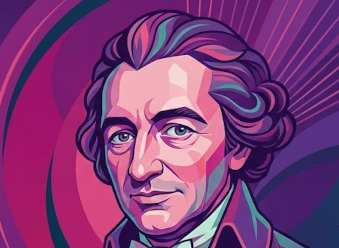
Thomas Paine — Radical Voice of Revolution and Reason (1737–1809)
Paine was the wandering firebrand whose pen helped ignite revolutions on both sides of the Atlantic. His writings carried the unmistakable force of clarity: that ordinary people have the power — and the right — to reshape their world.
A Restless Spirit in the Age of Upheaval
Born in Thetford, England, Paine drifted through a string of modest jobs before meeting Benjamin Franklin, who encouraged him to sail to America. He arrived just as colonial tensions were reaching a breaking point. Paine had impeccable timing: the world was about to catch fire, and he had matches.
“The mind once enlightened cannot again become dark.”
*Common Sense* — A Pamphlet That Shook an Empire
In 1776 Paine wrote Common Sense, a fierce argument for independence written in language every colonist could understand. It rejected monarchy, attacked hereditary privilege, and insisted that political legitimacy could only come from the people.
His genius was rhetorical: he made revolution sound not just desirable, but obvious. Small wonder the pamphlet spread like wildfire.
“Society is produced by our wants, government by our wickedness.”
Revolutionary on Multiple Fronts
After helping spark the American Revolution, Paine plunged into the French Revolution as well. His work The Rights of Man defended the Revolution’s ideals and attacked monarchy and aristocracy across Europe. His dedication to justice brought him both admiration and danger — he narrowly escaped execution during the Reign of Terror.
His later book, The Age of Reason, championed deism and criticized organized religion, earning him fierce criticism from the devout. Paine remained unbothered; he believed truth-seeking demanded courage.
“My country is the world, and my religion is to do good.”
A Belief in Universal Rights
Paine held that individual rights are inherent — not granted by kings or governments. He pushed this further than many of his contemporaries: he supported abolition, universal male suffrage, social welfare programs, and republican democracy at a time when such views were considered wildly radical.
He even proposed a form of basic income funded by land taxes, anticipating debates still unfolding centuries later.
“The world is my country, all mankind are my brethren.”
Legacy — The Outsider Who Spoke for Everyone
Paine died with little wealth and few friends, but his ideas continue to echo through democratic societies. His writings remind citizens that power is not a birthright but a responsibility, and that reason remains a revolutionary force when wielded with clarity and conviction.
His work still stirs revolutions of the mind — an inheritance that grows more valuable whenever complacency threatens freedom.
“We have it in our power to begin the world over again.”
CivilSimian.com created by AxiomaticPanic, CivilSimian, Kalokagathia