

3 months 1 week ago
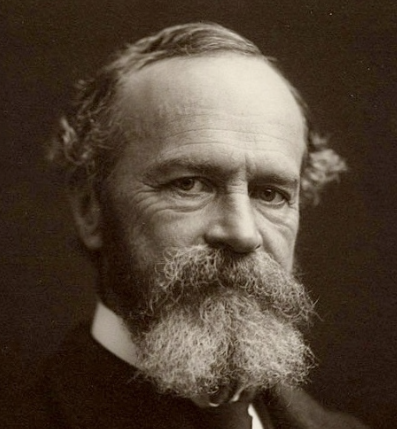
When all is said and done, we are in the end absolutely dependent on the universe; and into sacrifices and surrenders of some sort, deliberately looked at and accepted, we are drawn and pressed as into our only permanent positions of repose. Now in those states of mind which fall short of religion, the surrender is submitted to as an imposition of necessity, and the sacrifice is undergone at the very best without complaint. In the religious life, on the contrary, surrender and sacrifice are positively espoused: even unnecessary givings-up are added in order that the happiness may increase. Religion thus makes easy and felicitous what in any case is necessary; and if it be the only agency that can accomplish this result, its vital importance as a human faculty stands vindicated beyond dispute. It becomes an essential organ of our life, performing a function which no other portion of our nature can so successfully fulfill.
▼
Source
source
Lecture II, "Circumscription of the Topic"

3 months 1 week ago
Why do I think that we, the intellectuals, are able to help? Simply because we, the intellectuals, have done the most terrible harm for thousands of years. Mass murder in the name of an idea, a doctrine, a theory, a religion - that is all our doing, our invention: the invention of the intellectuals. If only we would stop setting man against man - often with the best intentions - much would be gained. Nobody can say that it is impossible for us to stop doing this.

3 months 6 days ago
One age misunderstands another; and a petty age misunderstands all the others in its own ugly way.
▼
Source
source
p. 98e

3 months 1 week ago
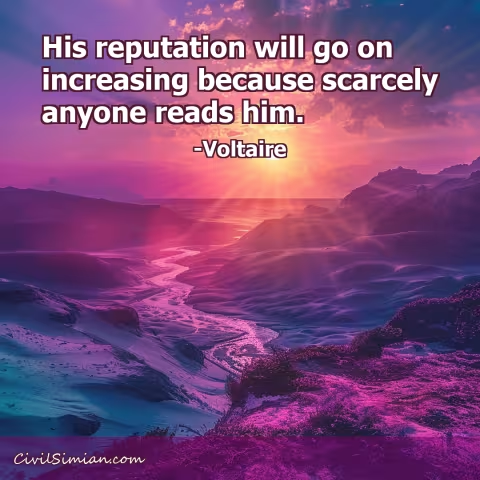
His reputation will go on increasing because scarcely anyone reads him.
▼
Source
source
"Dante", 1765
1 month 3 weeks ago
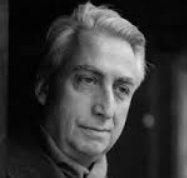
The bourgeoisie hides the fact that it is the bourgeoisie and thereby produces myth; revolution announces itself openly as revolution and thereby abolishes myth.
▼
Source
source
p. 146

3 months 1 week ago
Have no mean hours, but be grateful for every hour, and accept what it brings. The reality will make any sincere record respectable. No day will have been wholly misspent, if one sincere, thoughtful page has been written. Let the daily tide leave some deposit on these pages, as it leaves sand and shells on the shore. So much increase of terra firma. this may be a calendar of the ebbs and flows of the soul; and on these sheets as a beach, the waves may cast up pearls and seaweed.
▼
Source
source
July 6, 1840
1 month 3 weeks ago
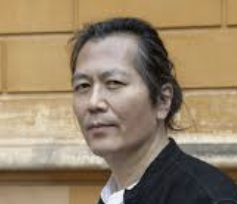
In contrast to festivals, events do not create community.
3 months 3 weeks ago
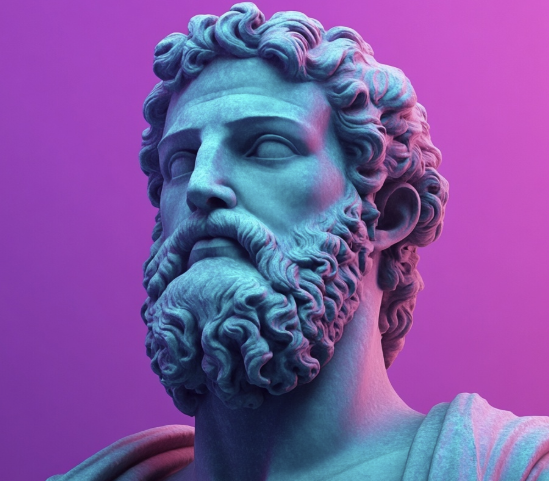
If what the philosophers say be true,—that all men's actions proceed from one source; that as they assent from a persuasion that a thing is so, and dissent from a persuasion that it is not, and suspend their judgment from a persuasion that it is uncertain, so likewise they seek a thing from a persuasion that it is for their advantage.
▼
Source
source
Book I, ch. 18, 1.
3 weeks 3 days ago
The gradual spread of sterility in seeding plants would result in a global catastrophe that could eventually wipe out higher life forms, including humans, from the planet.
▼
Source
source
On the terminator gene, from the book "Stolen Harvest: The Hijacking of the Global Food Supply" (2001), p.83
1 month 6 days ago
There is no general reason to expect evolution to be progressive - even in the weak, value-neutral sense. There will be times when increased size of some organ is favoured and other times when decreased size is favoured. Most of the time, average-sized individuals will be favoured in the population and both extremes will be penalised. During these times the population exhibits evolutionary stasis (i.e., no change) with respect to the factor being measured. If we had a complete fossil record and looked for trends in some particular dimension, such as leg length, we would expect to see periods of no change alternating with fitful continuations or reversals in direction - like a weathervane in changeable, gusty weather.
3 months 1 week ago
Instinct leads, intelligence does but follow.
▼
Source
source
Statement of 1902 quoted in The William James Reader (2007), Vol I, p. 264

3 months 2 weeks ago
Now as we call every thing custom, which proceeds from a past repetition, without any new reasoning or conclusion, we may establish it as a certain truth, that all the belief, which follows upon any present impression, is deriv'd solely from that origin.
▼
Source
source
Part 3, Section 8

3 months 1 week ago
No nation was ever so virtuous as each believes itself, and none was ever so wicked as each believes the other.
▼
Source
source
Justice in War-Time (1916), p. 70

1 month 3 weeks ago
The heart, oddly enough, seems to be the essential organ concerned. When we are in a hurry or doing something we dislike, we clench the heart, exactly like clenching a fist, and nothing can get in. When we are filled with a sense of multiplicity and excitement we somehow 'open' the heart and allow reality to flow in. But in that state we only need to entertain the shadow of some unpleasant thought for it to close again. And human beings are so naturally prone to mistrust that it is hard to maintain the openness for very long. Children on the other hand find it easy to slip into states of wonder and delight when the heart finally opens so wide that the whole world seems magical. the 'trick' of the peak experience lies in this ability to relax out of our usual defensive posture and to 'open the heart'.
▼
Source
source
p. 360
1 month 3 weeks ago
The most important misunderstanding seems to me to lie in a confusion between the human necessities which I consider part of human nature, and the human necessities as they appear as drives, needs, passions, etc., in any given historical period. This division is not very different from Marx's concept of "human nature in general", to be distinguished from "human nature as modified in each historical period". The same distinction exists in Marx when he distinguishes between "constant" or "fixed" drives and "relative" drives. The constant drives "exist under all circumstances and ... can be changed by social conditions only as far as form and direction are concerned". The relative drives "owe their origin only to a certain type of social organization".
1 month 3 weeks ago
Ethics occupies a central place in philosophy because it is concerned with sin, with the origin of good and evil and with moral valuations. And since these problems have a universal significance, the sphere of ethics is wider than is generally supposed. It deals with meaning and value and its province is the world in which the distinction between good and evil is drawn, evaluations are made and meaning is sought.
▼
Source
source
The Destiny of Man (1931), p. 15
3 months 1 week ago
So long as antimilitarists propose no substitute for war's disciplinary function, no moral equivalent of war, analogous, as one might say, to the mechanical equivalent of heat, so long they fail to realize the full inwardness of the situation.
▼
Source
source
The Moral Equivalent of War
3 months 1 week ago
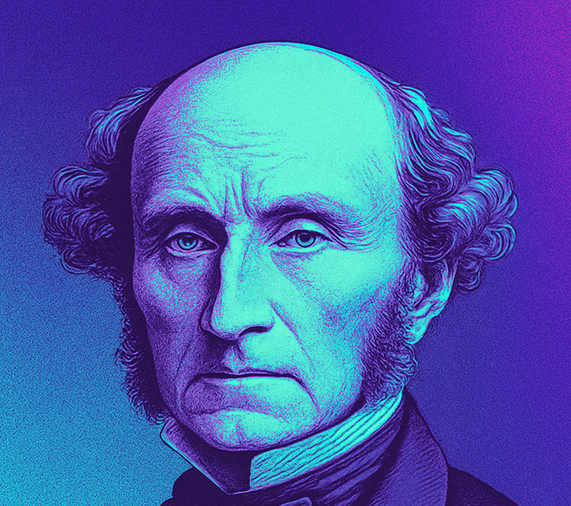
The application of algebra to geometry... far more than any of his metaphysical speculations, has immortalized the name of Descartes, and constitutes the greatest single step ever made in the progress of the exact sciences.
▼
Source
source
An Examination of Sir William Hamilton's Philosophy (1865) as quoted in 5th ed. (1878) p. 617.
Just now
Excellence is an art won by training and habituation: we do not act rightly because we have virtue or excellence, but we rather have these because we have acted rightly; 'these virtues are formed in man by his doing the actions'; we are what we repeatedly do. Excellence, then, is not an act but a habit: 'the good of man is a working of the soul in the way of excellence in a complete life... for as it is not one swallow or one fine day that makes a spring, so it is not one day or a short time that makes a man blessed and happy'.
▼
Source
source
p. 87; the quoted phrases within the quotation are from the Nicomachean Ethics, Book II, 4; Book I, 7

1 month 1 week ago
While Poe and the Symbolists were exploring the irrational in literature, Freud had begun to explore the resonant figure/ground double-plot of the conscious and unconscious.
▼
Source
source
p. 52
3 months 1 week ago
This world is but canvas to our imaginations.
1 month 1 week ago
Speech structures the abyss of mental and acoustic space...it is a cosmic, invisible architecture of the human dark.
▼
Source
source
(p. 13)
1 month 3 weeks ago
Power turns pure being into a having.
3 months 5 days ago
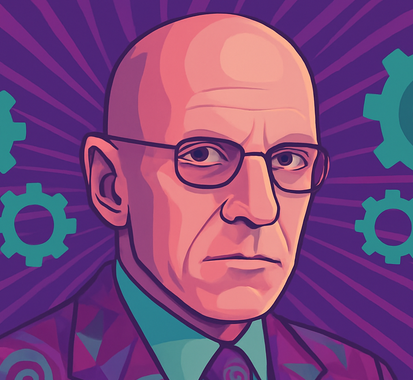
Between the fine point of the brush and the steely gaze, the scene is about to yield up its volume.
▼
Source
source
Las Meninas
2 months 1 week ago
On its pass through finitude, the being-for-itself of the counter-image expresses itself most potently as ""I-ness", as self-identical individuality. Just as a planet in its orbit no sooner reaches its farthest distance from the center than it returns to its closest proximity, so the point of the farthest distance from God, the I-ness, is also the moment of its return to the Absolute, of the re-absorption into the ideal.
▼
Source
source
P. 30
1 month 1 week ago
Literate man, civilized man, tends to restrict and to separate functions, whereas tribal man has freely extended the form of his body to include the universe.
▼
Source
source
(p. 117)

3 months 1 week ago
I need Christ, not something that resembles Him.
2 months 2 days ago
If we ignore the prior work of attention and notice only the emptiness of the moment of choice we are likely to identify freedom with the outward movement since there is nothing else to identify it with. But if we consider what the work of attention is like, how continuously it goes on, and how imperceptibly it builds up structures of value round about us, we shall not be surprised that at crucial moments of choice most of the business of choosing is already over.
▼
Source
source
The Sovereignty of Good (1970) p. 36.
3 months 1 week ago
Man ought to be content, it is said; but with what?
▼
Source
source
Pensées, Remarques, et Observations de Voltaire; ouvrage posthume (1802)

1 month 3 weeks ago
The oneness of the universe, and the oneness of each element of the universe, repeat themselves to the crack of doom in the creative advance from creature to creature, each creature including in itself the whole of history and exemplifying the self-identity of things and their mutual diversities.
▼
Source
source
Pt. III, ch. 1, sec. 7.
3 months 1 week ago
Revolutionaries do not make revolutions! The revolutionaries are those who know when power is lying in the street and when they can pick it up. Armed uprising by itself has never yet led to revolution.
▼
Source
source
"Thoughts on Politics and Revolution: A Commentary"


1 day ago
"By what method or methods can the able men from every rank of life be gathered, as diamond-grains from the general mass of sand: the able men, not the sham-able;-and set to do the work of governing, contriving, administering and guiding for us!" It is the question of questions. All that Democracy ever meant lies there: the attainment of a truer and truer Aristocracy, or Government again by the Best.
3 months 3 weeks ago
The fellow who eggs you on to avenge yourself will rob you of what you were going to say, as we forgive our debtors. When you have forfeited that, all your sins will be held against you; absolutely nothing is forgiven.
▼
Source
source
2.382673611
1 month 3 days ago
The ethical life... is maintained in being by a common culture, which also upholds the togetherness of society... Unlike the modern youth culture, a common culture sanctifies the adult state, to which it offers rites of passage.
▼
Source
source
"Idle Hands" (p. 127)

2 months 6 days ago
Jean Paul calls the most important night of his life the one when he discovered there was no difference between dying the next day or in thirty years. A revelation as significant as it is futile; if we occasionally manage to grasp its cogency, we resist on the other hand drawing its consequences, in immediacy the difference in question seeming to each of us somehow irreducible, even absolute: to exist is to prove that we have not understood to what point it is all one and the same thing to die now or no matter when.
1 month 2 weeks ago
Second, we make no distinction between man and nature: the human essence of nature and the natural essence of man become one within nature in the form of production or industry, just as they do within the life of man as a species. Industry is then no longer considered from the extrinsic point of view of utility, but rather from the point of view of its fundamental identity with nature as production of man and by man.
▼
Source
source
The Desiring Machine

1 month 3 weeks ago
Everything in me that conspires to break the unity and continuity of my life conspires to destroy me and consequently to destroy itself. Every individual in a people who conspires to break the spiritual unity and continuity of that people tends to destroy it and to destroy himself as a part of that people.

2 months 1 week ago
Those who give and those who receive arbitrary power are alike criminal; and there is no man but is bound to resist it to the best of his power, wherever it shall show its face to the world. It is a crime to bear it, when it can be rationally shaken off. Nothing but absolute impotence can justify men in not resisting it to the utmost of their ability.
▼
Source
source
Speech in opening the impeachment of Warren Hastings (16 February 1788), quoted in The Works of the Right Honourable Edmund Burke, Volume the Ninth (1899), p. 458
2 months 1 week ago
Pantheism makes God into a present, real, and material being; empiricism - to which rationalism also belongs - makes God into an absent, remote, unreal, and negative being. Empiricism does not deny God existence, but denies him all positive determinations, because their content is supposed to be only finite and empirical; the infinite cannot, therefore, be an object for man. But the more determinations I deny to a being, the more do I cut it of[ from myself, and the less power and influence do I concede to it over me, the freer do I make myself of it. The more qualities I possess, the more I am for others, and the greater is the extent of my influence and effects. And the more one is, the more one is known to others. Hence, each negation of an attribute of God is a partial atheism, a sphere of godlessness.
▼
Source
source
Part I, Section 16

2 months 2 weeks ago
He was as great as a man can be without morality.
▼
Source
source
Said of Napoleon (1842)
3 months 1 week ago
The history of science, like the history of all human ideas, is a history of irresponsible dreams, of obstinacy, and of error. But science is one of the very few human activities - perhaps the only one - in which errors are systematically criticized and fairly often, in time, corrected. This is why we can say that, in science, we often learn from our mistakes, and why we can speak clearly and sensibly about making progress there.
▼
Source
source
Ch. 1 "Science : Conjectures and Refutations"

3 months 1 week ago
Despotic government supports itself by abject civilization, in which debasement of the human mind, and wretchedness in the mass of the people, are the chief criterions. Such governments consider man merely as an animal; that the exercise of intellectual faculty is not his privilege; that he has nothing to do with the laws but to obey them; and they politically depend more upon breaking the spirit of the people by poverty, than they fear enraging it by desperation.
▼
Source
source
Means by Which the Fund Is to Be Created

6 days ago
In the same way that the figure of the peasant tends to disappear, so too does the figure of the industrial worker, the service industry worker and all other separate categories.
▼
Source
source
125

2 months 2 weeks ago
The heart of man is the place the devil dwells in; I feel sometimes a hell within myself.
▼
Source
source
Section 51

3 months 2 weeks ago
The ancient Egyptians had a superstitious antipathy to the sea; a superstition nearly of the same kind prevails among the Indians; and the Chinese have never excelled in foreign commerce.
▼
Source
source
Chapter V, p. 402.

3 months 2 weeks ago
The value of life lies not in the length of days, but in the use we make of them... Whether you find satisfaction in life depends not on your tale of years, but on your will.
▼
Source
source
Book I, Ch. 20

2 months 3 days ago
One who seeks will find, and for one who knocks it will be opened.
4 months 1 week ago
This fact, that the opposite of sin is by no means virtue, has been overlooked. The latter is partly a pagan view, which is content with a merely human standard, and which for that very reason does not know what sin is, that all sin is before God. No, the opposite of sin is faith.
3 months 2 weeks ago
If we allow them any influence in our conscience, they become the cloak of evil, heresies and blasphemies.
▼
Source
source
Marthin Luther, Comment, ad Galat., 310. As cited by Rev. Msgr. Patrick F. O'Hare (1916), The Facts about Luther, p. 119. OCLC 4200594.
CivilSimian.com created by AxiomaticPanic, CivilSimian, Kalokagathia