


1 month 1 day ago
There will be a time when those trying to turn the world into a Colosseum for their own amusement will be raw meat thrown to the wolves themselves, and the rest of us will watch, as justice is served, with a clean conscience.
3 weeks ago
The educated man is the man who does not live in immediate intuition, but in his recollection so that little is new to him any longer.
▼
Source
source
Chapter 4, Philosophy As Writing: The Case Of Hegel, p. 74

2 months 2 weeks ago
Justice is the first virtue of those who command, and stops the complaints of those who obey.
▼
Source
source
As quoted in The Golden Treasury of Thought : A Gathering of Quotations from the Best Ancient and Modern Authors (1873) by Theodore Taylor, p. 227
3 months 1 week ago
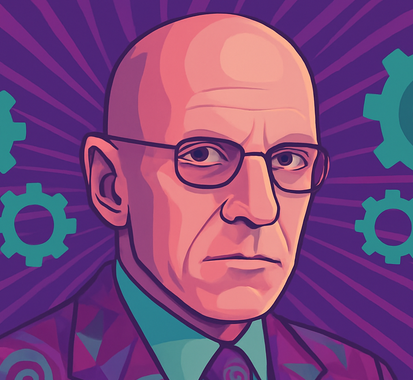
The soul is the prison of the body.
▼
Source
source
Discipline and Punish (1977) as translated by Alan Sheridan, p. 30

1 month 1 week ago
Environments work us over and remake us. It is man who is the content of and the message of the media, which are extensions of himself. Electronic man must know the effects of the world he has made above all things.
▼
Source
source
(p. 90)

2 months 1 week ago
As far as we can discern, the sole purpose of human existence is to kindle a light in the darkness of mere being.
▼
Source
source
p. 326

3 months 1 week ago
Men go to a fire for entertainment. When I see how eagerly men will run to a fire, whether in warm or in cold weather, by day or by night, dragging an engine at their heels, I'm astonished to perceive how good a purpose the level of excitement is made to serve.
▼
Source
source
June, 1850

3 months 1 week ago
We will not go to Heaven,Goetz, and even if we both entered it, we would not have eyes to see each other, nor hands to touch each other. Up there, God gets all the attention.... We can only love on this earth and against God.
▼
Source
source
Acts 8 & 9

3 months 2 weeks ago
Faith is born and preserved in us by preaching why Christ came, what he brought and gave to us, and the benefits we obtain when we receive him. This happens when Christian liberty - which he gives to us - is rightly taught and we are told in what way as Christians we are all kings and priests and therefore lords of all.
▼
Source
source
p. 70
1 month 4 weeks ago
I can assure you that no kingdom has ever had as many civil wars as the kingdom of Christ.
▼
Source
source
No. 29. (Rica writing to Ibben)
4 months 1 week ago
Moreover, there is a victory and defeat, the first and best of victories, the lowest and worst of defeat, which each man gains or sustains at the hands, not of another, but of himself; this shows that there is a war against ourselves going on within every one of us. Book I Sometimes paraphrased as "The first and best victory is to conquer self".

1 month 1 week ago
Humanity unceasingly strives forward from a lower, more partial and obscure understanding of life to one more general and more lucid. And in this, as in every movement, there are leaders - those who have understood the meaning of life more clearly than others - and of those advanced men there is always one who has in his words and life, manifested this meaning more clearly, accessibly, and strongly than others. This man's expression ... with those superstitions, traditions, and ceremonies which usually form around the memory of such a man, is what is called a religion. Religions are the exponents of the highest comprehension of life ... within a given age in a given society ... a basis for evaluating human sentiments. If feelings bring people nearer to the religion's ideal ... they are good, if these estrange them from it, and oppose it, they are bad.
4 months 1 week ago
I shall assume that your silence gives consent.

4 months 2 days ago
Things have their root and their branches. Affairs have their end and their beginning. To know what is first and what is last will lead near to what is taught in the Great Learning.

1 week 1 day ago
Beginning in the 1970s, however, the techniques and organizational form of industrial production shifted toward smaller and more mobile labor units and more flexible structures of production, a shift often labeled as a move from Fordist to post-Fordist production.
▼
Source
source
82

3 months 2 weeks ago
For it is extremely absurd to expect to be enlightened by reason, and yet to prescribe to her beforehand on which side she must incline.
▼
Source
source
A 747, B 775; as translated by F. Max Mueller

2 months 1 week ago
A certain maxim of Logic which I have called Pragmatism has recommended itself to me for diverse reasons and on sundry considerations. Having taken it as my guide for most of my thought, I find that as the years of my knowledge of it lengthen, my sense of the importance of it presses upon me more and more. If it is only true, it is certainly a wonderfully efficient instrument. It is not to philosophy only that it is applicable. I have found it of signal service in every branch of science that I have studied. My want of skill in practical affairs does not prevent me from perceiving the advantage of being well imbued with pragmatism in the conduct of life.
▼
Source
source
Lecture I : Pragmatism : The Normative Sciences, CP 5.14
3 months 1 week ago
If there is a kind of "proof" of the sincerity of the parrhesiastes, it is his courage... Saying something dangerous-different from what the majority believes-is a strong indication that he is a parrhesiastes.
6 days ago
This shows, perhaps, why we have tried to put all physical phenomena into the same frame. But that can not pass for a definition of simultaneity, since this hypothetical intelligence, even if it existed, would be for us impenetrable. It is... necessary to seek something else.
3 months 3 weeks ago
Like strawberry wives, that laid two or three great strawberries at the mouth of their pot, and all the rest were little ones.
▼
Source
source
No. 54
3 months 1 week ago
Today, criminal justice functions and justifies itself only by this perpetual reference to something other than itself, by this unceasing reinscription in non-juridical systems.
3 months 2 weeks ago
Lawyers are the only persons in whom ignorance of the law is not punished.
▼
Source
source
Attributed to Bentham in The Dictionary of Humorous Quotations (1949) by Evan Esar, p. 29; no earlier sources for this have been located.

2 months 5 days ago
Whoever believes and is baptized will be saved, but whoever does not believe will be condemned. And these signs will accompany those who believe: In my name they will drive out demons; they will speak in new tongues; they will pick up snakes with their hands; and when they drink deadly poison, it will not hurt them at all; they will place their hands on sick people, and they will get well.
▼
Source
source
Jesus, Mark 16:16-18
1 month 1 week ago
In order that men should embrace the truth - not in the vague way they did in childhood, nor in the one-sided and perverted way presented to them by their religious and scientific teachers, but embrace it as their highest law the complete liberation of this truth from all and every superstition (both pseudo-religious and pseudo-scientific) by which it is still obscured is essential: not a partial, timid attempt, reckoning with traditions sanctified by age and with the habits of the people - not such as was effected in the religious sphere by Guru Nanak, the founder of the sect of the Sikhs, and in the Christian world by Luther, and by similar reformers in other religions - but a fundamental cleansing of religious consciousness from all ancient religious and modern scientific superstitions.
▼
Source
source
VI

3 months 1 week ago
Things added to things, as statistics, civil history, are inventories. Things used as language are inexhaustibly attractive.
▼
Source
source
Plato; or, The Philosopher

1 month 3 weeks ago
Passion, intellect, moral activity - these three have never been satisfied in a woman. In this cold and oppressive conventional atmosphere, they cannot be satisfied. To say more on this subject would be to enter into the whole history of society, of the present state of civilisation.

2 weeks 5 days ago
In Kleist's essay humans are caught between the graceful automatism of the puppet and the conscious freedom of a god. The jerky, stuttering quality of their actions comes from their feeling that they must determine the course of their lives. Other animals live without having to choose their path through life. Whatever uncertainty they may feel sniffing their way through the world is not a permanent condition; once they reach a place of safety, they are at rest. In contrast, human life is spent anxiously deciding how to live.
▼
Source
source
The Faith of Puppets: Leopardi and the Souls of Machines (p.25-6)

3 months 1 week ago
Nothing is yet in its true form.
2 months 4 days ago
... classic philosophy maintained that change, and consequently time, are marks of inferior reality, holding that true and ultimate reality is immutable and eternal. Human reasons, all too human, have given birth to the idea that over and beyond the lower realm of things that shift like the sands on the seashore there is the kingdom of the unchanging, of the complete, the perfect. The grounds for the belief are couched in the technical language of philosophy, but the grounds for the cause is the heart's desire for surcease from change, struggle, and uncertainty. The eternal and immutable is the consummation of mortal man's quest for certainty.
1 month 3 weeks ago
I retain my faith in the humanist tradition, that it's possible to deal with discrepant experiences truthfully without resolving into simple things like only women should write about women, only Chicanos should write about Chicanos, only Latinos should write about Latinos... I think that's the most damaging crime, and misapprehension of what I'm saying. That's why they debate all these things and they trace them back to me and people say 'you did that!' Absolutely not. I'm talking from a universalistic, if you like cosmopolitan point of view to which I adhere and which is the only way the world makes sense to me. I don't believe in the politics of identity, although in many ways paradoxically I seem to be the father of identity politics, but it's a thing I totally disbelieve in because I realise the damage that identities have done.
▼
Source
source
Interview with Michaël Zeeman for Leven en Werken
4 months 2 days ago
The institutions of the Ruler are rooted in his own character and conduct, and sufficient attestation of them is given by the masses of the people. He examines them by comparison with those of the three kings, and finds them without mistake. He sets them up before Heaven and Earth, and finds nothing in them contrary to their mode of operation. He presents himself with them before spiritual beings, and no doubts about them arise. He is prepared to wait for the rise of a sage a hundred ages after, and has no misgivings. His presenting himself with his institutions before spiritual beings, without any doubts arising about them, shows that he knows Heaven. His being prepared, without any misgivings, to wait for the rise of a sage a hundred ages after, shows that he knows men.

1 month 1 week ago
The loss which is unknown is no loss at all.
▼
Source
source
Maxim 38
2 months 1 week ago
The Teutons believed that the only possible way to get rid of barbarism was to become Romans. The immigrants to what was formerly Roman soil became as Roman as they possibly could. But in their imagination the term "barbarous" soon acquired the secondary meaning of " common, plebeian, and loutish," and in this way "Roman," on the contrary, became synonymous with " distinguished."
▼
Source
source
Consequences of the Difference p. 81

1 month 4 weeks ago
Progress usually comes from the barbarian, and there is nothing more stagnant than the philosophy of the philosophers and the theology of the theologians.

1 month 3 weeks ago
Do not all theists insist that there can be no morality, no justice, honesty or fidelity without the belief in a Divine Power? Based upon fear and hope, such morality has always been a vile product, imbued partly with self-righteousness, partly with hypocrisy. As to truth, justice, and fidelity, who have been their brave exponents and daring proclaimers? Nearly always the godless ones: the Atheists; they lived, fought, and died for them. They knew that justice, truth, and fidelity are not conditioned in heaven, but that they are related to and interwoven with the tremendous changes going on in the social and material life of the human race; not fixed and eternal, but fluctuating, even as life itself.

2 months 2 weeks ago
The universe comprises all being in a totality; for nothing that exists is outside or beyond infinite being, as the latter has no outside or beyond.
3 months 1 week ago
Before mass leaders seize the power to fit reality to their lies, their propaganda is marked by its extreme contempt for facts as such, for in their opinion fact depends entirely on the power of man who can fabricate it.
▼
Source
source
On "alternate facts"
3 months 1 week ago
The critique of the highest values hitherto does not simply refute them or declare them invalid. It is rather a matter of displaying their origins as impositions which must affirm precisely what ought to be negated by the values established.
▼
Source
source
p. 26
1 month 2 weeks ago
Our design, not respecting arts, but philosophy, and our subject, not manual, but natural powers, we consider chiefly those things which relate to gravity, levity, elastic force, the resistance of fluids, and the like forces, whether attractive or impulsive; and therefore we offer this work as mathematical principles of philosophy; for all the difficulty of philosophy seems to consist in this - from the phenomena of motions to investigate the forces of nature, and then from these forces to demonstrate the other phenomena...
▼
Source
source
Preface

4 months 1 week ago
Science fiction may be defined as that branch of literature which deals with the response of human beings to advances in science and technology. Actual change in science and technology, occurring quickly enough and striking deeply enough to affect a human being in the course of his normal lifetime, is a phenomenon peculiar to the world only since the Industrial Revolution ... The first well-known writer who responded to this new factor in human affairs by dealing regularly with science fiction, by studying the effect of additional scientific advance upon mankind ... was Jules Verne. In the English language, the early master was H. G. Wells. Between them, they laid the foundation for every theme upon which science fiction writers have been ringing variations ever since.
1 month 2 weeks ago
You need to know at least one foreign language well enough so that you can read the best literature that that language has produced in the original, and so you carry on a reasonable conversation and have dreams in that language. There are several reasons why this is crucial, but the most important is perhaps this: you can never understand one language until you understand at least two.
2 months 3 days ago
At one time in his life the apostate radically changes his political, religious or philosophical convictions by taking up all possible means of argumentation against that which he formerly held to be true, and lives now for the sake of its negation. His new ideas and opinions consist in continuous acts of revenge on his spiritual past.
▼
Source
source
Manfred Frings, Max Scheler (1996), p. 60

4 months 2 days ago
The end of living, or the ultimate good, which is to be sought for its own sake, according to the universal opinion of mankind, is happiness; yet men, for the most part, fail in the pursuit of this end, either because they do not form a right idea of the nature of happiness, or because they do not make use of proper means to attain it.

2 months 1 week ago
The arrogance of age must submit to be taught by youth.
▼
Source
source
Letter to Frances Burney

4 months 1 week ago
Metaphysical rebellion is a claim, motivated by the concept of a complete unity, against the suffering of life and death and a protest against the human condition both for its incompleteness, thanks to death, and its wastefulness, thanks to evil.
1 month 1 week ago
The future masters of technology will have to be lighthearted and intelligent. The machine easily masters the grim and the dumb.
▼
Source
source
(p. 55)
1 month 1 day ago
Your Constitution is all sail and no anchor.
▼
Source
source
Letter to H.S. Randall, author of a Life of Thomas Jefferson

2 months 2 weeks ago
Were the happiness of the next world as closely apprehended as the felicities of this, it were a martyrdom to live.
▼
Source
source
Chapter IV
CivilSimian.com created by AxiomaticPanic, CivilSimian, Kalokagathia