


4 months 3 weeks ago
Blessed are the hearts that can bend; they shall never be broken.

1 week 2 days ago
But he has no fear; unconquered he looks down from a lofty height upon his sufferings.
4 months 2 days ago
You must not murder. (Exodus 20:13) Q. What does this mean? A. We should fear and love God so that we may not hurt or harm our neighbor in his body, but help and befriend him in every bodily need [in every need and danger of life and body].
3 months 3 weeks ago
The point, as Marx saw it, is that dreams never come true.
▼
Source
source
"On Violence"

4 months 2 days ago
No matter that we may mount on stilts, we still must walk on our own legs. And on the highest throne in the world, we still sit only on our own bottom.
▼
Source
source
Ch. 13

3 months 3 weeks ago
All of the other people have committed crimes, the Jews are the only ones who have boasted about committing them. They are, all of them, born with raging fanaticism in their hearts, just as the Bretons and the Germans are born with blond hair. I would not be in the least bit surprised if these people would not some day become deadly to the human race.
▼
Source
source
Lettres de Memmius a Cicéron, 1771
1 month 2 weeks ago
I've never been an optimist but that's fine because pessimists have the possibility of being agreeably surprised, and that's a reason for being pessimistic, but I've always defended a certain kind of pessimism because what is known as optimism is really a collection of illusions and I think one must recognise what all religious people know, which is that human beings are imperfect and fallen and there's no way in which they can alone surmount the problems which they themselves create.
▼
Source
source
From an interview with George Eaton "The Roger Scruton interview: the full transcript", New Statesman

2 months 2 weeks ago
The notion of nothingness is not characteristic of laboring humanity: those who toil have neither time nor inclination to weigh their dust; they resign themselves to the difficulties or the doltishness of fate; they hope: hope is a slave's virtue.
1 week 2 days ago
Friendship is always helpful, but love sometimes even does harm
2 weeks ago
Wisdom, if it were young, would cherish love, nursing it with devotion, deepening it with sacrifice, vitalizing with parentage, making all things subordinate to it till the end. Even though it consumes us in its service and overwhelms us with tragedy, even though it breaks us down with separations, let it be first. How can it matter what price we pay for love?
▼
Source
source
Ch. 2 : On Youth
4 months 2 weeks ago
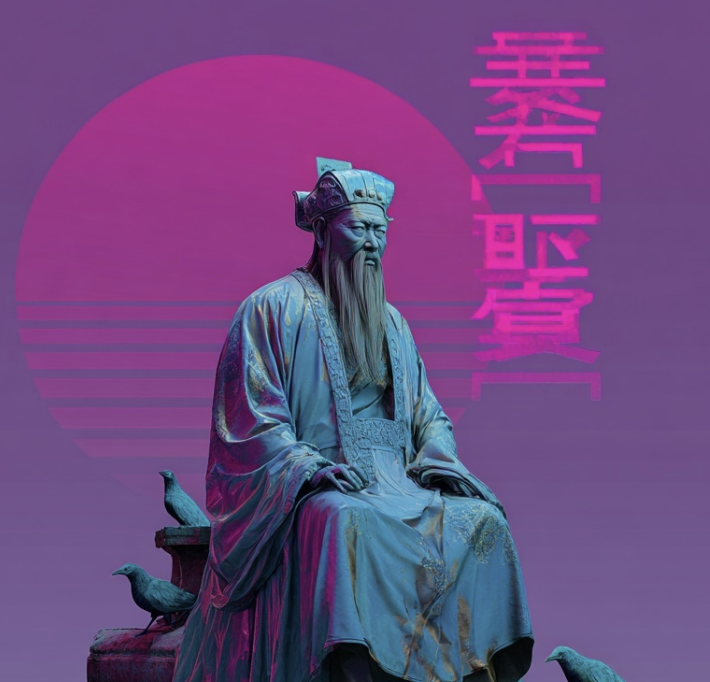
Things have their root and their branches. Affairs have their end and their beginning. To know what is first and what is last will lead near to what is taught in the Great Learning.

3 months 6 days ago
Dispose thy Soul to all good and necessary things!
2 months 3 weeks ago
The benefit of the governed is made to lie on one side and the benefit of the governors on the other.
▼
Source
source
Book III, Chapter 9

3 months 4 weeks ago
When the profits of trade happen to be greater than ordinary, over-trading becomes a general error both among great and small dealers.
▼
Source
source
Chapter I, p. 469.
3 months 2 weeks ago
Plato has preserved in the Theaetetus - the story is that Thales, while occupied in studying the heavens above and looking up, fell into a well. A good-looking and whimsical maid from Thrace laughed at him and told him that while he might passionately want to know all things in the universe, the things in front of his very nose and feet were unseen by him." Plato added: "This jest also fits all those who become involved in Philosophy." Therefore, the question, What is a thing?" must always be rated as one that causes housemaids to laugh.
▼
Source
source
p. 3
2 months 2 weeks ago
That history just unfolds, independently of a specified direction, of a goal, no one is willing to admit.

3 months 3 weeks ago
I feel like that intellectual but plain-looking lady who was warmly complimented on her beauty. In accepting his Nobel Prize, in December 1950; Russell denied that he had contributed anything in particular to literature.
▼
Source
source
Quoted in LIFE, Editorials: "A great mind is still annoying and adorning our age", 26 May 1952

2 weeks 1 day ago
All work, even cotton spinning, is noble; work is alone noble ... A life of ease is not for any man, nor for any god.
▼
Source
source
Bk. III, ch. 4.

3 months 3 weeks ago
The New Testament is an invaluable book, though I confess to having been slightly prejudiced against it in my very early days by the church and the Sabbath school, so that it seemed, before I read it, to be the yellowest book in the catalogue. Yet I early escaped from their meshes. It was hard to get the commentaries out of one's head and taste its true flavor. - I think that Pilgrim's Progress is the best sermon which has been preached from this text; almost all other sermons that I have heard, or heard of, have been but poor imitations of this. - It would be a poor story to be prejudiced against the Life of Christ because the book has been edited by Christians.
1 month 3 weeks ago
The public health authorities never mention the main reason many Americans have for smoking heavily, which is that smoking is a fairly sure, fairly honorable form of suicide.
▼
Source
source
Preface (p. xi)
2 months 2 weeks ago
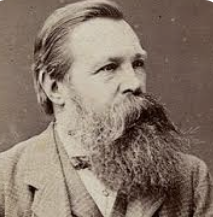
The introduction of free competition is thus public declaration that from now on the members of society are unequal only to the extent that their capitals are unequal, that capital is the decisive power, and that therefore the capitalists, the bourgeoisie, have become the first class in society. Free competition is necessary for the establishment of big industry, because it is the only condition of society in which big industry can make its way.
2 months 2 weeks ago
With success and a literary career one becomes an unquestioning part of the mechanism, whereas the only truly important years are those in which one is unknown.

3 months 3 weeks ago
When all is said and done, we are in the end absolutely dependent on the universe; and into sacrifices and surrenders of some sort, deliberately looked at and accepted, we are drawn and pressed as into our only permanent positions of repose. Now in those states of mind which fall short of religion, the surrender is submitted to as an imposition of necessity, and the sacrifice is undergone at the very best without complaint. In the religious life, on the contrary, surrender and sacrifice are positively espoused: even unnecessary givings-up are added in order that the happiness may increase. Religion thus makes easy and felicitous what in any case is necessary; and if it be the only agency that can accomplish this result, its vital importance as a human faculty stands vindicated beyond dispute. It becomes an essential organ of our life, performing a function which no other portion of our nature can so successfully fulfill.
▼
Source
source
Lecture II, "Circumscription of the Topic"

3 months 3 weeks ago
Manufacture was all the time sheltered by protective duties in the hoe market, by monopolies in the colonial market, and broad as much as possible by differential duties.
▼
Source
source
ibid, pp. 183
3 months 3 weeks ago
As we passed under the last bridge over the canal, just before reaching the Merrimack, the people coming out of church paused to look at us from above, and apparently, so strong is custom, indulged in some heathenish comparisons; but we were the truest observers of this sunny day.
2 weeks ago
Children and fools speak the truth; and somehow they find happiness in their sincerity.
▼
Source
source
Ch. 1 : Our life begins
1 month 1 day ago
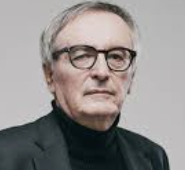
Darwinist thinkers such as Richard Dawkins and Daniel Dennett are militant opponents of Christianity. Yet their atheism and humanism are versions of Christian concepts. As a defender of Darwinism, Dawkins is committed to the view that humans are like other animal species in being 'gene machines' ruled by the laws of natural selection. He asserts nevertheless that humans, uniquely, can defy these natural laws: 'We, alone on earth, can rebel against the tyranny of the selfish replicators.' In affirming human uniqueness in this way, Dawkins relies on a Christian world-view.
▼
Source
source
Post-Apocalypse: After Secularism (pp. 265-6)

3 months 4 weeks ago
Theologian: But what is to love? Philosopher: To be delighted by the happiness of another.
▼
Source
source
Confessio philosophi, 1673

2 months 1 week ago
The full expression of personality depends upon its being inflated by social prestige; it is a social privilege.
▼
Source
source
p. 64

3 months ago
No man can justly censure or condemn another, because indeed no man truly knows another.
▼
Source
source
Section 4
3 months 3 weeks ago
There is but one indefectibly certain truth, and that is the truth that pyrrhonistic scepticism itself leaves standing, - the truth that the present phenomenon of consciousness exists.
▼
Source
source
The Will to Believe, 1897

1 month 3 weeks ago
The criminal, like the artist, is a social explorer.
▼
Source
source
quoted in "Marshall McLuhan, Author, Dies; Declared 'Medium Is the Message'" by Alden Whitman, The New York Times, January 1, 1981

3 months 4 weeks ago
Extreme pride or dejection indicates extreme ignorance of self.
▼
Source
source
Part IV, Prop. LV

3 months 3 weeks ago
...in order to change poverty into wealth, one must start by displaying it.
▼
Source
source
p. 420
2 months 2 weeks ago
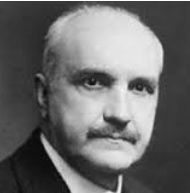
In solitude it is possible to love mankind; in the world, for one who knows the world, there can be nothing but secret or open war.
4 months 2 weeks ago
It is said in the Book of Poetry, "In silence is the offering presented, and the spirit approached to; there is not the slightest contention." Therefore the superior man does not use rewards, and the people are stimulated to virtue. He does not show anger, and the people are awed more than by hatchets and battle-axes.

2 months 4 weeks ago
"The will of the nation" is one of those expressions which have been most profusely abused by the wily and the despotic of every age.
▼
Source
source
Chapter IV.
2 months 2 weeks ago
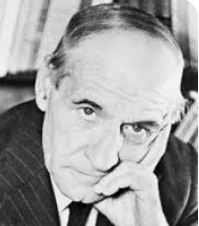
As one advances in life, one realises more and more that the majority of men - and of women - are incapable of any other effort than that strictly imposed on them as a reaction to external compulsion. And for that reason, the few individuals we have come across who are capable of a spontaneous and joyous effort stand out isolated, monumentalised, so to speak, in our experience. These are the select men, the nobles, the only ones who are active and not merely reactive, for whom life is a perpetual striving, an incessant course of training. Training = askesis. These are the ascetics.
▼
Source
source
Chap. VII: Noble Life And Common Life, Or Effort And Inertia
4 months 3 weeks ago
If the world were clear, art would not exist.
1 month 2 weeks ago
A writer who says that there are no truths, or that all truth is 'merely relative,' is asking you not to believe him. So don't.
▼
Source
source
"The Nature of Philosophy" (p. 6)
1 month 3 days ago
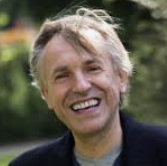
If we want eternal life, then we'll need to rewrite our bug-ridden genetic code and become god-like. "May all that have life be delivered from suffering", said Gautama Buddha. It's a wonderful sentiment. Sadly, only hi-tech solutions can ever eradicate suffering from the living world. Compassion alone is not enough.
▼
Source
source
Interview with Nick Bostrom and David Pearce, Dec. 2007

1 month 2 weeks ago
While the intellectual space does contain universal ideas, definitions, those definitions are detailed a posteriori. Truth corresponds with reality at a minimum.
3 months 2 weeks ago
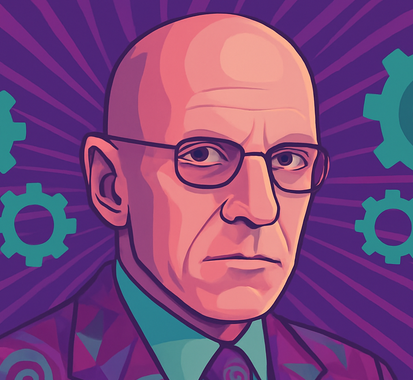
The man described for us, whom we are invited to free, is already in himself the effect of a subjection much more profound than himself. A 'soul' inhabits him and brings him to existence...the soul is the effect and instrument of political anatomy; the soul is the prison of the body.
4 months 3 weeks ago
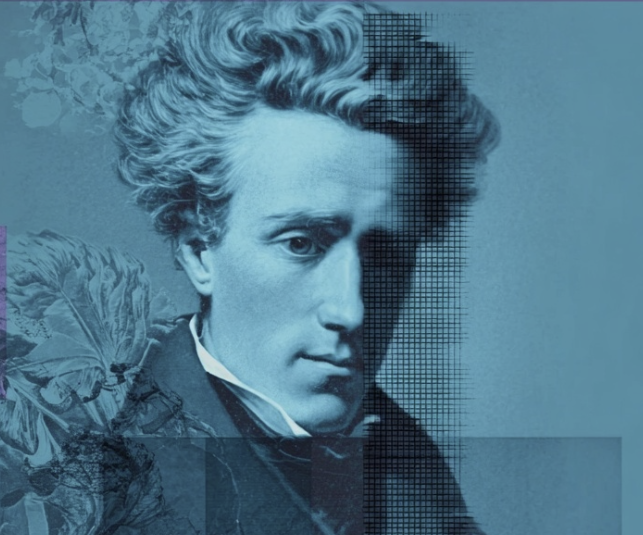
Deep within every human being there still lives the anxiety over the possibility of being alone in the world, forgotten by God, overlooked among the millions and millions in this enormous household. One keeps this anxiety at a distance by looking at the many round about who are related to him as kin and friends, but the anxiety is still there, nevertheless, and one hardly dares think of how he would feel if all this were taken away.
4 months 1 week ago
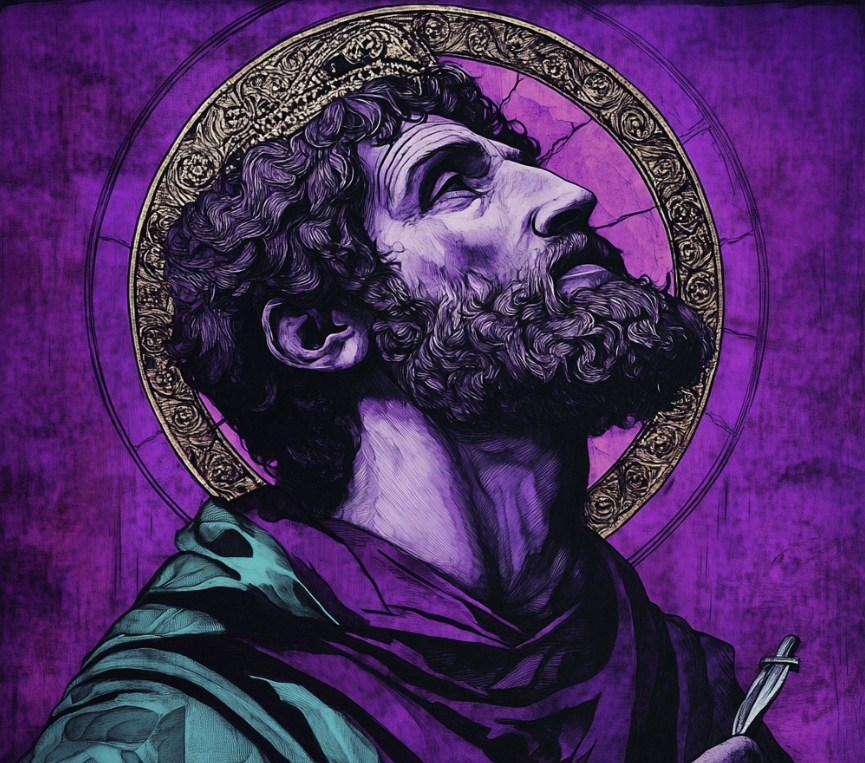
People travel to wonder at the height of mountains, at the huge waves of the sea, at the long courses of rivers, at the vast compass of the ocean, at the circular motion of the stars; and they pass by themselves without wondering.
▼
Source
source
Variant: Men go abroad to admire the heights of mountains, the mighty billows of the sea, the broad tides of rivers, the compass of the ocean, and the circuits of the stars, and pass themselves by. X
3 months 3 weeks ago
The force of the word World, as commonly used, of itself falls in with us. For no one will attribute accidents to the World as parts, but as determinations, states; hence the so-called world of the ego, unrestrained by the single substance and its accidents, is not very appositely called a World, unless, perhaps, an imaginary one.
1 month 1 week ago
I've had letters from Chinese scientists at the peak of the SARS epidemic who said the problem is a hybridization between the viruses planted into GMO feed, which is then fed to animals, then the virus jumped from the animals to humans. We're going to see more and more of these kinds of risks. I think the whole issue of the H1N1 virus was the fact that it had genes for three influenza types--human, chicken, pig. All of these crossings are becoming possible because of the crossing of genes across species barriers.
▼
Source
source
On the SARS epidemic, as quoted in "A Visit to My Kitchen: Vandana Shiva", The Huffington Post

3 months 3 weeks ago
I saw men go up and down, In the country and the town, With this tablet on their neck,- 'Judgement and a judge we seek.' Not to monarchs they repair, Nor to learned jurist's chair; But they hurry to their peers, To their kinsfolk and their dears; Louder than with speech they pray,- 'What am I? companion, say.'
▼
Source
source
Astræa
4 months 2 weeks ago
The silent treasuring up of knowledge; learning without satiety; and instructing others without being wearied: which one of these things belongs to me? To keep silently in mind what one has seen and heard, to study hard and never feel contented, to teach others tirelessly; have I done (all of) these things?
CivilSimian.com created by AxiomaticPanic, CivilSimian, Kalokagathia