
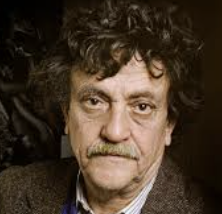
Kurt Vonnegut — The Humanist Satirist of Absurdity, War, and Fragile Hope (1922–2007)
Kurt Vonnegut was the novelist who laughed at catastrophe without trivializing it. Armed with dark humor, moral urgency, and science-fiction scaffolding, he confronted the most unsettling facts of modern life: mass violence, technological arrogance, bureaucratic cruelty, and the terrifying ease with which human beings dehumanize one another. His work insists, quietly and stubbornly, that kindness matters even when the universe appears indifferent.
A Midwestern Beginning and a World Shattered
Born in Indianapolis to a cultured but declining family, Vonnegut grew up surrounded by libraries, architecture, and dry wit. His early life was shaped by the Great Depression, which eroded his family’s social standing and instilled in him a lifelong skepticism toward American optimism.
World War II marked the decisive rupture. Captured during the Battle of the Bulge, Vonnegut survived the Allied firebombing of Dresden while imprisoned in an underground meat locker. Tens of thousands died. Civilization collapsed into ash. The experience haunted him for the rest of his life — not as heroic trauma, but as proof of how casually systems annihilate individuals.
“There is nothing intelligent to say about a massacre.”
Slaughterhouse-Five — Time, Trauma, and Anti-War Fiction
Vonnegut’s most famous novel, Slaughterhouse-Five, is not a traditional war story. It refuses heroism, chronology, and narrative comfort. Instead, it presents trauma as fractured time — moments looping, repeating, and refusing closure.
The novel’s protagonist, Billy Pilgrim, becomes “unstuck in time,” experiencing his life out of sequence. This is not science fiction as escape, but as metaphor: trauma does not move forward; it revisits.
The refrain “So it goes” follows every death, not as indifference, but as a grim acknowledgment of inevitability in a world addicted to violence.
“So it goes.”
Science Fiction as Moral Satire
Vonnegut often used science fiction — aliens, machines, imaginary technologies — not to predict the future, but to expose the present. His invented worlds exaggerate modern logic until its cruelty becomes impossible to ignore.
In Cat’s Cradle, scientific brilliance leads to global annihilation. In Player Piano, automation hollows out human purpose. In The Sirens of Titan, free will dissolves into cosmic absurdity.
Technology, Vonnegut warned, advances faster than wisdom. Intelligence without compassion is not progress — it is acceleration toward disaster.
“We are what we pretend to be, so we must be careful about what we pretend to be.”
Humanism Without Illusions
Vonnegut described himself as a humanist — but not a sentimental one. He had no faith in grand narratives, divine plans, or historical inevitability.
What he believed in instead were small decencies: mercy, humor, shared vulnerability. If the universe lacks meaning, then meaning becomes a human responsibility.
His novels are filled with damaged people doing their best in systems designed to crush them. Failure is common. Kindness is rare. That rarity makes it sacred.
“Hello babies. Welcome to Earth. It’s hot in the summer and cold in the winter. It’s round.”
Style — Simplicity as Ethical Choice
Vonnegut wrote in short sentences. Plain words. Childlike drawings. This was not laziness. It was moral discipline.
He believed that obscurity often protects cruelty, and that clear language forces responsibility. Anyone should be able to understand what is being said — especially when it concerns suffering, power, or death.
His humor disarms, then wounds, then lingers.
Public Voice and Late Years
In his later life, Vonnegut became a public moral voice — delivering commencement speeches, essays, and interviews filled with curmudgeonly wisdom. He criticized war, greed, environmental destruction, and the emptiness of corporate culture.
Yet he never claimed moral superiority. He included himself among the foolish, the frightened, the confused. His authority came from honesty, not righteousness.
Legacy — Laughing While the House Burns
Kurt Vonnegut occupies a singular place between literature, philosophy, and moral witness. He rejected both cynicism and false hope, offering instead a fragile ethic of care in an absurd world.
His work reminds us that intelligence without kindness is dangerous, that history is not a teacher, and that the smallest humane acts may be all that stands between civilization and ruin.
If there is a message beneath the jokes, it is this: be gentle. You don’t know what anyone is carrying.
“Be kind.”
CivilSimian.com created by AxiomaticPanic, CivilSimian, Kalokagathia