









2 months 3 weeks ago

Someone arrived there - who lifted the veil of the goddess, at Sais. - But what did he see? He saw - wonder of wonders - himself. Novalis here alludes to Plutarch's account of the shrine of the goddess Minerva, identified with Isis, at Sais, which he reports had the inscription "I am all that hath been, and is, and shall be; and my veil no mortal has hitherto raised."

0
0
1 month 3 weeks ago

The automated presidential surrogate is the superlative nobody.

0
0
Source
source
(p. 157)
4 months 3 weeks ago

To work and create "for nothing," to sculpture in clay, to know one's creation has no future, to see one's work destroyed in a day while being aware that fundamentally this has no more importance than building for centuries, this is the difficult wisdom that absurd thought sanctions. Performing these two tasks simultaneously, negating on the one hand and magnifying on the other, it the way open to the absurd creator. He must give the void its colors.

0
0
2 months 1 week ago

The conflicts that tear society apart resemble the distinction between the concept and the particular facts subordinated to it. ... Whatever refuses to abide by the unity imposed by the principle of dominion manifests itself not as something indifferent to that principle, but as an infringement of logic: as a contradiction.

0
0
Source
source
p. 169
1 month 2 weeks ago

The real reason people are conservatives is that they are attached to the things that they love, and want to preserve them from abuse and decay. They are attached to their family, their friends, their religion, and their immediate environment. They have made a lifelong distinction between the things that nourish and the things that threaten their security and peace of mind.

0
0
Source
source
Conservatism and the Conservatory,, National Review
3 months 3 weeks ago

War involves in its progress such a train of unforeseen and unsupposed circumstances ... that no human wisdom can calculate the end. Prospects on the Rubicon

0
0
Source
source
London: J. Debrett, 1787

The belly is an ungrateful wretch, it never remembers past favors, it always wants more tomorrow.

0
0
2 months 1 week ago

Spirit is never an object; nor a spiritual reality an objective one. In the so-called objective world there's no such nature, thing, or objective reality as spirit. Hence it is easy to deny the reality of spirit. God is spirit because he is not object, because he is subject.

0
0
Source
source
p. 10
3 months 2 weeks ago

My point is not that everything is bad, but that everything is danger­ous, which is not exactly the same as bad. If everything is dangerous, then we always have something to do. So my position leads not to apa­thy but to a hyper- and pessimistic activism. I think that the ethico-political choice we have to make every day is to determine which is the main danger. "

0
0
Source
source
On the Genealogy of Ethics: An Overview of Work in Progress." Afterword, in Hubert L. Dreyfus and Paul Rabinow, Michel Foucault: Beyond Structuralism and Hermeneutics, 2nd ed. Chicago: University of Chicago Press.
3 weeks ago

We are by no means opposed to the globalization of relationships as such-in fact, as we said, the strongest forces of Leftist internationalism have effectively led this process. The enemy, rather, is a specific regime of global relations that we call Empire.

0
0
Source
source
45-46
4 months 3 days ago

The Apostle Paul wants us to work with our hands in order to share with the needy (Ephesians 5:28). Notice that he could have said that we should work to support ourselves. But Paul says that we work to give to those in need. This is why caring for our body is also a Christian work. If the body is healthy and fit, we are able to work and save money that can be used to help those in need.

0
0
Source
source
p. 80
2 months 1 week ago

The truth is sum, ergo cogito - I am, therefore I think, although not everything that is thinks. Is not consciousness of thinking above all consciousness of being? Is pure thought possible, without consciousness of self, without personality? Can there exist pure knowledge without feeling, without that species of materiality which feelings lends to it? Do we not perhaps feel thought, and do we not feel ourselves in the act of knowing and willing? Could not the man in the stove [Descartes] have said: "I feel, therefore I am"? or "I will, therefore I am"? And to feel oneself, is it not perhaps to feel oneself imperishable?

0
0
1 month 3 weeks ago

Even a single hair casts its shadow.

0
0
Source
source
Maxim 228
1 month 4 days ago

The point is that philosophy is seen to have come full circle, and to have exhausted itself.

0
0
Source
source
Chapter 5, Nietzsche's Styles, p. 95
2 months 2 weeks ago

The man with the clear head is the man who frees himself from those fantastic "ideas" and looks life in the face, realises that everything in it is problematic, and feels himself lost. As this is the simple truth - that to live is to feel oneself lost - he who accepts it has already begun to find himself, to be on firm ground. Instinctively, as do the shipwrecked, he will look round for something to which to cling, and that tragic, ruthless glance, absolutely sincere, because it is a question of his salvation, will cause him to bring order into the chaos of his life.

0
0
Source
source
Chapter XIV: Who Rules The World?
2 months 3 weeks ago

The idea does not belong to the soul; it is the soul that belongs to the idea.

0
0
Source
source
Vol. I, par. 216
2 months 1 week ago

By abstaining from all definite content, whether as formal logic and theory of science or as the legend of Being beyond all beings, philosophy declared its bankruptcy regarding concrete social goals.

0
0
Source
source
p. 6
3 months 3 weeks ago

The place of the father in the modern suburban family is a very small one - particularly if he plays golf, which he usually does.

0
0
Source
source
Introduction to The New Generation, 1930
3 months 2 days ago

Before anything else the One must exist eternally; from his power derives everything that always is or will ever be. He is the Eternal and embraces all times. He knows profoundly all events and He himself is everything. He creates everything beyond any beginning of time and beyond any limit of place and space. He is not subject to any numerical law, or to any law of measure or order. He himself is law, number, measure, limit without limit, end without end, act without form.

0
0
Source
source
VIII 2, as quoted in The Acentric Labyrinth (1995) by Ramon Mendoza
4 months 3 weeks ago

The third kind of life is the life of contemplation.

0
0
3 months 3 weeks ago

Like everything metaphysical the harmony between thought and reality is to be found in the grammar of the language.

0
0
Source
source
§ 112
1 week 3 days ago

As the French say, there are three sexes - men, women, and clergymen.

0
0
Source
source
Vol. I, ch. 9, p. 313
4 months 4 weeks ago
One has attained to mastery when one neither goes wrong nor hesitates in the performance.
0
0
2 weeks 2 days ago

In the lowest broad strata of the population, equally as in the highest and narrowest, are produced men of every kind of genius; man for man, your chance of genius is as good among the millions as among the units;-and class for class, what must it be! From all classes, not from certain hundreds now but from several millions, whatsoever man the gods had gifted with intellect and nobleness, and power to help his country, could be chosen: O Heavens, could,-if not by Tenpound Constituencies and the force of beer, then by a Reforming Premier with eyes in his head, who I think might do it quite infinitely better. Infinitely better. For ignobleness cannot, by the nature of it, choose the noble: no, there needs a seeing man who is himself noble, cognizant by internal experience of the symptoms of nobleness.

0
0
4 months 3 days ago

There is no wish more natural than the wish to know.

0
0
Source
source
Ch. 13
4 months 3 weeks ago

Ten years on the moon could tell us more about the universe than a thousand years on the earth might be able to.

0
0
3 months 3 weeks ago

Your questions refer to words; so I have to talk about words. You say: The point isn't the word, but its meaning, and you think of the meaning as a thing of the same kind as the word, though also different from the word. Here the word, there the meaning.

0
0
Source
source
§ 120
1 week 3 days ago

So near at hand is freedom, and is anyone still a slave?

0
0
3 months 4 weeks ago

Nothing but the most exemplary morals can give dignity to a man of small fortune.

0
0
Source
source
Chapter I, Part III, Article III, p. 874.
3 months 3 weeks ago

Friends are not primarily absorbed in each other. It is when we are doing things together that friendship springs up - painting, sailing ships, praying, philosophizing, fighting shoulder to shoulder. Friends look in the same direction. Lovers look at each other - that is, in opposite directions. To transfer bodily all that belongs to one relationship into the other is blundering.

0
0
7 months 3 weeks ago

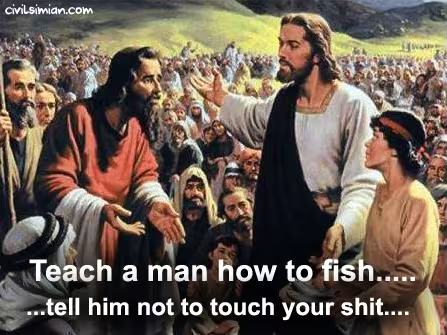
I think we all understand why this image is absurd. Whether modern Christians want to believe it or not, Jesus was liberal minded. He taught a message of universality and aversion to greed. That being said, it's really hard to know exactly what has been added into the Christian bible as a matter of political council and what has truly been said by the characters.


0
0
3 months 3 weeks ago

One might say: art shows us the miracles of nature. It is based on the concept of the miracles of nature.

0
0
3 months 3 weeks ago

The best way to drive out the devil, if he will not yield to texts of Scripture, is to jeer and flout him, for he cannot bear scorn. 

0
0
Source
source
Martin Luther, quoted at the beginning of The Screwtape Letters
3 months 3 weeks ago

The world is sacred because it gives an inkling of a meaning that escapes us.

0
0
Source
source
p. 280
3 months 3 weeks ago

An organised system of machines, to which motion is communicated by the transmitting mechanism from a central automation, is the most developed form of production by machinery.

0
0
Source
source
Vol. I, Ch. 15, Section 1, pg. 416.
2 months 1 week ago

Neurosis can be understood best as the battle between tendencies within an individual; deep character analysis leads, if successful, to the progressive solution.

0
0
Source
source
p. 264
4 months 3 weeks ago

Irony limits, finitizes, and circumscribes and thereby yields truth, actuality, content; it disciplines and punishes and thereby yields balance and consistency.

0
0
3 months 3 weeks ago

Subject matters in general do not exist. There are no subject matters; no branches of learning-or, rather, of inquiry: there are only problems, and the urge to solve them.

0
0
4 months 3 weeks ago

Thus I progressed on the surface of life, in the realm of words as it were, never in reality. All those books barely read, those friends barely loved, those cities barely visited, those women barely possessed! I went through the gestures out of boredom or absent-mindedness. Then came the human beings, they wanted to cling, but there was nothing to cling to, and that was unfortunate for them. As for me, I forgot. I never remembered anything but myself.

0
0
3 months 4 weeks ago

If I had as clear an idea of ghosts, as I have of a triangle or a circle, I should not in the least hesitate to affirm that they had been created by God; but as the idea I possess of them is just like the ideas, which my imagination forms of harpies, gryphons, hydras, &c., I cannot consider them as anything but dreams, which differ from God as totally as that which is not differs from that which is.

0
0
Source
source
Letter to Hugo Boxel (October 1674) The Chief Works of Benedict de Spinoza (1891) Tr. R. H. M. Elwes, Vol. 2, Letter 58 (54).
2 months 3 weeks ago

Speculative philosophy as the realisation of God is the positing of God, and at the same time his cancellation or negation; theism and at the same time atheism: for God - in the sense of theology - is God only as long as he is taken to be a being distinguished from and independent of the being of man as well as of nature. The theism that as the positing of God is simultaneously his negation or, conversely, as the negation of God equally his affirmation, is pantheism. Theological theism - that is, theism properly speaking - is nothing other than imaginary pantheism which itself is nothing other than real and true theism.

0
0
Source
source
Part I, Section 14
2 weeks 1 day ago

Science tells us how to heal and how to kill; it reduces the death rate in retail and then kills us wholesale in war; but only wisdom - desire coordinated in the light of all experience - can tell us when to heal and when to kill. To observe processes and to construct means is science; to criticize and coordinate ends is philosophy: and because in these days our means and instruments have multiplied beyond our interpretation and synthesis of ideals and ends, our life is full of sound and fury, signifying nothing. For a fact is nothing except in relation to desire; it is not complete except in relation to a purpose and a whole. Science without philosophy, facts without perspective and valuation, cannot save us from havoc and despair. Science gives us knowledge, but only philosophy can give us wisdom.

0
0
Source
source
Introduction : On the Uses of Philosophy
3 months 3 weeks ago

It is easy to live for others; everybody does. I call on you to live for yourselves.

0
0
Source
source
May 3, 1845
2 months 1 week ago

What is Mysticism? Is it not the attempt to draw near to God, not by rites or ceremonies, but by inward disposition? Is it not merely a hard word for " The Kingdom of Heaven is within"? Heaven is neither a place nor a time. There might be a Heaven not only here but now. It is true that sometimes we must sacrifice not only health of body, but health of mind (or, peace) in the interest of God; that is, we must sacrifice Heaven. But "thou shalt be like God for thou shalt see Him as He is": this may be here and now, as well as there and then. And it may be for a time - then lost - then recovered - both here and there, both now and then.

0
0
2 months 2 weeks ago

The philosopher ... subjects experience to his critical judgment, and this contains a value judgment - namely, that freedom from toil is preferable to toil, and an intelligent life is preferable to a stupid life. It so happened that philosophy was born with these values. Scientific thought had to break this union of value judgment and analysis, for it became increasingly clear that the philosophic values did not guide the organisation of society.

0
0
Source
source
p. 126
2 weeks 2 days ago

The Age that admires talk so much can have little discernment for inarticulate work, or for anything that is deep and genuine. Nobody, or hardly anybody, having in himself an earnest sense for truth, how can anybody recognize an inarticulate Veracity, or Nature-fact of any kind; a Human Doer especially, who is the most complex, profound, and inarticulate of all Nature's Facts? Nobody can recognize him: till once he is patented, get some public stamp of authenticity, and has been articulately proclaimed, and asserted to be a Doer. To the worshipper of talk, such a one is a sealed book. An excellent human soul, direct from Heaven,-how shall any excellence of man become recognizable to this unfortunate? Not except by announcing and placarding itself as excellent,-which, I reckon, it above other things will probably be in no great haste to do.

0
0
3 months 3 weeks ago

Of all tyrannies, a tyranny sincerely exercised for the good of its victims may be the most oppressive. It would be better to live under robber barons than under omnipotent moral busybodies. The robber baron's cruelty may sometimes sleep, his cupidity may at some point be satiated; but those who torment us for our own good will torment us without end for they do so with the approval of their own conscience. They may be more likely to go to Heaven yet at the same time likelier to make a Hell of earth. This very kindness stings with intolerable insult. To be "cured" against one's will and cured of states which we may not regard as disease is to be put on a level of those who have not yet reached the age of reason or those who never will; to be classed with infants, imbeciles, and domestic animals.

0
0
Source
source
God in the Dock: Essays on Theology (Making of Modern Theology)
4 months 1 week ago

When you close your doors, and make darkness within, remember never to say that you are alone, for you are not alone; nay, God is within, and your genius is within. And what need have they of light to see what you are doing?

0
0
Source
source
Book I, ch. 14, 13, 14.
3 months 4 weeks ago

There are two kinds of truths: those of reasoning and those of fact. The truths of reasoning are necessary and their opposite is impossible; the truths of fact are contingent and their opposites are possible.

0
0
Source
source
La monadologie (33).

CivilSimian.com created by AxiomaticPanic, CivilSimian, Kalokagathia