


3 months 1 week ago
How can you worship leeks and onions? we shall suppose a SORBONNIST to say to a priest of SAIS. If we worship them, replies the latter; at least, we do not, at the same time, eat them. But what strange object of adoration are cats and monkeys? says the learned doctor. They are at least as good as the relics or rotten bones of martyrs, answers his no less learned antagonist. Are you not mad, insists the Catholic, to cut one another's throat about the preference of a cabbage or a cucumber? Yes, says the pagan; I allow it, if you will confess, that those are still madder, who fight about the preference among volumes of sophistry, ten thousand of which are not equal in value to one cabbage or cucumber.
▼
Source
source
Part XII - With regard to doubt or conviction
1 month 2 weeks ago
Since my world picture approximates reality only crudely, I cannot aspire to optimize anything; at most, I can aim at satisficing. Searching for the best can only dissipate scarce cognitive resources; the best is the enemy of the good.
▼
Source
source
(p.361) p. 361; As cited in Ronald J. Baker (2010) Implementing Value Pricing: A Revolutionary Business Model for Professional Firms. p. 122.

4 months 1 week ago
Since my earliest childhood a barb of sorrow has lodged in my heart. As long as it stays I am ironic - if it is pulled out I shall die.

3 months 1 week ago
He would have left a Greek accent slanting the wrong way, and righted up a falling man.
3 months 1 week ago
In vain, therefore, should we pretend to determine any single event, or infer any cause or effect, without the assistance of observation and experience.
▼
Source
source
§ 4.11
1 month 2 weeks ago
We do not think good metaphors are anything very important, but I think that a good metaphor is something even the police should keep an eye on...
▼
Source
source
E 91 Variant translation: A good metaphor is something even the police should keep an eye on.
2 months 1 week ago
Raise your eyes and count the small gang of your oppressors who are only strong through the blood they suck from you and through your arms which you lend them unwillingly.
3 weeks 3 days ago
I adopt Mr. Darwin's hypothesis, therefore, subject to the production of proof that physiological species may be produced by selective breeding; just as a physical philosopher may accept the undulatory theory of light, subject to the proof of the existence of the hypothetical ether; or as the chemist adopts the atomic theory, subject to the proof of the existence of atoms; and for exactly the same reasons, namely, that it has an immense amount of primâ facie probability: that it is the only means at present within reach of reducing the chaos of observed facts to order; and lastly, that it is the most powerful instrument of investigation which has been presented to naturalists since the invention of the natural system of classification and the commencement of the systematic study of embryology.
▼
Source
source
Ch.2, p. 128
4 months 5 days ago
No human being, even the most passionately loved and passionately loving, is ever in our possession.
1 month 3 weeks ago
Art is the imposing of a pattern on experience, and our aesthetic enjoyment in recognition of the pattern.
▼
Source
source
Ch. 29, June 10, 1943.

2 months 4 days ago
The multiplication of our kind borders on the obscene; the duty to love them, on the preposterous.

3 months 1 week ago
Although I consider our political world to be the best of which we have any historical knowledge, we should beware of attributing this fact to democracy or to freedom. Freedom is not a supplier who delivers goods to our door. Democracy does not ensure that anything is accomplished - certainly not an economic miracle. It is wrong and dangerous to extol freedom by telling people that they will certainly be all right once they are free. How someone fares in life is largely a matter of luck or grace, and to a comparatively small degree perhaps also of competence, diligence, and other virtues. The most we can say of democracy or freedom is that they give our personal abilities a little more influence on our well-being.
1 day ago
I have found a paper of mine among some others in which I call architecture 'petrified music.' Really there is something in this; the tone of mind produced by architecture approaches the effect of music.
▼
Source
source
Conversations with Eckermann (23 March 1829) - Often quoted as "Architecture is frozen music."
2 months 6 days ago
This means that no state, howsoever democratic its forms, not even the reddest political republic - a people's republic only in the sense of the lie known as popular representation - is capable of giving the people what they need: the free organization of their own interests from below upward, without any interference, tutelage, or coercion from above. That is because no state, not even the most republican and democratic, not even the pseudo-popular state contemplated by Marx, in essence represents anything but government of the masses from above downward, by an educated and thereby privileged minority which supposedly understands the real interests of the people better than the people themselves.
3 months 3 weeks ago
The best people renounce all for one goal, the eternal fame of mortals; but most people stuff themselves like cattle. For what sense or understanding have they? They follow minstrels and take the multitude for a teacher, not knowing that many are bad and few good. For the best men choose one thing above all immortal glory among mortals; but the masses stuff themselves like cattle.
3 months 3 days ago
You could attach prices to ideas. Some cost a lot some little. ... And how do you pay for ideas? I believe: with courage.
▼
Source
source
p. 60e
3 months 1 week ago
The fundamental criterion for judging any procedure is the justice of its likely results.
▼
Source
source
Chapter IV, Section 37, p. 230

3 months 1 week ago
Our aim as scientists is objective truth; more truth, more interesting truth, more intelligible truth. We cannot reasonably aim at certainty. Once we realize that human knowledge is fallible, we realize also that we can never be completely certain that we have not made a mistake.

3 months 2 weeks ago
An armed insurrection ... would hinder and bring into disrepute this spiritual insurrection.
▼
Source
source
p. 68

3 months 1 week ago
Hatred and anger are the greatest poison to the happiness of a good mind.
▼
Source
source
Section II, Chap. III.
2 months 4 weeks ago
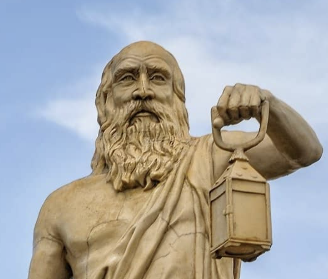
He was seized and dragged off to King Philip, and being asked who he was, replied, "A spy upon your insatiable greed."
▼
Source
source
Diogenes Laërtius, vi. 43. Cf. Plutarch, Moralia, 70CD.

1 month 3 weeks ago
It is not in a person's nature to desire what he already has. Desire is a tendency, the start of a movement toward something, toward a point from which one is absent. If, at the very outset, this movement doubles back on itself toward its point of departure, a person turns round and round like a squirrel in a cage or a prisoner in a condemned cell. Constant turning soon produces revulsion. All workers, especially though not exclusively those who work under inhumane conditions, are easily the victims of revulsion, exhaustion and disgust and the strongest are often the worst affected.
▼
Source
source
p. 245
3 months 1 week ago
You can hardly convince a man of an error in a lifetime, but must content yourself with the reflection that the progress of science is slow. If he is not convinced, his grandchildren may be.
7 months 2 weeks ago
The general reference of the philosophical discussion is usually the triangle world: world-language-subject, the relation of the subject to the world of objects, mediated through language.

3 months 1 week ago
Hitch your wagon to a star.
▼
Source
source
Civilization

3 months 1 week ago
A testimony is sufficient when it rests on: 1st. A great number of very sensible witnesses who agree in having seen well. 2d. Who are sane, bodily and mentally. 3d. Who are impartial and disinterested. 4th. Who unanimously agree. 5th. Who solemnly certify to the fact.
▼
Source
source
As quoted by H. P. Blavatsky in Isis Unveiled, Vol. I, p. 108, 1877

2 months 4 weeks ago
A sensible man takes pleasure in what he has instead of pining for what he has not.
1 month 1 day ago
Tocqueville predicted that in democratic countries the public would demand larger and larger doses of excitement and increasingly stronger stimulants from its writers. He probably did not expect that public to dramatize itself so extensively, to make the world scene everybody's theatre, or, in the developed countries, to take to alcohol and drugs in order to get relief from the horrors of ceaseless intensity, the torment of thrills and distractions. A great many writers have done little more than meet the mounting demand for thrills. I think that this demand has, in the language of marketing, peaked.
▼
Source
source
The Distracted Public
2 weeks 1 day ago
If our universe is one of many, unlike others in containing observers like ourselves, there is no need to posit a designer. Most universes will be too chaotic to allow the emergence of life or mind. In that case, the fact that humans exist in this universe needs no special explanation.
▼
Source
source
Sweet Morality (p. 222)

1 month 1 week ago
In former times the chief method of justifying the use of violence and thereby infringing the law of love was by claiming a divine right for the rulers: the Tsars, Sultans, Rajahs, Shahs, and other heads of states. But the longer humanity lived the weaker grew the belief in this peculiar, God-given right of the ruler. That belief withered in the same way and almost simultaneously in the Christian and the Brahman world, as well as in Buddhist and Confucian spheres, and in recent times it has so faded away as to prevail no longer against man's reasonable understanding and the true religious feeling. People saw more and more clearly, and now the majority see quite clearly, the senselessness and immorality of subordinating their wills to those of other people just like themselves, when they are bidden to do what is contrary not only to their interests but also to their moral sense.
▼
Source
source
III
3 months 4 weeks ago
The superior man, when resting in safety, does not forget that danger may come. When in a state of security he does not forget the possibility of ruin. When all is orderly, he does not forget that disorder may come. Thus his person is not endangered, and his States and all their clans are preserved.
3 months 1 week ago
I do not know but it is too much to read one newspaper a week. I have tried it recently, and for so long it seems to me that I have not dwelt in my native region. The sun, the clouds, the snow, the trees say not so much to me. You cannot serve two masters. It requires more than a day's devotion to know and to possess the wealth of a day.
▼
Source
source
p. 491
3 months 2 days ago
The soul is the prison of the body.
▼
Source
source
Discipline and Punish (1977) as translated by Alan Sheridan, p. 30
3 months 3 weeks ago
I have read in Plato and Cicero sayings that are very wise and very beautiful; but I never read in either of them, "Come unto me, all ye that labor and are heavy laden."
▼
Source
source
p. 62
1 month 2 weeks ago
If we accept values as given and consistent, if we postulate an objective description of the world as it really is, and if we assume that the decision maker's computational powers are unlimited, then two important consequences follow. First, we do not need to distinguish between the real world and the decision maker's perception of it: he or she perceives the world as it really is. Second, we can predict the choices that will be made by a rational decision maker entirely from our knowledge of the real world and without a knowledge of the decision maker's perceptions or modes of calculation. (We do, of course, have to know his or her utility function.)
2 months 4 weeks ago
Remember Bostrom's definition of existential risk, which refers to the annihilation not of human beings, but of "Earth-originating intelligent life." The replacement of our species by some other form of conscious intelligent life is not in itself, impartially considered, catastrophic. Even if the intelligent machines kill all existing humans, that would be...a very small part of the loss of value that Parfit and Bostrom believe would be brought about by the extinction of Earth-originating intelligent life. The risk posed by the development of AI, therefore, is not so much whether it is friendly to us, but whether it is friendly to the idea of promoting wellbeing in general, for all sentient beings it encounters, itself included.
▼
Source
source
Chapter 15: Preventing Human Extinction (p. 176)
3 months 3 weeks ago
Speaking with sense we must fortify ourselves in the common sense of all, as a city is fortified by its law, and even more forcefully. For all human laws are nourished by the one divine law. For it prevails as far as it will and suffices for all and is superabundant.

2 months 2 weeks ago
All things are in all.
▼
Source
source
V 9; as translated by Dorothea Waley Singer
1 month 1 day ago
The real reason people are conservatives is that they are attached to the things that they love, and want to preserve them from abuse and decay. They are attached to their family, their friends, their religion, and their immediate environment. They have made a lifelong distinction between the things that nourish and the things that threaten their security and peace of mind.
▼
Source
source
Conservatism and the Conservatory,, National Review
1 month 2 weeks ago
If the importance of science does not lie in its constituting the whole of human knowledge, even less does it lie, in my view, in its technological applications. Science at the best is a way of coming to know, and hopefully a way of acquiring some reverence for, the wonders of nature. The philosophical study of science, at the best, has always been a way of coming to understand both some of the nature and some of the limitations of human reason. These seem to me to be sufficient grounds for taking science and philosophy of science seriously; they do not justify science worship.
▼
Source
source
"Introduction: Science as approximation to truth"
1 month 4 weeks ago
When all these things are lacking there is no culture; there is in the strictest sense of the word, barbarism. And let us not deceive ourselves, this is what is beginning to appear in Europe under the progressive rebellion of the masses. The traveller who arrives in a barbarous country knows that in that territory there are no ruling principles to which it is possible to appeal. Properly speaking, there are no barbarian standards. Barbarism is the absence of standards to which appeal can be made.
▼
Source
source
Chap. VIII: The Masses Intervene In Everything, And Why Their Intervention Is Solely By Violence

1 month 3 weeks ago
Corruption of politics has nothing to do with the morals, or the laxity of morals, of various political personalities. Its cause is altogether a material one. Politics is the reflex of the business and industrial world, the mottos of which are: "To take is more blessed than to give"; "buy cheap and sell dear"; "one soiled hand washes the other." There is no hope even that woman, with her right to vote, will ever purify politics.

3 months 1 week ago
Religious suffering is, at one and the same time, the expression of real suffering and a protest against real suffering. Religion is the sigh of the oppressed creature, the heart of a heartless world, and the soul of soulless conditions. It is the opium of the people.The abolition of religion as the illusory happiness of the people is the demand for their real happiness. To call on them to give up their illusions about their condition is to call on them to give up a condition that requires illusions. The criticism of religion is, therefore, in embryo, the criticism of that vale of tears of which religion is the halo.Criticism has plucked the imaginary flowers on the chain not in order that man shall continue to bear that chain without fantasy or consolation, but so that he shall throw off the chain and pluck the living flower.
3 months 1 week ago
Scientific Method... [is] even less existent than some other non-existent subjects.
2 months 4 days ago
We are so captivated by and entangled in our subjective consciousness that we have forgotten the age-old fact that God speaks chiefly through dreams and visions.
▼
Source
source
The Symbolic Life (1953); also in Man and His Symbols
CivilSimian.com created by AxiomaticPanic, CivilSimian, Kalokagathia