



2 months 2 weeks ago
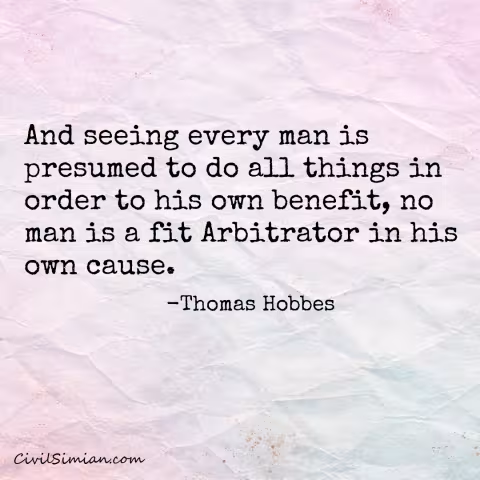
There is hardly a member of Congress who can make up his mind to go home without having despatched at least one speech to his constituents; nor who will endure any interruption until he has introduced into his harangue whatever useful suggestions may be made touching the four-and-twenty States of which the Union is composed, and especially the district which he represents.
▼
Source
source
Book One, Chapter XXI.

4 months 2 weeks ago
All that exists that can be denied deserves to be denied; and being truthful means: to believe in an existence that can in no way be denied and which is itself true and without falsehood.
3 weeks ago
As the neurobiological basis of feeling and emotion is unravelled, and the human genome decoded and rewritten, it will become purely an issue of post-human decision whether negative modes of consciousness are generated in any form or texture whatsoever. "The Hedonistic Imperative: Heaven on Earth", BLTC Research

2 months 5 days ago
Ye fools, did not he that made that which is without make that which is within also?
▼
Source
source
11:40 (KJV)
2 months 1 week ago
There is something beautiful about virtue, Captain. But I am just a poor guy.
▼
Source
source
Scene VI.

4 months 1 week ago
Hungary conquered and in chains has done more for freedom and justice than any people for twenty years. But for this lesson to get through and convince those in the West who shut their eyes and ears, it was necessary, and it can be no comfort to us, for the people of Hungary to shed so much blood which is already drying in our memories. In Europe's isolation today, we have only one way of being true to Hungary, and that is never to betray, among ourselves and everywhere, what the Hungarian heroes died for, never to condone, among ourselves and everywhere, even indirectly, those who killed them. It would indeed be difficult for us to be worthy of such sacrifices.
1 week 1 day ago
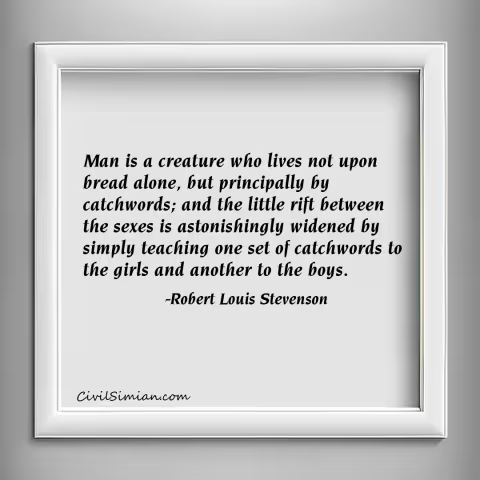
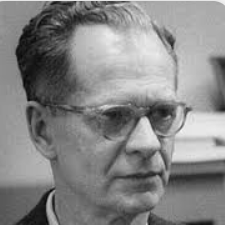
It is a mistake to suppose that the whole issue is how to free man. The issue is to improve the way in which he is controlled.
▼
Source
source
"I have been misunderstood" An interview with B.F.Skinner, Center Magazine (March/April 1972), pp. 63

3 days ago
He that works and does some Poem, not he that merely says one, is worthy of the name of Poet.
▼
Source
source
Introduction to Cromwell's Letters and Speeches (1845).

1 month 3 weeks ago
The vitality of the ordinary members of society is dependent on its Outsiders.
▼
Source
source
Chapter Three, The Romantic Outsider
1 month 1 week ago
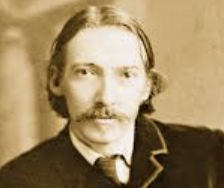
They say cowardice is infectious; but then argument is, on the other hand, a great emboldener.
▼
Source
source
Ch. 4, The Sea Chest.

2 months 1 week ago
We must now turn to the question of how the existence of archetypes can be proved. Since archetypes are supposed to produce certain psychic forms, we must discuss how and where one can get hold of the material demonstrating these forms. The main source, then, is dreams, which have the advantage of being involuntary, spontaneous products of nature not falsified by any conscious purpose. By questioning the individual one can ascertain which of the motifs appearing in the dream are known to him... Consequently, we must look for motifs which could not possibly be known to the dreamer and yet behave functionally of the archetype known from historical sources.
▼
Source
source
p. 48

3 months 2 weeks ago
A book can never be anything more than the impression of its author's thoughts [Ein Buch kann nie mehr seyn, als der Abdruck der Gedanken des Verfassers]. The value of these thoughts lies either in the matter about which he has thought, or in the form in which he develops his matter - that is to say, what he has thought about it.

2 months 1 week ago
Fathers and teachers, I ponder, "What is hell?" I maintain that it is the suffering of being unable to love.
▼
Source
source
Book VI, Chapter 3 (trans. Constance Garnett)
2 months 1 week ago
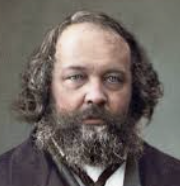
In a word, we reject all legislation, all authority, and all privileged, licensed, official, and legal influence, even though arising from universal suffrage, convinced that it can turn only to the advantage of a dominant minority of exploiters against the interest of the immense majority in subjection to them. This is the sense in which we are really Anarchists.

3 months 1 week ago
As the brain-changes are continuous, so do all these consciousnesses melt into each other like dissolving views. Properly they are but one protracted consciousness, one unbroken stream.
▼
Source
source
Ch. 9

1 month 1 week ago
Electricity does not centralize, but decentralizes.
▼
Source
source
(p. 36)

4 months 2 days ago
A true friend will partake of the wants and sorrows of his friend, as if they were his own; if he be in want, he will relieve him; if he be in prison, he will visit him; if he be sick, he will come to him; nay-situations may occur, in which he would not scruple to die for him. It cannot then be doubted, that friendship is one of the most useful means of procuring a secure, tranquil, and happy life.

3 months 1 week ago
The profit of books is according to the sensibility of the reader. The profoundest thought or passion sleeps as in a mine until an equal mind and heart finds and publishes it.
▼
Source
source
Quotation and Originality
2 months 1 week ago
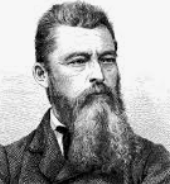
The secret of Hegel's dialectic lies ultimately in this alone, that it negates theology through philosophy in order then to negate philosophy through theology. Both the beginning and the end are constituted by theology; philosophy stands in the middle as the negation of the first positedness, but the negation of the negation is again theology. At first everything is overthrown, but then everything is reinstated in its old place, as in Descartes. The Hegelian philosophy is the last grand attempt to restore a lost and defunct Christianity through philosophy, and, of course, as is characteristic of the modern era, by identifying the negation of Christianity with Christianity itself.
▼
Source
source
Part II, Section 21
4 months 1 week ago
I leave Sisyphus at the foot of the mountain! One always finds one's burden again. But Sisyphus teaches the higher fidelity that negates the gods and raises rocks. He too concludes that all is well. This universe henceforth without a master seems to him neither sterile nor futile. Each atom of that stone, each mineral flake of that night filled mountain, in itself forms a world. The struggle itself toward the heights is enough to fill a man's heart. One must imagine Sisyphus happy.

2 months 1 week ago
It is trifling to believe in what you do or in what others do. You should avoid simulacra and even "realities"; you should take up a position external to everything and everyone, drive off or grind down your appetites, live, according to a Hindu adage, with as few desires as a "solitary elephant.

1 month 3 weeks ago
We do not think good metaphors are anything very important, but I think that a good metaphor is something even the police should keep an eye on...
▼
Source
source
E 91 Variant translation: A good metaphor is something even the police should keep an eye on.
3 months ago
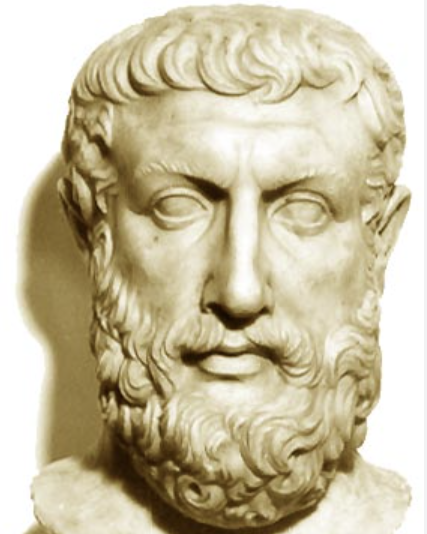
You must learn all things, both the unshaken heart of persuasive truth, and the opinions of mortals in which there is no true warranty.
▼
Source
source
Frag B 1.28-30, quoted by Sextus Empiricus, Against the Mathematicians, vii. 3
2 months 5 days ago
If you know these things, happy you are if you do them.
▼
Source
source
13:17, New World Translation of the Holy Scriptures
1 month 1 week ago
The role of the artist is to create an Anti-environment as a means of perception and adjustment.
▼
Source
source
(p. 31)

3 months 2 weeks ago
I had hoped that out of so many stories you would at least have produced one or two, which could hardly be questioned, and which would clearly show that ghosts or spectres exist. The case you relate... seems to me laughable. In like manner it would be tedious here to examine all the stories of people, who have written on these trifles. To be brief, I cite the instance of Julius Caesar, who, as Suetonius testifies, laughed at such things and yet was happy. ...And so should all who reflect on the human imagination, and the effects of the emotions, laugh at such notions; whatever Lavater and others, who have gone dreaming with him in the matter, may produce to the contrary.
▼
Source
source
Letter to Hugo Boxel (October 1674) The Chief Works of Benedict de Spinoza (1891) Tr. R. H. M. Elwes, Vol. 2, Letter 58 (54).
3 months 1 week ago
Old-fashioned determinism was what we may call hard determinism. It did not shrink from such words as fatality, bondage of the will, necessitation, and the like. Nowadays, we have a soft determinism which abhors harsh words, and, repudiating fatality, necessity, and even predetermination, says that its real name is freedom; for freedom is only necessity understood, and bondage to the highest is identical with true freedom.
▼
Source
source
The Dilemma of Determinism (1884) republished in The Will to Believe, Dover, 1956, p. 149

2 months 1 week ago
I think I can hardly overrate the malignity of the principles of Protestant ascendancy, as they affect Ireland; or of Indianism, as they affect these countries, and as they affect Asia; or of Jacobinism, as they affect all Europe, and the state of human society itself. The last is the greatest evil.
▼
Source
source
Letter to Sir Hercules Langrishe (26 May 1795), quoted in R. B. McDowell (ed.)

2 months 1 week ago
It shews the anxiety of the great men who influenced the conduct of affairs at that great event, to make the Revolution a parent of settlement, and not a nursery of future revolutions.
▼
Source
source
Referring to the Glorious Revolution of 1688
2 months 1 week ago
I have never yet seen any plan which has not been mended by the observation of those who were much inferior in understanding to the person who took the lead in the business.
4 months 1 week ago
At any street corner the feeling of absurdity can strike any man in the face.
3 months 3 weeks ago
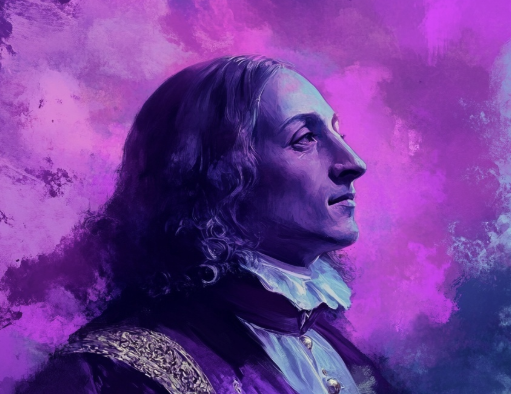
When I consider the short duration of my life, swallowed up in the eternity before and after, the small space which I fill, or even can see, engulfed in the infinite immensity of spaces whereof I know nothing, and which know nothing of me, I am terrified, and wonder that I am here rather than there, for there is no reason why here rather than there, or now rather than then. Who has set me here? By whose order and design have this place and time been destined for me? It is not well to be too much at liberty. It is not well to have all we want.How many kingdoms know nothing of us! The eternal silence of these infinite spaces alarms me.
▼
Source
source
"The Misery of Man Without God": "Man's Disproportion," The Thoughts of Blaise Pascal translated from the Text of M. Auguste Molinier Tr. C. Kegan Paul, 1885
1 month 1 week ago
There are no passengers on Spaceship Earth. We are all crew.
▼
Source
source
Statement in 1965, in reference to Operating Manual for Spaceship Earth (1963) by Buckminster Fuller

3 months 2 weeks ago
The Apostle Paul wants us to work with our hands in order to share with the needy (Ephesians 5:28). Notice that he could have said that we should work to support ourselves. But Paul says that we work to give to those in need. This is why caring for our body is also a Christian work. If the body is healthy and fit, we are able to work and save money that can be used to help those in need.
▼
Source
source
p. 80

3 months 2 weeks ago
I want to be seen here in my simple, natural, ordinary fashion, without straining or artifice; for it is myself that I portray...I am myself the matter of my book. To the Reader
▼
Source
source
tr. Donald M. Frame, 1957

3 months 1 week ago
We tend to believe the premises because we can see that their consequences are true, instead of believing the consequences because we know the premises to be true. But the inferring of premises from consequences is the essence of induction; thus the method in investigating the principles of mathematics is really an inductive method, and is substantially the same as the method of discovering general laws in any other science.
▼
Source
source
"The Regressive Method of Discovering the Premises of Mathematics" (1907), in Essays in Analysis (1973), pp. 273-274
3 months 1 week ago
Consciousness, then, does not appear to itself chopped up in bits ... A 'river' or a 'stream' are the metaphors by which it is most naturally described. In talking of it hereafter, let us call it the stream of thought, of consciousness, or of subjective life.
▼
Source
source
Ch. 9
2 months 2 weeks ago
There are two things which a democratic people will always find very difficult-to begin a war and to end it.
▼
Source
source
Book Three, Chapter XXII.
3 months 1 week ago
Many agnostics (including myself) are quite as doubtful of the body as they are of the soul, but this is a long story taking one into difficult metaphysics. Mind and matter alike, I should say, are only convenient symbol in discourse, not actually existing things.
▼
Source
source
What is an Agnostic?, 1953
3 days ago
Again, and again, we say, the great, the creative and enduring is ever a secret to itself; only the small, the barren and transient is otherwise.
▼
Source
source
Characteristics.

1 month 1 week ago
Audacity augments courage; hesitation, fear.
▼
Source
source
Maxim 63 Variant translation: "Valour grows by daring, fear by holding back."
4 months 1 week ago
At that moment he knew what his mother was thinking, and that she loved him. But he knew, too, that to love someone means relatively little; or, rather, that love is never wrong enough to find the word befitting it.

2 months 5 days ago
The happy consciousness is shaky enough-a thin surface over fear, frustration, and disgust.
▼
Source
source
p. 76

1 week ago
The other big issue is an emotional one. We tend to feel the greatest bonds of solidarity with people that are close to us. There are very few true citizens of the world. We're citizens of individual countries and we really feel the closest bonds to people that live within our nation, and therefore... the nation becomes a kind of social glue. But if you're going to make a national identity compatible with liberalism, it has to be the right kind of national identity. It has to be one that is open to all of the citizens that actually live in the territory of the nation. It can't exclude certain groups by race, by ethnicity, by religious belief and the like, and therefore it needs to be an open identity that is based on essentially liberal ideas.
▼
Source
source
24:46:00
1 month 3 weeks ago
Roughly speaking, rationality is concerned with the selection of preferred behavior alternatives in terms of some system of values, whereby the consequences of behavior can be evaluated.
▼
Source
source
p. 84.

2 months 2 weeks ago
I cleave the heavens and soar to the infinite. And while I rise from my own globe to others And penetrate ever further through the eternal field, That which others saw from afar, I leave far behind me. Variant translation: While I venture out beyond this tiny globe Into reaches past the bounds of starry night I leave behind what others strain to see afar.
CivilSimian.com created by AxiomaticPanic, CivilSimian, Kalokagathia