


1 month 4 weeks ago
To desire friendship is a great fault. Friendship should be a gratuitous joy like those afforded by art or life. We must refuse it so that we may be worthy to receive it; it is of the order of grace.
▼
Source
source
p. 274
4 months 3 days ago
To no one but the Son of Heaven does it belong to order ceremonies, to fix the measures, and to determine the written characters.

3 months 1 week ago
Though thou loved her as thyself, As a self of purer clay, Tho' her parting dims the day, Stealing grace from all alive, Heartily know, When half-gods go, The gods arrive.
▼
Source
source
Give All to Love, st. 4
1 month 2 weeks ago
1. Fidelity & Allegiance sworn to the King is only such a fidelity and obedience as is due to him by the law of the land; for were that faith and allegiance more than what the law requires, we would swear ourselves slaves, and the King absolute; whereas, by the law, we are free men, notwithstanding those Oaths. 2. When, therefore, the obligation by the law to fidelity and allegiance ceases, that by the Oath also ceases...
▼
Source
source
Letter to Dr. Covel Feb. 21, (1688-9) Thirteen Letters from Sir Isaac Newton to J. Covel, D.D.
3 months 1 week ago
Plato was synthesis of Europe and Asia, and a decidedly Oriental element pervades his philosophy, giving it a sunrise color.
▼
Source
source
Quoted in Swami Abhedananda, India and Her People, 6th ed., Calcutta: Ramakrishna Vedanta Math, 1945

2 months 5 days ago
He also said to them, "You completely invalidate God's command in order to maintain your tradition! For Moses said: Honor your father and your mother; and, Whoever speaks evil of father or mother must be put to death.
▼
Source
source
7:9-10

2 months 1 week ago
If a single cell, under appropriate conditions, becomes a man in the space of a few years, there can surely be no difficulty in understanding how, under appropriate conditions, a cell may, in the course of untold millions of years, give origin to the human race.
▼
Source
source
Vol. I, Part III: The Evolution of Life, Ch. 3 : General Aspects of the Evolution
5 days ago
Young Schopenhauer, a zealous and thorough-going Kantian, tried to explain that light would cease to exist along with the seeing eye. "What!" he said, according to Schopenhauer's own report, "looking at him with his Jove-like eyes,"-"You should rather say that you would not exist if the light could not see you?"
▼
Source
source
As quoted by Friedrich Jodl, "Goethe and Kant," The Monist (1901) f. Edward C. Hegeler, ed. Paul Carus, Vol. 11, p. 264. As translated from Professor Jodl's MS. by W. H. Carruth, of the University of Kansas.
3 months 2 weeks ago
The first characteristic of the human species is man's ability, as a rational being, to establish character for himself, as well as for the society into which nature has placed him. This ability, however, presupposes an already favorable natural predisposition and an inclination to the good in man, because the evil is really without character (since it is at odds with itself, and since it does not tolerate any lasting principle within itself)
▼
Source
source
Kant, Immanuel (1996), page 246
3 months 2 weeks ago
Most shocking of all is alledging the Sacred Scriptures to favour this wicked practice. One would have thought none but infidel cavillers would endeavour to make them appear contrary to the plain dictates of natural light, and Conscience, in a matter of common Justice and Humanity; which they cannot be. Such worthy men, as referred to before, judged otherways; Mr. Baxter declared, the Slave-Traders should be called Devils, rather than Christians; and that it is a heinous crime to buy them.

3 months 1 week ago
[W]e only become what we are by the radical and deep-seated refusal of that which others have made of us.
1 month 2 weeks ago
Where questions of style and exposition are concerned I try to follow a simple maxim: if you can't say it clearly you don't understand it yourself.
▼
Source
source
P. x.
4 months 1 week ago
They despised everything but virtue, caring little for their present state of life, and thinking lightly of the possession of gold and other property, which seemed only a burden to them; neither were they intoxicated by luxury; nor did wealth deprive them of their self-control; but they were sober, and saw clearly that all these goods are increased by virtue and friendship with one another, whereas by too great regard and respect for them, they are lost and friendship with them.

2 months 1 week ago
Men reject their prophets and slay them, but they love their martyrs and honor those they have slain.
1 week 2 days ago
The way positive reinforcement is carried out is more important than the amount.
▼
Source
source
As quoted in Meditations for Parents Who Do Too Much (1993) by Jonathon Lazear and Wendy Lazear, p. 5

3 months 2 weeks ago
The governors of the world believe, and have always believed, that virtue can only be taught by teaching falsehood, and that any man who knew the truth would be wicked. I disbelieve this, absolutely and entirely. I believe that love of truth is the basis of all real virtue, and that virtues based upon lies can only do harm.
2 months 4 days ago
If one examines the reason why certain works of art offend us, one is likely to find that the cause is that there is no personally felt emotion guiding the selecting the assembling of the materials presented. We derive the impression that the artist, say the author of a novel, is trying to regulate by conscious intent the nature of the emotion aroused. We are irritated by a feeling that he is manipulating materials to secure an effect decided upon in advance. The facets of the work, the variety so indispensable to it, are held together by some external force. The movement of the parts and the conclusion disclose no logical necessity. The author, not the subject matter, is the arbiter.
2 months 1 week ago
Third, consider the insistency of an idea. The insistency of a past idea with reference to the present is a quantity which is less, the further back that past idea is, and rises to infinity as the past idea is brought up into coincidence with the present.

2 months 1 week ago
Each of us is born with a share of purity, predestined to be corrupted by our commerce with mankind, by that sin against solitude.

3 months 2 weeks ago
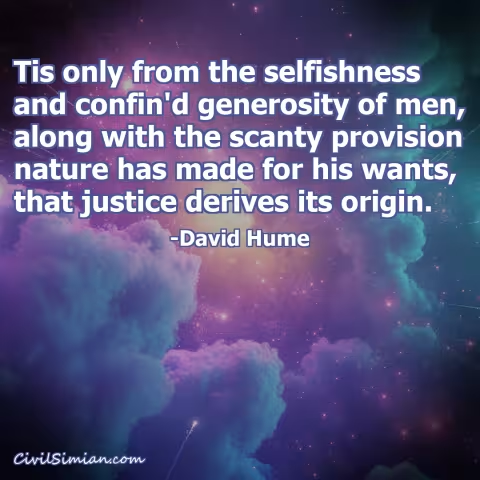
All sentiment is right; because sentiment has a reference to nothing beyond itself, and is always real, wherever a man is conscious of it. But all determinations of the understanding are not right; because they have a reference to something beyond themselves, to wit, real matter of fact; and are not always conformable to that standard.
▼
Source
source
Part I, Essay 23: Of The Standard of Taste

3 months 2 weeks ago
"Optimism," said Cacambo, "What is that?" "Alas!" replied Candide, "It is the obstinacy of maintaining that everything is best when it is worst!

4 months 2 weeks ago
The modern scientific counterpart to belief in God is the belief in the universe as an organism: this disgusts me. This is to make what is quite rare and extremely derivative, the organic, which we perceive only on the surface of the earth, into something essential, universal, and eternal! This is still an anthropomorphizing of nature!
2 months 4 days ago
That Marxism should triumph in Russia, where there is no industry, would be the greatest contradiction that Marxism could undergo. But there is no such contradiction, for there is no such triumph. Russia is Marxist more or less as the Germans of the Holy Roman Empire were Romans.
▼
Source
source
Chapter XIV: Who Rules The World?
2 months 1 week ago
Everything turns on pain; the rest is accessory, even nonexistent, for we remember only what hurts. Painful sensations being the only real ones, it is virtually useless to experience others.

1 month 1 week ago
The hardware world tends to move into software form at the speed of light.


1 month 3 weeks ago
Every daring attempt to make a great change in existing conditions, every lofty vision of new possibilities for the human race, has been labelled Utopian.
▼
Source
source
"Socialism: Caught in the Political Trap", a lecture (c. 1912), published in Red Emma Speaks, Part 1 (1972) edited by Alix Kates Shulman
3 months 3 days ago
The distance between oneself and other persons and other species can fall anywhere on a continuum. Even for other persons the understanding of what it is like to be them is only partial, and when one moves to species very different from oneself, a lesser degree of partial understanding may still be available. The imagination is remarkably flexible. My point, however, is not that we cannot know what it is like to be a bat. I am not raising that epistemological problem. My point is rather that even to form a conception of what it is like to be a bat and a fortiori to know what it is like to be a bat, one must take up the bat's point of view.
▼
Source
source
p. 172, note 8.

3 months 3 weeks ago
The most manifest sign of wisdom is a continual cheerfulness; her state is like that in the regions above the moon, always clear and serene.
▼
Source
source
Book I, Ch. 26

3 months 1 week ago
Pretend what we may, the whole man within us is at work when we form our philosophical opinions. Intellect, will, taste, and passion co-operate just as they do in practical affairs; and lucky it is if the passion be not something as petty as a love of personal conquest over the philosopher across the way.
2 months 1 week ago
I anticipated witnessing in my lifetime the disappearance of our species. But the Gods have been against me.
2 months 4 days ago
Reason is like an open secret that can become known to anyone at any time; it is the quiet space into which everyone can enter through his own thought.
▼
Source
source
As quoted in Philosophy for a Time of Crisis : An Interpretation, with Key Writings by Fifteen Great Modern Thinkers (1959) by Adrienne Koch, Ch. 18, "Karl Jaspers : A New Humanism"
2 months 1 week ago
I call a sign which stands for something merely because it resembles it, an icon. Icons are so completely substituted for their objects as hardly to be distinguished from them. Such are the diagrams of geometry. A diagram, indeed, so far as it has a general signification, is not a pure icon; but in the middle part of our reasonings we forget that abstractness in great measure, and the diagram is for us the very thing. So in contemplating a painting, there is a moment when we lose the consciousness that it is not the thing, the distinction of the real and the copy disappears, and it is for the moment a pure dream, - not any particular existence, and yet not general. At that moment we are contemplating an icon.

4 months 1 week ago
I don't believe in an afterlife, so I don't have to spend my whole life fearing hell, or fearing heaven even more. For whatever the tortures of hell, I think the boredom of heaven would be even worse.

3 months 1 week ago
If there is equality, it is in His love, not in us.
3 months 1 week ago
Existentialism is nothing else but an attempt to draw the full conclusions from a consistently atheistic position. Its intention is not in the least that of plunging men into despair. And if by despair one means as the Christians do - any attitude of unbelief, the despair of the existentialists is something different. Existentialism is not atheist in the sense that it would exhaust itself in demonstrations of the non-existence of God. It declares, rather, that even if God existed that would make no difference from its point of view. Not that we believe God does exist, but we think that the real problem is not that of His existence; what man needs is to find himself again and to understand that nothing can save him from himself, not even a valid proof of the existence of God. In this sense existentialism is optimistic. It is a doctrine of action, and it is only by self-deception, by confining their own despair with ours that Christians can describe us as without hope.
▼
Source
source
p. 56
2 months 4 days ago
The assurance that we have no means of answering [final] questions is no valid excuse for callousness towards them. The more deeply should we feel, down to the roots of our being, their pressure and their sting. Whose hunger has ever been [sated] with the knowledge that he could not eat?
▼
Source
source
p. 15
2 months 2 weeks ago
Expect nothing more from philosophy than a voice, language and grammar of the instinct for Godliness that lies at its origin, and, essentially, is philosophy itself.
▼
Source
source
"On Philosophy: To Dorothea," in Theory as Practice (1997), p. 421

3 months 2 weeks ago
As for my own business, even that kind of surveying which I could do with most satisfaction my employers do not want. They would prefer that I should do my work coarsely and not too well, ay, not well enough. When I observe that there are different ways of surveying, my employer commonly asks which will give him the most land, not which is most correct.
▼
Source
source
p. 486
4 months 3 days ago
The institutions of the Ruler are rooted in his own character and conduct, and sufficient attestation of them is given by the masses of the people. He examines them by comparison with those of the three kings, and finds them without mistake. He sets them up before Heaven and Earth, and finds nothing in them contrary to their mode of operation. He presents himself with them before spiritual beings, and no doubts about them arise. He is prepared to wait for the rise of a sage a hundred ages after, and has no misgivings. His presenting himself with his institutions before spiritual beings, without any doubts arising about them, shows that he knows Heaven. His being prepared, without any misgivings, to wait for the rise of a sage a hundred ages after, shows that he knows men.
3 months 1 week ago
If we cannot "practice the presence of God," it is something to practice the absence of God, to become increasingly aware of our unawareness till we feel like man who should stand beside a great cataract and hear no noise, or like a man in a story who looks in a mirror and finds no face there, or a man in a dream who stretches his hand to visible objects and gets no sensation of touch. To know that one is dreaming is to no longer be perfectly asleep. Bur for news of the fully waking world you must go to my betters.
▼
Source
source
"Charity"
1 month 3 weeks ago
Affectation is a very good word when someone does not wish to confess to what he would none the less like to believe of himself.
▼
Source
source
F 149
3 months 2 weeks ago
The great end of all human industry, is the attainment of happiness. For this were arts invented, sciences cultivated, laws ordained, and societies modelled, by the most profound wisdom of patriots and legislators.
▼
Source
source
Part I, Essay 16: The Stoic

4 days ago
What is all Knowledge too but recorded Experience, and a product of History; of which, therefore, Reasoning and Belief, no less than Action and Passion, are essential materials?
▼
Source
source
Carlyle, Essays, On History. Quote reported in Hoyt's New Cyclopedia Of Practical Quotations (1922), p. 419-23.
4 days ago
Scientific revolutions are inaugurated by a growing sense... that an existing paradigm has ceased to function adequately in the exploration of an aspect of nature to which that paradigm itself had previously led the way. p. 91
▼
Source
source
2012 ed.
4 months 1 week ago
In memory yet green, in joy still felt, The scenes of life rise sharply into view. We triumph; Life's disasters are undealt, And while all else is old, the world is new.
1 week ago
Mathematicians do not study objects, but the relations between objects; to them it is a matter of indifference if these objects are replaced by others, provided that the relations do not change. Matter does not engage their attention, they are interested in form alone.
▼
Source
source
Ch. II: Dover abridged edition (1952), p. 20
1 month 3 weeks ago
We will likely also find that the nature of the problem to be solved will be a principal determinant of the mix. With our growing understanding of the organization of judgmental and intuitive processes, of the specific knowledge that of the specific knowledge that is required to perform particular judgmental tasks, and of the cues that evoke such knowledge in situations in which it is relevant, we have a powerful new tool for improving expert judgment. We can specify the knowledge and the recognition capabilities that experts in a domain need to acquire, and use these specifications for designing appropriate learning procedures.
▼
Source
source
p. 137.
2 months 2 weeks ago
The most dangerous madmen are those created by religion, and ... people whose aim is to disrupt society always know how to make good use of them on occasion.
CivilSimian.com created by AxiomaticPanic, CivilSimian, Kalokagathia