






2 months 2 weeks ago

If man has learned to see and know what really is, he will act in accordance with truth, Epistemology is in itself ethics, and ethics is epistemology.

0
0
Source
source
p. 125
4 months 1 week ago

The Apostle says: I make up in my flesh what is lacking to the sufferings of Christ (Col. 1:24). I make up, he tells us, not what is lacking to my sufferings, but what is lacking to the sufferings of Christ; not in Christ flesh, but in mine. not in Christ's flesh, but in mine. Christ is still suffering, not in His own flesh which He took with Him into heaven, but in my flesh, which is still suffering on earth.

0
0
Source
source
p.423

The ethic of Reverence for Life prompts us to keep each other alert to what troubles us and to speak and act dauntlessly together in discharging the responsibility that we feel. It keeps us watching together for opportunities to bring some sort of help to animals in recompense for the great misery that men inflict upon them, and thus for a moment we escape from the incomprehensible horror of existence.

0
0
2 months 2 weeks ago

To think is to submit to the whims and commands of an uncertain health.

0
0
2 months 3 weeks ago

In the United States, the majority undertakes to supply a multitude of ready-made opinions for the use of individuals, who are thus relieved from the necessity of forming opinions of their own.

0
0
Source
source
Book One, Chapter II.
2 months 1 week ago

Morally, it is wrong to suppose the source of evil is outside oneself, that one is a vessel of holiness running over with virtue. Such a disposition is the best soil for a hateful and cruel fanaticism. It is as wrong to impute every wickedness to Jews, Freemasons, "intellectuals," as it is to blame all crimes on the bourgeoisie, the nobility, and the powers that were. No; the root of evil is in me as well, and I must take my share of the responsibility and the blame. That was true before the revolution and it is true still.

0
0
Source
source
p. 128
2 months 2 weeks ago

We wish, in a word, equality - equality in fact as a corollary, or rather, as primordial condition of liberty. From each according to his faculties, to each according to his needs; that is what we wish sincerely and energetically.

0
0
Source
source
As quoted in The Old Order and the New (1890) by J. Morris Davidson

I understand the task of sociology to be description and determination of the historical-psychological origin of those forms in which interactions take place between human beings. The totality of these interactions, springing from the most diverse impulses, directed toward the most diverse objects, and aiming at the most diverse ends, constitutes "society."

0
0
Source
source
p. 167
3 months 2 weeks ago

I think He made one law of that kind in order that there might be obedience. In all these other matters what you call obeying Him is but doing what seems good in your eyes also. Is love content with that? You do them, indeed, because they are His will, but not only because they are his will. Where can you taste the joy of obeying unless he bids you do something for which His bidding is the only reason?

0
0
4 months 1 week ago

The reason, however, why the philosopher may be likened to the poet is this: both are concerned with the marvellous.

0
0
Source
source
Commentary on the Metaphysics (c. 1270-1272), 1, 3; quoted in Josef Pieper, Leisure, the Basis of Culture (New York, 1952), p. 88
3 months 3 weeks ago

The degree of one's emotion varies inversely with one's knowledge of the facts - the less you know the hotter you get.

0
0
Source
source
Attributed to Russell in Distilled Wisdom (1964) by Alfred Armand Montapert, p. 145
3 months 1 week ago

Force without wisdom falls of its own weight.

0
0
3 months 4 weeks ago

As all those have shown who have discussed civil institutions, and as every history is full of examples, it is necessary to whoever arranges to found a Republic and establish laws in it, to presuppose that all men are bad and that they will use their malignity of mind every time they have the opportunity; and if such malignity is hidden for a time, it proceeds from the unknown reason that would not be known because the experience of the contrary had not been seen, but time, which is said to be the father of every truth, will cause it to be discovered.

0
0
Source
source
Book 1, Ch. 3
3 months 1 week ago

September 11, 2001, was just another day for most of the world's desperately poor people, so presumably close to 30,000 children under five died from these causes on that day-about ten times the number of victims of the terrorist attacks. The publication of these figures did not lead to an avalanche of money for UNICEF or other aid agencies helping to reduce infant mortality. In the year 2000 Americans made private donations for foreign aid of all kinds totaling about $4 per person in extreme poverty, or roughly $20 per family. New Yorkers who were living in lower Manhattan on September 11, 2001, whether wealthy or not, were able to receive an average of $5,300 per family. The distance between these amounts encapsulates the way in which, for many people, the circle of concern for others stops at the boundaries of their own country-if it extends even that far.

0
0
Source
source
Chapter 5: One Community (p. 176)
1 month 2 weeks ago

The individual selectionist would admit that groups do indeed die out, and that whether or not a group goes extinct may be influenced by the behaviour of the individuals in that group. He might even admit that if only the individuals in a group had the gift of foresight they could see that in the long run their own best interests lay in restraining their selfish greed, to prevent the destruction of the whole group. How many times must this have been said in recent years to the working people of Britain? But group extinction is a slow process compared with the rapid cut and thrust of individual competition. Even while the group is going slowly and inexorably downhill, selfish individuals prosper in the short term at the expense of altruists. The citizens of Britain may or may not be blessed with foresight, but evolution is blind to the future.

0
0
Source
source
Ch. 1. Why Are People?
3 months 3 weeks ago

Every man is, no doubt, by nature, first and principally recommended to his own care; and as he is fitter to take care of himself than of any other person, it is fit and right that it should be so.

0
0
Source
source
Section II, Chap. II.
2 months 1 week ago

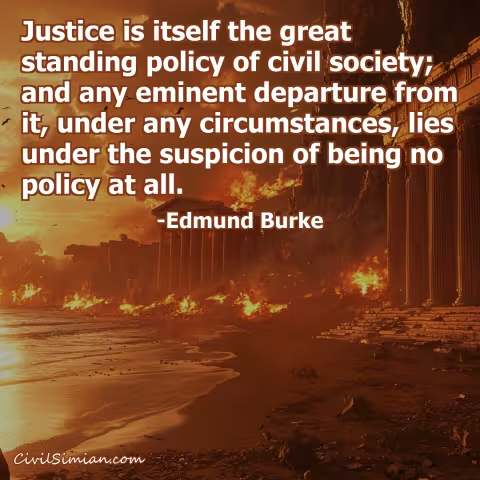
To be honest, from what I've seen, pure justice is better viewed stripped away from historical context to a certain extent. Too much history and time and we spin off into infinite circling. Not enough history and we fail to get the balance right. So many want the former to justify grievance retribution.


0
0
2 months 3 days ago

How very little can be done under the spirit of fear.

0
0
Source
source
As quoted in The Book of Positive Quotations (2007) by John Cook, p. 479
3 months 3 weeks ago

This idea of weapons of mass extermination is utterly horrible and is something which no one with one spark of humanity can tolerate. I will not pretend to obey a government which is organising a mass massacre of mankind.

0
0
Source
source
Speech in Birmingham, England encouraging civil disobedience in support of nuclear disarmament, 4/15/1961

Reverence for life, veneratio vitæ, is the most direct and at the same time the profoundest achievement of my will-to-live. In reverence for life my knowledge passes into experience. The simple world- and life-affirmation which is within me just because I am will-to-live has, therefore, no need to enter into controversy with itself, if my will-to-live learns to think and yet does not understand the meaning of the world. In spite of the negative results of knowledge, I have to hold fast to world- and life-affirmation and deepen it. My life carries its own meaning in itself. This meaning lies in my living out the highest idea which shows itself in my will-to-live, the idea of reverence for life. With that for a starting-point I give value to my own life and to all the will-to-live which surrounds me, I persevere in activity, and I produce values.

0
0
2 months 2 weeks ago

No position is so false as having understood and still remaining alive.

0
0
2 months 4 days ago

Because the book became a freak 'bestseller', because I found myself bracketed with the 'Angry Young Men' of the period, I found myself carried to 'fame' on a wave of publicity -- only to discover that this kind of fame is one of the subtlest forms of obscurity. Everybody knew who I was, and nobody knew what I stood for. The public image meant that nobody was interested in what I had to say, for everyone was convinced that they already knew. I could talk until I was blue in the face about my attempt to revise the pessimistic existentialism of Heidegger, Camus and Sartre; as far as most people were concerned, I was an autodidact who was angry about something or other.

0
0
Source
source
p. 188, George Bernard Shaw: A personal view
4 months 3 weeks ago

Let others complain that the age is wicked; my complaint is that it is paltry; for it lacks passion. Men's thoughts are thin and flimsy like lace, they are themselves pitiable like the lacemakers. The thoughts of their hearts are too paltry to be sinful. For a worm it might be regarded as a sin to harbor such thoughts, but not for a being made in the image of God. Their lusts are dull and sluggish, their passions sleepy. They do their duty, these shopkeeping souls, but they clip the coin a trifle, like the Jews; they think that even if the Lord keeps ever so careful a set of books, they may still cheat Him a little. Out upon them! This is the reason my soul always turns back to the Old Testament and to Shakespeare. I feel that those who speak there are at least human beings; they hate, they love, they murder their enemies, and curse their descendants throughout all generations, they sin.

0
0
2 months 2 weeks ago

The judgment that human life is worth living, or rather can and ought to be made worth living, ... underlies all intellectual effort; it is the a priori of social theory, and its rejection (which is perfectly logical) rejects theory itself.

0
0
Source
source
p. xliii
2 months 3 weeks ago

The doctrine of the transmigration of souls was indigenous to India and was brought into Greece by Pythagoras.

0
0
Source
source
quoted in Londhe, S. (2008). A tribute to Hinduism: Thoughts and wisdom spanning continents and time about India and her culture. New Delhi: Pragun Publication.
2 months 1 week ago

Advancing bourgeois society liquidates memory, time, recollection as irrational leftovers of the past.

0
0
Source
source
"Was bedeutet Aufarbeitung der Vergangenheit"

People do not cooperate under the division of labor because they love or should love one another. They cooperate because this best serves their own interests. Neither love nor charity nor any other sympathetic sentiments but rightly understood selfishness is what originally impelled man to adjust himself to the requirements of society, to respect the rights and freedoms of his fellow men and to substitute peaceful collaboration for enmity and conflict.

0
0
4 months 2 weeks ago

Self-education is, I firmly believe, the only kind of education there is.

0
0
4 months 2 weeks ago

They despised everything but virtue, caring little for their present state of life, and thinking lightly of the possession of gold and other property, which seemed only a burden to them; neither were they intoxicated by luxury; nor did wealth deprive them of their self-control; but they were sober, and saw clearly that all these goods are increased by virtue and friendship with one another, whereas by too great regard and respect for them, they are lost and friendship with them.

0
0
1 month 2 weeks ago

Literate man, civilized man, tends to restrict and to separate functions, whereas tribal man has freely extended the form of his body to include the universe.

0
0
Source
source
(p. 117)
4 months 1 week ago

How abundantly do spiritual beings display the powers that belong to them! We look for them, but do not see them; we listen to, but do not hear them; yet they enter into all things, and there is nothing without them.

0
0
3 months 1 week ago

Into the middle things.

0
0
Source
source
Line 148

Press on, therefore, as you have begun; perhaps you will be led to perfection, or to a point which you alone understand is still short of perfection.

0
0
2 months 1 week ago

That science is incapable of solving in its own way those fundamental questions is no sufficient reason for slighting them.

0
0
Source
source
p. 14
4 months 4 days ago

All the excesses, all the violence, and all the vanity of great men, come from the fact that they know not what they are: it being difficult for those who regard themselves at heart as equal with all men... For this it is necessary for one to forget himself, and to believe that he has some real excellence above them, in which consists this illusion that I am endeavoring to discover to you.

0
0
2 weeks 2 days ago

Liberalism has been very severely threatened in recent years. It's been threatened from a number of sources. So internationally you have two great powers, Russia and China, that are definitely not liberal polities, that have expansive ambitions... As Vladimir Putin said... in an iterview with the FT in 2019 "Liberalism is an obsolete doctrine." But the threat... also comes from other places. ...You have the rise of a populist nationalist right in many countries. This is Viktor Orbán in Hungary. This is Narendra Modi in India, Donald Trump in the United States, ...Marine Le Pen in France. All of them criticizing liberalism precisely for the tolerance that it permits and tries to deal with, in diverse and increasingly ethnically and racially diverse countries.

0
0
Source
source
5:36 Ref: Vladimir Putin says liberalism has 'become obsolete' (June 27, 2019) Financial Times.
1 month 2 weeks ago

There is absolutely no inevitability, so long as there is a willingness to contemplate what is happening.

0
0
Source
source
[A chapter sub-heading attributed by McLuhan to Alfred North Whitehead]
4 months 3 weeks ago
If each us had a different kind of sense perception — if we could only perceive things now as a bird, now as a worm, now as a plant, or if one of us saw a stimulus as red, another as blue, while a third even heard the same stimulus as a sound, then no one would speak of such a regularity of nature, rather, nature would be grasped only as a creation which is subjective in the highest degree. After all, what is a law of nature as such for us? We are not acquainted with it in itself, but only with its effects, which means in its relation to other laws of nature which, in turn, are known to us only as sums of relations. Therefore all these relations always refer again to others and are thoroughly incomprehensible to us in their essence.
0
0
3 months 3 weeks ago

Change is one thing, progress is another.

0
0
2 months 2 weeks ago

O faithless and perverse generation, how long shall I be with you? how long shall I suffer you? bring him hither to me.

0
0
Source
source
17:17 (KJV)
4 months 3 weeks ago

Even Plato assumes that the genuinely perfect condition of man means no sex distinction (and how strange this is for people like Feuerbach who are so occupied with affirming sex-differentiation, regarding which they would do best to appeal to paganism). He assumes that originally there was only the masculine (and when there is no thought of femininity, sex-distinction is undifferentiated), but through degeneration and corruption the feminine appeared. He assumes that base and cowardly men became women in death, but he still gives them hope of being elevated again to masculinity. He thinks that in the perfect life the masculine, as originally, will be the only sex, that is, that sex-distinction is a matter of indifference. So it is in Plato, and this, the idea of the state notwithstanding, was the culmination of his philosophy. How much more so, then, the Christian view.

0
0
1 month ago

As well as seriously - indeed exhaustively - researching everything that could conceivably go wrong, I think we should also investigate what could go right. The world is racked by suffering. The hedonic treadmill might more aptly be called a dolorous treadmill. Hundreds of millions of people are currently depressed, pain-ridden or both. Hundreds of billions of non-human animals are suffering too. If we weren't so inured to a world of pain and misery, then the biosphere would be reckoned in the throes of a global medical emergency. Thanks to breakthroughs in biotechnology, pain-thresholds, default anxiety levels, hedonic range and hedonic set-points are all now adjustable parameters in human and non-human animals alike. We are living in the final century of life on Earth in which suffering is biologically inevitable. As a society, we need an ethical debate about how much pain and misery we want to preserve and create. How do you break the hedonic treadmill?"

0
0
Source
source
, Quora, 6 Apr. 2019
4 weeks ago

Science is not distinguished from myth by science being literally true and myth only a type of poetic analogy. While their aims are different, both are composed of symbols we use to deal with a slippery world.

0
0
Source
source
Beyond the Last Thought: Freud's cigars and the long way round to Nirvana (p. 96)
2 months 1 week ago

Hardness and softness, roughness and smoothness, moonlight and sunlight present themselves in our recollection not preeminently as sensory contents but as certain kinds of symbioses, certain ways outside has of invading us and certain ways we have of meets this invasion...

0
0
Source
source
p. 317
2 months 2 weeks ago

Men do not sufficiently realise that their future is in their own hands. Theirs is the task of determining first of all whether they want to go on living or not. Theirs is the responsibility, then, for deciding if they want merely to live, or intend to make just the extra effort required for fulfilling, even on their refractory planet, the essential function of the universe, which is a machine for the making of gods.

0
0
4 months 6 days ago

Do you suppose that you can do the things you do now, and yet be a philosopher? Do you suppose that you can eat in the same fashion, drink in the same fashion, give way to anger and to irritation, just as you do now?

0
0
Source
source
Book III, ch. 15, 10 (= Enchiridion 29, 10).
3 months 3 weeks ago

People who invented the word charity, and used it in a good sense, inculcated more clearly, and much more efficaciously, the precept, Be charitable, than any pretended legislator or prophet, who should insert such a maxim in his writings.

0
0
Source
source
Part I, Essay 22: Of the Standard of Taste
3 months 2 weeks ago

The sins of the flesh are bad, but they are the least bad of all sins. All the worst pleasures are purely spiritual: the pleasure of putting other people in the wrong, of bossing and patronising and spoiling sport, and back-biting; the pleasures of power, of hatred. For there are two things inside me, competing with the human self which I must try to become. They are the Animal self, and the Diabolical self. The Diabolical self is the worse of the two. That is why a cold, self-righteous prig who goes regularly to church may be far nearer to hell than a prostitute. But, of course, it is better to be neither.

0
0
Source
source
Book III, Chapter 5, "Sexual Morality"
3 months 2 weeks ago

If the many, the specialists, gain the day, it will be the end of science as we know it - of great science. It will be a spiritual catastrophe comparable in its consequences to nuclear armament.

0
0
Source
source
K. Popper, The Myth of the Framework, London: Routledge. As quoted in The Cambridge Companion to Karl Popper (2016) by J. Shearmur, G. Stokes

CivilSimian.com created by AxiomaticPanic, CivilSimian, Kalokagathia