

2 months 2 weeks ago
I bow before the authority of special men because it is imposed upon me by my own reason. I am conscious of my inability to grasp, in all its details and positive developments, any very large portion of human knowledge. The greatest intelligence would not be equal to a comprehension of the whole. Thence results, for science as well as for industry, the necessity of the division and association of labor. I receive and I give - such is human life. Each directs and is directed in his turn. Therefore there is no fixed and constant authority, but a continual exchange of mutual, temporary, and, above all, voluntary authority and subordination.

1 week 2 days ago
The uttered part of a man's life, let us always repeat, bears to the unuttered, unconscious part a small unknown proportion. He himself never knows it, much less do others.

1 week 1 day ago
Those who try to include all life when trying to determine justice: Should a man be executed for killing a fly? No? The fly has a short life span? The fly is small? All these rationalizations can be applied to you, by a creature that lives longer, is bigger, etc. #philosophy
2 months 1 week ago
This they do in the service of an imaginary science; and, like the astrologers and soothsayers whom they have succeeded, cast up their eyes to the clouds, and speak in immense, unsubstantiated images and similes, in deeply misleading metaphors and allegories, and make use of hypnotic formulae with little regard for experience, or rational argument, or tests of proven reliability. Thereby they throw dust in their own eyes as well as in ours, obstruct our vision of the real world, and further confuse an already sufficiently bewildered public about the relations of morality to politics, and about the nature and methods of the natural sciences and historical studies alike.
2 months 2 weeks ago
But like the desire for eternal life, the desire for omniscience and absolute perfection is merely an imaginary desire; and, as history and daily experience prove, the supposed human striving for unlimited knowledge and perfection is a myth. Man has no desire to know everything; he only wants to know the things to which he is particularly drawn.
▼
Source
source
Lecture XXX, Atheism alone a Positive View

3 months 2 weeks ago
Since the working-class lives from hand to mouth,it buys as long as it has the means to buy.
▼
Source
source
Vol. II, Ch. XX, p. 449.

1 month 1 day ago
Biopiracy is biological theft; illegal collection of indigenous plants by corporations who patent them for their own use.
▼
Source
source
On biopiracy, from the booklet "No Patents on Seeds: A Handbook For Activists"

3 months 2 weeks ago
I am writing to you to tell you of my decision to return to your Government the Carl von Ossietzsky medal for peace. I do so reluctantly and after two years of private approaches on behalf of Heinz Brandt, whose continued imprisonment is a barrier to coexistence, relaxation of tension and understanding between East and West... I regret not to have heard from you on this subject. I hope that you will yet find it possible to release Brandt through an amnesty which would be a boon to the cause of peace and to your country.
▼
Source
source
Letter to Walter Ulbricht, January 7, 1964.
1 week ago
Human progress having reached a high level through respect for the liberty and dignity of men, it has become desirable to re-affirm these evident truths: That differences of race, color, and creed are natural, and that diverse groups, institutions, and ideas are stimulating factors in the development of man; That to promote harmony in diversity is a responsible task of religion and statesmanship; That since no individual can express the whole truth, it is essential to treat with understanding and good will those whose views differ from our own; That by the testimony of history intolerance is the door to violence, brutality and dictatorship; and That the realization of human interdependence and solidarity is the best guard of civilization.

3 months 2 weeks ago
The necessity of speaking, the predicament of having nothing to say, and the desire for tact are three things that can turn the greatest man into a laughingstock.

2 days ago
To no creature besides man has been given wisdom, foresight, industry, and reflection.
2 months 1 week ago
If this superstitious fear of Spirits were taken away, and with it, Prognostiques from Dreams, false Prophecies, and many other things depending thereon, by which, crafty ambitious persons abuse the simple people, men would be much more fitted then they are for civill Obedience.
▼
Source
source
The First Part, Chapter 2, p. 8
2 months 2 weeks ago
A living language can stand on a higher level of culture in comparison with another, but it can never in itself attain that perfection of development which a dead language quite easily attains. In the latter the connotation of words is fixed, and the possibilities of suitable combinations will also gradually become exhausted. Hence, he who wishes to speak this language must speak it just as it is; but, after he has once learnt to do this, the language speaks itself in his mouth and thinks and imagines for him.
▼
Source
source
Consequences of the Difference p. 85

3 months 2 weeks ago
You have not that power you ought to have over him, till he comes to be more afraid of offending so good a friend than of losing some part of his future expectation.
▼
Source
source
Sec. 97

1 month 2 weeks ago
If a work of art is to explore new environments, it is not to be regarded as a blueprint but rather as a form of action-painting.
▼
Source
source
To Wilfred Watson, October 6 1965. Letters of Marshall McLuhan (1987), p. 325
2 months 2 weeks ago
All religions are cruel, all founded on blood; for all rest principally on the idea of sacrifice - that is, on the perpetual immolation of humanity to the insatiable vengeance of divinity.

3 months 2 weeks ago
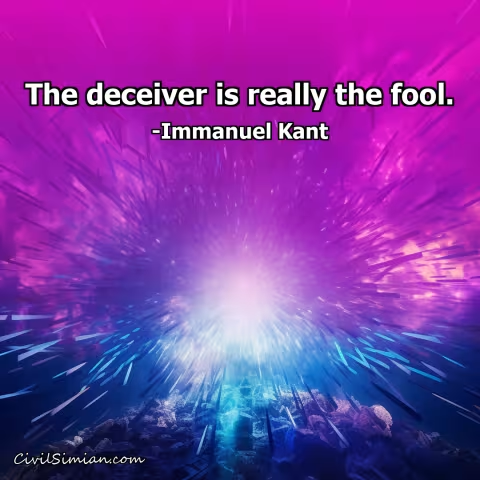
The deceiver is really the fool.
▼
Source
source
Kant, Immanuel (1996), page 101


3 months 1 week ago
I am sitting with a philosopher in the garden; he says again and again "I know that that's a tree", pointing to a tree that is near us. Someone else arrives and hears this, and I tell them: "This fellow isn't insane. We are only doing philosophy."
1 week 2 days ago
In the learned professions as in the unlearned, and in human things throughout, in every place and in every time, the true function of intellect is not that of talking, but of understanding and discerning with a view to performing!

4 months 2 weeks ago
Scientists have pushed back the horizon of time from the biblical 6,000 years to 4,600,000,000 years for the age of Earth a 760,000-fold increase.
1 month 2 weeks ago
It is the fantasy of seizing reality live that continues-ever since Narcissus bent over his spring. Surprising the real in order to immobilize it, suspending the real in the expiration of its double. You bend over the hologram like God over his creature: only God has this power of passing through walls, through people, and finding Himself immaterially in the beyond. We dream of passing through ourselves and of finding ourselves in the beyond: the day when your holographic double will be there in space, eventually moving and talking, you will have realized this miracle. Of course, it will no longer be a dream, so its charm will be lost.
▼
Source
source
"Holograms," p. 105
1 month 1 week ago
It is therefore, the interest of all, that every one, from birth, should be well educated, physically and mentally, that society may be improved in its character, - that everyone should be beneficially employed, physically and mentally, that the greatest amount of wealth may be created, and knowledge attained, - that everyone should be placed in the midst of those external circumstances that will produce the greatest number of pleasurable sensations, through the longest life, that man may be made truly intelligent, moral and happy, and be thus prepared to enter upon the coming Millennium.
▼
Source
source
A Development of the Principles & Plans on which to establish self-supporting Home Colonies

3 months 3 weeks ago
There is no conversation more boring than the one where everybody agrees.
1 month 2 weeks ago
He is a despicable sage whose wisdom does not profit himself.
▼
Source
source
Maxim 629

3 months 2 weeks ago
To some extent, mythology is only the most ancient history and biography. So far from being false or fabulous in the common sense, it contains only enduring and essential truth, the I and you, the here and there, the now and then, being omitted. Either time or rare wisdom writes it. Before printing was discovered, a century was equal to a thousand years. The poet is he who can write some pure mythology to-day without the aid of posterity.

3 months 2 weeks ago
Whether, then, all ought not immediately to discontinue and renounce it, with grief and abhorrence? Should not every society bear testimony against it, and account obstinate persisters in it bad men, enemies to their country, and exclude them from fellowship; as they often do for much lesser faults?
1 week 3 days ago
One must be something in order to do something.
▼
Source
source
Conversations with Eckermann
3 months 3 weeks ago
Every rich man is avaricious, in my opinion.
▼
Source
source
Ch. 14

2 months 1 day ago
People with healthy self-esteem do not need to create pretend identities.
3 months 2 weeks ago
He [Jesus] not only forbids actual uncleanness, but all irregular desires, upon pain of hell-fire; causeless divorces; swearing in conversation, as well as forswearing in judgment; revenge; retaliation; ostentation of charity, of devotion, and of fasting; repetitions in prayer, covetousness, worldly care, censoriousness: and on the other side commands loving our enemies, doing good to those that hate us, blessing those that curse us, praying for those that despitefully use us; patience and meekness under injuries, forgiveness, liberality, compassion: and closes all; his particular injunctions, with this general golden rule, Matt. VII. 12, "All things whatsoever ye would that men should do to you, do you even so to them, for this is the law and the prophets." And to show how much He is in earnest, and expects obedience to these laws, He tells them, Luke VI. 35, That if they obey, " great shall be their reward".
▼
Source
source
§ 116
1 month 2 weeks ago
Primitivism has become the vulgar cliche of much modern art and speculation.
▼
Source
source
(p. 77)

3 months 2 weeks ago
Let sanguine healthy-mindedness do its best with its strange power of living in the moment and ignoring and forgetting, still the evil background is really there to be thought of, and the skull will grin in at the banquet.
▼
Source
source
Lectures IV and V, "The Religion of Healthy-Mindedness"
2 months 1 week ago
Bourgeois political economy ... never gets to see man who is its real subject. It disregards the essence of man and his history and is thus in the profoundest sense not a 'science of people' but of non-people and of an inhuman world of objects and commodities.
▼
Source
source
"The Foundations of Historical Materialism," Studies in Critical Philosophy (1972), p. 9

2 months ago
books are only what we want them to be; rather, what we read into them.

4 months 2 days ago
What is food to one, is to others bitter poison.
▼
Source
source
Book IV, line 637 (reported in Bartlett's Familiar Quotations) Compare: "What's one man's poison, signor, / Is another's meat or drink", Beaumont and Fletcher, Love's Cure (1647), Act III, scene 2
2 months 1 week ago
:...Vienna is the origin of so many schools of its own which were dominant in the 1920s. And one of the most fundamental and influential, in which we all were partially caught, was logical positivism. In fact, Mises' brother, Richard von Mises, became one of the leading figures. Now he and I all grew up in this Ernst Mach philosophy that ultimately everything must be rationally justified...
▼
Source
source
Friedrich Hayek, in 1985 interview, quoted in Alan Ebenstein, Hayek's Journey: The Mind of Friedrich Hayek (2003), Ch. 10. Epistemology, Psychology, and Methodology
1 week 2 days ago
He who would write heroic poems should make his whole life a heroic poem.
▼
Source
source
Life of Schiller.
1 week 2 days ago
Man's unhappiness, as I construe, comes of his greatness; it is because there is an Infinite in him, which with all his cunning he cannot quite bury under the Finite.
▼
Source
source
Bk. I, ch. 9.

3 months 3 weeks ago
As to the Approbation or Esteem of those Blockheads who call themselves the Public, & whom a Bookseller, a Lord, a Priest, or a Party can guide, I do most heartily despise it.
▼
Source
source
Letter 138, To Gilbert Elliot of Minto; August 9, 1757
1 week 2 days ago
In every man's writings, the character of the writer must lie recorded.
▼
Source
source
Goethe (1828).
3 months 3 weeks ago
There is no method of reasoning more common, and yet none more blameable, than, in philosophical disputes, to endeavour the refutation of any hypothesis, by a pretence of its dangerous consequences to religion and morality. When any opinion leads to absurdities, it is certainly false; but it is not certain that an opinion is false, because it is of dangerous consequence. Such topics, therefore, ought entirely to be forborne; as serving nothing to the discovery of truth, but only to make the person of an antagonist odious.
▼
Source
source
Of Liberty and Necessity, Part II
2 months 1 week ago
No, you cannot expect people to understand the higher reaches of philosophy. Culture should be taken out of the hands of the dollar chasers. We need a national subsidy for literature. It is disgraceful that artists are treated like peddlers and that art works have to be sold like soap.

2 months 1 week ago
Those who exalt themselves will be humbled, and those who humble themselves will be exalted.
▼
Source
source
18:14 NIV

1 month 3 weeks ago
We do not think good metaphors are anything very important, but I think that a good metaphor is something even the police should keep an eye on...
▼
Source
source
E 91 Variant translation: A good metaphor is something even the police should keep an eye on.
2 months 1 week ago
Even at the outset, the total and massive quality has its uniqueness; even when vague and undefined, it is just that which it is and not anything else. If the perception continues, discrimination inevitably sets in. Attention must move, and as it moves, parts, members, emerge from the background. And if attention moves in a unified direction instead of wandering, it is controlled by the pervading qualitative unity; attention is controlled by it because it operates within it.
▼
Source
source
p. 199
2 months 1 week ago
Since the management of industry by individuals necessarily implies private property, and since competition is in reality merely the manner and form in which the control of industry by private property owners expresses itself, it follows that private property cannot be separated from competition and the individual management of industry. Private property must, therefore, be abolished and in its place must come the common utilization of all instruments of production and the distribution of all products according to common agreement - in a word, what is called the communal ownership of goods.
CivilSimian.com created by AxiomaticPanic, CivilSimian, Kalokagathia