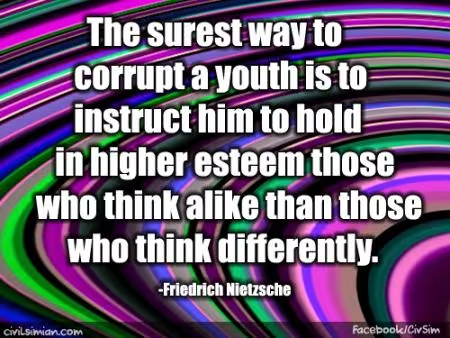
Think differently, but know when it's your duty to think the same...



Conformity is an imitation of grace.

The opinions that are held with passion are always those for which no good ground exists; indeed the passion is the measure of the holder's lack of rational conviction.
At the bottom of the heart of every human being, from earliest infancy until the tomb, there is something that goes on indomitably expecting, in the teeth of all experience of crimes committed, suffered, and witnessed, that good and not evil will be done to him. It is this above all that is sacred in every human being.The good is the only source of the sacred. There is nothing sacred except the good and what pertains to it.

A thatched roof once covered free men; under marble and gold dwells slavery.

Four snakes gliding up and down a hollow for no purpose that I could see - not to eat, not for love, but only gliding.

A man can live and be healthy without killing animals for food; therefore, if he eats meat, he participates in taking animal life merely for the sake of his appetite. And to act so is immoral.

So far as it goes, a small thing may give an analogy of great things, and show the tracks of knowledge.

That passivity was the essence of the problem. The human being was intended to be passive only in a condition of fatigue, and not always then. Too much passivity of body produced surplus fat, short-windedness, indigestion: passivity of mind produced the same symptoms on the mental level. a feeling of spiritual dyspepsia. Since the average human being has no purposes that are not connected with the activities of keeping alive, the black room was bound to produce passivity, increasing dullness, a state in which the mind is at once awake and static, motionless, stagnant. This sense of dullness was nothing less than the collapse of the sense of reality and of values, the retreat into one's inner world.

If we already lived in a cruelty-free world, the notion of re-introducing suffering, exploitation and creatures eating each other would seem not so much frightful as unimaginable - no more seriously conceivable than reverting to surgery without anaesthesia today.

Remind yourself that all men assert that wisdom is the greatest good, but that there are few who strenuously seek out that greatest good.

Ye have heard that it hath been said, Thou shalt love thy neighbour, and hate thine enemy. But I say unto you, Love your enemies, bless them that curse you, do good to them that hate you, and pray for them which despitefully use you, and persecute you; That ye may be the children of your Father which is in heaven: for he maketh his sun to rise on the evil and on the good, and sendeth rain on the just and on the unjust.
Very often the things that cost nothing cost us the most heavily; I can show you many objects the quest and acquisition of which have wrested freedom from our hands.
It makes a great difference in the force of a sentence whether a man be behind it or no.

People who live in society have learned how to see themselves in mirrors as they appear to their friends. I have no friends. Is that why my flesh is so naked?
In some places the metropolis makes do with paying a clique of feudal overlords; in others, it has fabricated a fake bourgeoisie of colonized subjects in a system of divide and rule; elsewhere, it has killed two birds with one stone: the colony is both settlement and exploitation.

How did they meet? By chance, like everybody ... Where did they come from? From the nearest place. Where were they going? Do we know where we are going?

Much of junk culture has a core of crisis - shoot-outs, conflagrations, bodies weltering in blood, naked embracers or rapist-stranglers. The sounds of junk culture are heard over a ground bass of extremism. Our entertainments swarm with specters of world crisis. Nothing moderate can have any claim to our attention.

It is a great force, and a great fortune, to be able to live without any ambition whatever. I aspire to it, but the very fact of so aspiring still participates in ambition.

Independence I have long considered as the grand blessing of life, the basis of every virtue; and independence I will ever secure by contracting my wants, though I were to live on a barren heath.

The mass of men lead lives of quiet desperation. What is called resignation is confirmed desperation.

We are now living in an age of literary exhaustion; we get used to the bleak landscape. Cyril Connolly said that the writer's business is to produce masterpieces; but what masterpieces have been produced in the past fifty years?

Mysticism is just tomorrow's science dreamed today.

Atheists have the intellectual courage to accept reality for what it is: wonderfully and shockingly explicable. As an atheist, you have the moral courage to live to the full the only life you're ever going to get: to fully inhabit reality, rejoice in it, and do your best finally to leave it better than you found it.
Our media make crisis chatter out of news and fill our minds with anxious phantoms of the real thing - a summit in Helsinki, a treaty in Egypt, a constitutional crisis in India, a vote in the U.N., the financial collapse of New York. We can't avoid being politicized (a word as murky as the condition which it describes) because it is necessary after all to know what is going on. Worse yet, what is going on will not let us alone. Neither the facts nor the deformations, the insidious platitudes of the media (tormenting because the underlying realities are so large and so terrible), can be screened out. The study of literature itself is heavily "politicized."

Man reaches the highest point of his knowledge about God when he knows that he knows him not, inasmuch as he knows that that which is God transcends whatsoever he conceives of him.

The annual labour of every nation is the fund which originally supplies it with all the necessaries and conveniences of life which it annually consumes.
The free being with absolute freedom proposes to itself certain ends. It wills because it wills, and the willing of an object is itself the last ground of such willing. Thus we have previously determined a free being, and any other determination would destroy the conception of an Ego, or of a free being. Now, if it could be so arranged that the willing of an unlawful end would necessarily - in virtue of an always effective law - result in the very reverse of that end, then the unlawful will would always ANNIHILATE ITSELF. A person could not will that end for the very reason because he did will it; his unlawful will would become the ground of its own annihilation, as the will is indeed always its own last ground.
The individual begins that long effort as an Outsider; he may finish it as a saint.

I can understand myself in believing, although in addition I can in a relative misunderstanding comprehend the human aspect of this life: but comprehend faith or comprehend Christ, I cannot.

My sympathies are, of course, with the Government side, especially the Anarchists; for Anarchism seems to me more likely to lead to desirable social change than highly centralized, dictatorial Communism.
Happily for poor traduced and degraded human nature, the principle for which we now content will speedily divest it of all the ridiculous and absurd mystery with which it has been hitherto enveloped by the ignorance of preceding times: and all the ''complicated'' and ''counteracting'' motives for good conduct, which have been multiplied almost to infinity, will be reduced to ''one single principle of action'', which, by its evident operation and sufficiency, shall render this intricate system ''unnecessary'', and ultimately supersede it in all parts of the earth. That principle is THE HAPPINESS OF SELF CLEARLY UNDERSTOOD AND UNIFORMLY PRACTICED; WHICH CAN ONLY BE ATTAINED BY CONDUCT THAT MUST PROMOTE THE HAPPINESS OF THE COMMUNITY.

These examples point to the third and most fundamental aspect of the incommensurability of competing paradigms. In a sense that I am unable to explicate further, the proponents of competing paradigms practice their trades in different worlds. One contains constrained bodies that fall slowly, the other pendulums that repeat their motions again and again. In one, solutions are compounds, in the other mixtures. One is embedded in a flat, the other in a curved, matrix of space. Practicing in different worlds, the two groups of scientists see different things when they look from the same point in the same direction. Again, that is not to say that they can see anything they please. Both are looking at the world, and what they look at has not changed. But in some areas they see different things, and they see them in different relations one to the other. That is why a law that cannot even be demonstrated to one group of scientists may occasionally seem intuitively obvious to another. p. 149
Ten thousand do not turn the scale against a single man of worth.

Just as the witticism brings two very different real objects under one concept, the pun brings two different concepts, by the assistance of accident, under one word.

Every daring attempt to make a great change in existing conditions, every lofty vision of new possibilities for the human race, has been labelled Utopian.
Each generation is a filter, a sieve; good genes tend to fall through the sieve into the next generation; bad genes tend to end up in bodies that die young or without reproducing.
Answers determined by the social division of labor become truth as such.

The universe is composed of matter, and, as a system, is sustained by motion. Motion is not a property of matter, and without this motion the solar system could not exist. Were motion a property of matter, that undiscovered and undiscoverable thing, called perpetual motion, would establish itself. It is because motion is not a property of matter, that perpetual motion is an impossibility in the hand of every being, but that of the Creator of motion. When the pretenders to Atheism can produce perpetual motion, and not till then, they may expect to be credited.

In the 1980s and 90s there was an extension of the autonomy of individual property owners in... a movement towards neoliberalism represented by Ronald Reagan, Margaret Thatcher and... by the Chicago school of economics that denigrated... the role of the state in the economy, that said the private markets would be able to solve most social distribution problems and the like. This was true in many ways. The world did become much richer in this period, but it also became much more unequal... Without adequate regulation and... effort to protect people against the excesses of market capitalism, you had people... left behind, even as their societies as a whole, grew. ...This ...became one of the triggers for the kind of populism we've seen arise in many rich countries.

...they cudgel their brains with absurd questions, such as, for instance, why God did not make the world many centuries earlier. They persuade themselves that it is easy to conceive, to be sure, how God may discern what is present, that is, what is actual in the time in which he is, but how He may foresee what is future, that is, what is actual in the time in which He is not yet, they deem an intellectual difficulty; as if the existence of the Necessary Being descended through all the moments of an imaginary time, and, having already exhausted a part of His duration, saw before Him the eternity He was yet to live simultaneously with the present events of the world. All these difficulties upon proper insight into the notion of time vanish like smoke.
Those who say that all historical accounts are ideological constructs (which is one version of the idea that there is really no historical truth) rely on some story which must itself claim historical truth. They show that supposedly "objective" historians have tendentiously told their stories from some particular perspective; they describe, for example, the biasses that have gone into constructing various histories of the United States. Such an account, as a particular piece of history, may very well be true, but truth is a virtue that is embarrassingly unhelpful to a critic who wants not just to unmask past historians of America but to tell us that at the end of the line there is no historical truth. It is remarkable how complacent some "deconstructive" histories are about the status of the history that they deploy themselves.

Logical analysis applied to mental phenomenon shows that there is but one law of mind, namely that ideas tend to spread continuously and to affect certain others which stand to them in a peculiar relation of affectibility. In this spreading they lose intensity, and especially the power of affecting others, but gain generality and become welded with other ideas.
The rights and duties of man thus simplified, it seems almost impertinent to attempt to illustrate truths that appear so incontrovertible: yet such deeply rooted prejudices have clouded reason, and such spurious qualities have assumed the name of virtues, that it is necessary to pursue the course of reason as it has been perplexed and involved in error, by various adventitious circumstances, comparing the simple axiom with casual deviations.Men, in general, seem to employ their reason to justify prejudices, which they have imbibed, they cannot trace how, rather than to root them out. The mind must be strong that resolutely forms its own principles; for a kind of intellectual cowardice prevails which makes many men shrink from the task, or only do it by halves. Yet the imperfect conclusions thus drawn, are frequently very plausible, because they are built on partial experience, on just, though narrow, views.
But how foolish it is to set out one's life, when one is not even owner of the morrow!
Impossible to spend sleepless nights and accomplish anything: if, in my youth, my parents had not financed my insomnias, I should surely have killed myself.
The second is the partiality for unity proper to the philosophical mind, whence this wide-spread canon has flown forth: principles are not to be multiplied beyond supreme necessity, to which we give in our adhesion, not because we have insight into causal unity in the world either by reason or experience, but as seeking it by an impulse of the intellect which seems to itself to have by thus much advanced in the explication of phenomena, by as much as it is granted to it to descend from the same principle to a greater number of consequences,
CivilSimian.com created by AxiomaticPanic, CivilSimian, Kalokagathia