



The different pieces of evidence did not constitute so many neutral elements, until such time as they could be gathered together into a single body of evidence that would bring the final certainty of guilt. Each piece of evidence aroused a particular degree of abomination. Guilt did not begin when all the evidence was gathered together; piece by piece, it was constituted by each of the elements that made it possible to recognize a guilty person. Thus a semi-proof did not leave the suspect innocent until such time as it was completed; it made him semi-guilty; slight evidence of a serious crime marked someone as slightly criminal. In short, penal demonstration did not obey a dualistic system: true or false; but a principle of continuous gradation; a degree reached in the demonstration already formed a degree of guilt and consequently involved a degree of punishment.
Let the punishments of criminals be useful. A hanged man is good for nothing; a man condemned to public works still serves the country, and is a living lesson.
It is easy to see that, even in the freedom of early youth, an American girl never quite loses control of herself; she enjoys all permitted pleasures without losing her head about any of them, and her reason never lets the reins go, though it may often seem to let them flap.
Try as I will, I don't see what might exist...
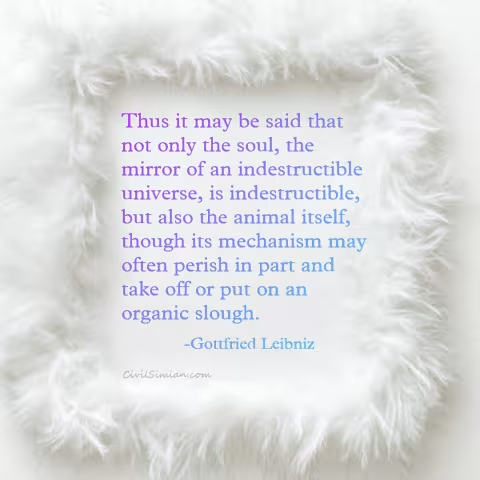
An entire mythology is stored within our language.
Yet sometimes vegetables and animals are, by certain epithets or circumstances, extended to other significations; as a Tree, when called the tree of life or of knowledge; and a Beast, when called the old serpent, or worshiped. When a Beast or Man is put for a kingdom, his parts and qualities are put for the analogous parts and qualities of the kingdom; as the head of a Beast, for the great men who precede and govern; the tail for the inferior people, who follow and are governed; the heads, if more than one, for the number of capital parts, or dynasties, or dominions in the kingdom, whether collateral or successive, with respect to the civil government; the horns on any head, for the number of kingdoms in that head, with respect to military power...
Ten thousand do not turn the scale against a single man of worth.
We must understand well that we do not proceed from a unity of God to the same unity of God again. We do not proceed from one chaos to another chaos, neither from one light to another light, nor from one darkness to another darkness. What would be the value of our life then? What would be the value of all life? But we set out from an almighty chaos, from a thick abyss of light and darkness tangled. And we struggle - plants, animals, men, ideas - in this momentary passage of individual life, to put in order the Chaos within us, to cleanse the abyss, to work upon as much darkness as we can within our bodies and to transmute it into light.
Hegel once observed that comedy is in act superior to tragedy and humourous reasoning superior to grandiloquent reasoning. Although Lincoln does not possess the grandiloquence of historical action, as an average man of the people he has its humour.
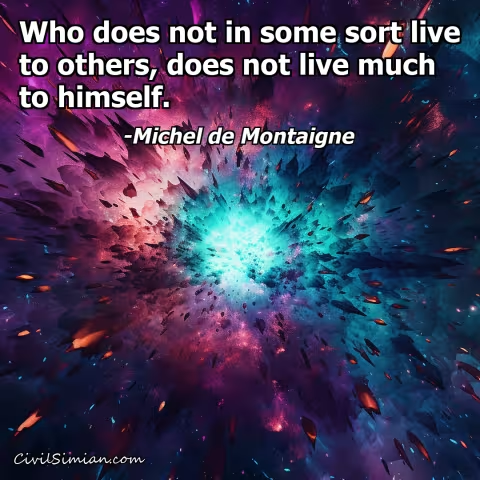
There is no man alone, because every man is a Microcosm, and carries the whole world about him.
The directing motive, the end and aim of capitalist production, is to extract the greatest possible amount of surplus value, and consequently to exploit labor-power to the greatest possible extent.
Wait for the appointed hour.
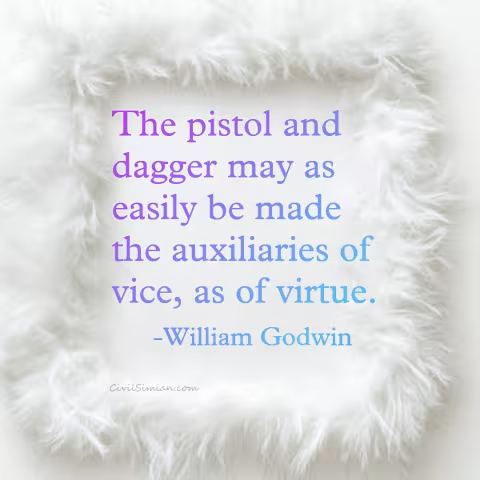
The evil that is in the world always comes of ignorance, and good intentions may do as much harm as malevolence, if they lack understanding. On the whole men are more good than bad; that, however, isn't the real point. But they are more or less ignorant, and it is this that we call vice or virtue; the most incorrigible vice being that of an ignorance which fancies it knows everything and therefore claims for itself the right to kill. There can be no true goodness, nor true love, without the utmost clear-sightedness.
To confuse our own constructions and inventions with eternal laws or divine decrees is one of the most fatal delusions of men.
These five rules [above] form all that is necessary to render proofs convincing, immutable, and to say all, geometrical; and the eight rules together render them even more perfect.
To these spurious principles must be added some others of great affinity with them... First, that by which we assume that everything in the universe is done according to the order of nature, which principle by Epicurus was proclaimed without any restriction, and by all other philosophers unanimously with extremely rare exceptions, not to be admitted but from supreme necessity.
What is at stake here is precisely the problem of the fulfillment of desire: when we encounter in reality an object which has all the properties of the fantasized object of desire, we are nevertheless necessarily somewhat disappointed; we experience a certain this is not it; it becomes evident that the finally found real object is not the reference of desire even though it possesses all the required properties.
He has spent all his life in letting down empty buckets into empty wells; and he is frittering away his age in trying to draw them up again.
As long as the aristocracy is healthy, the name of the sovereign sacred to it, and it loves the monarchy passionately, the State is unshakeable, whatever be the qualities of the king. But once it loses its greatness, its pride, its energy, its faith, the spirit withdraws, the monarchy is dead, and its cadaver is left to the worms.
The Whigs of this day have before them, in this Appeal, their constitutional ancestors: They have the doctors of the modern school. They will choose for themselves. The author of the Reflections has chosen for himself. If a new order is coming on, and all the political opinions must pass away as dreams, which our ancestors have worshipped as revelations, I say for him, that he would rather be the last (as certainly he is the least) of that race of men, than the first and greatest of those who have coined to themselves Whig principles from a French die, unknown to the impress of our fathers in the constitution.
Those distinct substances, which concretes generally either afford, or are made up of, may, without very much inconvenience, be called the elements or principles of them.
And to bring in a new word by the head and shoulders, they leave out the old one.
I should say that the universe is just there, and that is all.
In modern eyes, precious though wars may be they must not be waged solely for the sake of the ideal harvest. Only when forced upon one, is a war now thought permissible. It was not thus in ancient times. The earlier men were hunting men, and to hunt a neighboring tribe, kill the males, loot the village and possess the females, was the most profitable, as well as the most exciting, way of living. Thus were the more martial tribes selected, and in chiefs and peoples a pure pugnacity and love of glory came to mingle with the more fundamental appetite for plunder. Modern war is so expensive that we feel trade to be a better avenue to plunder; but modern man inherits all the innate pugnacity and all the love of glory of his ancestors. Showing war's irrationality and horror is of no effect on him. The horrors make the fascination. War is the strong life; it is life in extremis; war taxes are the only ones men never hesitate to pay, as the budgets of all nations show us.
What matters the party to me? I shall find enough anyhow who unite with me without swearing allegiance to my flag.
I fancy that most people who think at all have done a great deal of their thinking in the first fourteen years.
Happiness is a good flow of life.
The actor's realm is that of the fleeting.
Thus the social position of women is in this respect very similar to that of philosophers and of the working classes. And we now see why these three elements should be united. It is their combined action which constitutes the moral or modifying force of society.
Nature does nothing in vain, and in the use of means to her goals she is not prodigal. Her giving to man reason and the freedom of the will which depends upon it is clear indication of her purpose. Man accordingly was not to be guided by instinct, not nurtured and instructed with ready-made knowledge; rather, he should bring forth everything out of his own resources.
The book of the world, so richly studied by autodidacts, is being closed by the "learned," who are raising walls of opinions to shut the world out.
Know the joy of life by piling good deed on good deed until no rift or cranny appears between them.
The Churches as Churches have always been and cannot fail to be institutions not only alien to, but directly hostile towards, Christ's teaching.
Times are changed with him who marries; there are no more by-path meadows, where you may innocently linger, but the road lies long and straight and dusty to the grave. Idleness, which is often becoming and even wise in the bachelor, begins to wear a different aspect when you have a wife to support.
With men this is impossible; but with God all things are possible.
As the Genesis story teaches, knowledge cannot save us from ourselves. If we know more than before, it means only that we have greater scope to enact our fantasies. But - as the Genesis myth also teaches - there is no way we can rid ourselves of what we know. If we try to regain a state of innocence, the result can only be a worse madness. The message of Genesis is that in the most vital areas of human life there can be no progress, only an unending struggle with our own nature.
Is the child to be considered as an individuality, or as an object to be moulded according to the whims and fancies of those about it? This seems to me to be the most important question to be answered by parents and educators. And whether the child is to grow from within, whether all that craves expression will be permitted to come forth toward the light of day; or whether it is to be kneaded like dough through external forces, depends upon the proper answer to this vital question.
Listen widely to remove your doubts and be careful when speaking about the rest and your mistakes will be few. See much and get rid of what is dangerous and be careful in acting on the rest and your causes for regret will be few. Speaking without fault, acting without causing regret: 'upgrading' consists in this.
It is not to be supposed that she was, or that any one, at the age at which I first saw her, could be, all that she afterwards became. Least of all could this be true of her, with whom self-improvement, progress in the highest and in all senses, was a law of her nature; a necessity equally from the ardour with which she sought it, and from the spontaneous tendency of faculties which could not receive an impression or an experience without making it the source or the occasion of an accession of wisdom. Up to the time when I first saw her, her rich and powerful nature had chiefly unfolded itself according to the received type of feminine genius. To her outer circle she was a beauty and a wit, with an air of natural distinction, felt by all who approached her: to the inner, a woman of deep and strong feeling, of penetrating and intuitive intelligence, and of an eminently meditative and poetic nature.
Ancient philosophy will always hold its own among those who are worthy to judge it, because it forms... a system that is solid and well articulated like the body, whereas all these scattered members of modern philosophy form no system.
I posit myself as rational, that is, as free. In doing so I have the representation of freedom. In the same undivided act I posit other free beings. Hence, I describe through my power of imagination a sphere of freedom, which these many separate beings divide amongst themselves. I do not ascribe to myself all the freedom which I have posited, because I must also posit other free beings, and must ascribe part of it to them. Thus, in appropriating freedom to myself, I at the same time restrict myself, by leaving freedom to others.
Whenever you say anything good about East Germany, immediately somebody jumps up and says, "My God, you're a Stalinist..." I'm not defending everything about it, of course. But I laboured on the chapter that talks about the east. I fact-checked it; I had somebody else fact-check it. I knew that I was going to get a lot of flak for that. But in the beginning, East Germany did a better job. They just did.
By all means begin your folio; even if the doctor does not give you a year, even if he hesitates about a month, make one brave push and see what can be accomplished in a week.
Every man may claim the fullest liberty to exercise his faculties compatible with the possession of like liberties by every other man.
The Universe is one, infinite, immobile. The absolute potential is one, the act is one, the form or soul is one, the material or body is one, the thing is one, the being in one, one is the maximum and the best... It is not generated, because there is no other being it could desire or hope for, since it comprises all being. It does not grow corrupt. because there is nothing else into which it could change, given that it is itself all things. It cannot diminish or grow, since it is infinite.
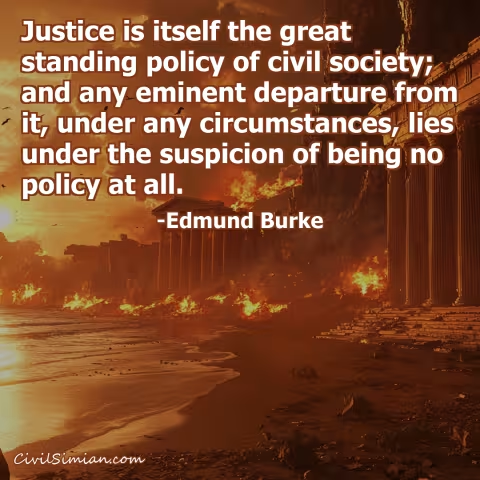
A man full of warm, speculative benevolence may wish his society otherwise constituted than he finds it, but a good patriot and a true politician always considers how he shall make the most of the existing materials of his country. A disposition to preserve and an ability to improve, taken together, would be my standard of a statesman. Everything else is vulgar in the conception, perilous in the execution.
All things are subject to decay and change.
CivilSimian.com created by AxiomaticPanic, CivilSimian, Kalokagathia