
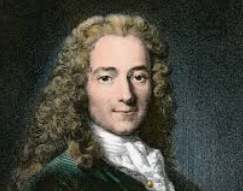
Voltaire
Member for
10 monthsVoltaire — Wit, Fire, and the Fight for Reason (1694–1778)
Voltaire was the sharp-tongued philosopher of the Enlightenment — a man who used irony like a blade, reason like a torch, and satire like artillery against tyranny, fanaticism, and ignorance.
A Mind Too Sharp for the Age
Born François-Marie Arouet in Paris, he quickly grew into a writer whose wit could topple reputations. His early satires landed him in the Bastille, but imprisonment only strengthened his resolve. The world, he decided, was filled with pompous illusions, and he felt duty-bound to puncture every one of them.
“Those who can make you believe absurdities can make you commit atrocities.”
England, Exile, and Enlightenment
After offending French aristocrats one time too many, Voltaire fled to England. The exile became an education. He absorbed Locke’s political philosophy, Newton’s science, and Britain’s culture of freer speech — ideas he carried back to France like contraband intellectual gunpowder.
His Letters on England praised British tolerance and reason, enraging French authorities and electrifying French readers. He became a central architect of the Enlightenment almost by accident — simply by describing what a rational society might look like.
“Appreciation is a wonderful thing: It makes what is excellent in others belong to us as well.”
Candide and the Art of Satirical Destruction
Voltaire’s masterpiece, Candide, dismantled the popular optimism of the day — especially the doctrine that the world is “the best of all possible worlds.” Instead of argument, Voltaire used absurdity: natural disasters, war, cruelty, corruption, each delivered with comic precision.
He wanted readers not to despair but to wake up — to see the world clearly, then make it better through action rather than wishful thinking.
“We must cultivate our garden.”
Champion of Tolerance and Enemy of Fanaticism
Voltaire fought tirelessly against injustice, especially in famous cases like the wrongful execution of Jean Calas. He believed that cruelty was almost always born from ignorance — and that enlightenment was the antidote. His slogans of tolerance and civil rights helped set the moral tone of modern secular democracies.
His vision was not naïve; it was disciplined. He trusted reason, not because humans are perfect, but because it is the best tool we have against the darker parts of ourselves.
“Liberty of thought is the life of the soul.”
Legacy — The Pen That Sparked a Century
Voltaire died a celebrity and a rebel, celebrated by the people and feared by the powerful. His works remain foundational to ideas about free expression, tolerance, secularism, and the dignity of every human mind.
His spirit lives whenever a smug idea is punctured by a precise sentence — or whenever someone dares to think freely despite the costs.
“I disapprove of what you say, but I will defend to the death your right to say it.”
CivilSimian.com created by AxiomaticPanic, CivilSimian, Kalokagathia