

2 months 3 weeks ago
The noble simplicity in the works of nature only too often originates in the noble shortsightedness of him who observes it.
▼
Source
source
H 1

4 months 2 weeks ago
The past treatment of Africans must naturally fill them with abhorrence of Christians; lead them to think our religion would make them more inhuman savages, if they embraced it; thus the gain of that trade has been pursued in opposition to the Redeemer's cause, and the happiness of men: Are we not, therefore, bound in duty to him and to them to repair these injuries, as far as possible, by taking some proper measures to instruct, not only the slaves here, but the Africans in their own countries? Primitive Christians laboured always to spread their Divine Religion; and this is equally our duty while there is an Heathen nation: But what singular obligations are we under to these injured people!

4 months 2 weeks ago
I don't care for the applause one gets by saying what others are thinking; I want actually to change people's thoughts. Power over people's minds is the main personal desire of my life; and this sort of power is not acquired by saying popular things.
▼
Source
source
Letter to Lucy Martin Donnelly, February 10, 1916
3 months 1 week ago
Life, individual or collective, personal or historic, is the one entity in the universe whose substance is compact of danger, of adventure. It is, in the strict sense of the word, drama. ... The primary, radical meaning of life appears when it is employed in the sense not of biology, but of biography. For the very strong reason that the whole of biology is quite definitely only a chapter in certain biographies, it is what biologists do in the portion of their lives open to biography.
▼
Source
source
Chap.IX: The Primitive and the Technical

1 month 3 days ago
What fools these mortals be!
4 months 2 weeks ago
Wherever one finds oneself inclined to bitterness, it is a sign of emotional failure: a larger heart, and a greater self-restraint, would put a calm autumnal sadness in the place of the instinctive outcry of pain.
▼
Source
source
The Collected Papers of Bertrand Russell: Contemplation and Action, 1902-1914, ed. Richard A. Rempel, Andrew Brink and Margaret Moran (Routledge, 1993


4 months 3 weeks ago
I assert once again as a truth to which history as a whole bears witness that men may second their fortune, but cannot oppose it; that they may weave its warp, but cannot break it. Yet they should never give up, because there is always hope, though they know not the end and more towards it along roads which cross one another and as yet are unexplored; and since there is hope, they should not despair, no matter what fortune brings or in what travail they find themselves.
▼
Source
source
Book 2, Ch. 29 (as translated by LJ Walker and B Crick)
2 months 1 day ago
Nature shrinks as capital grows. The growth of the market cannot solve the very crisis it creates.
▼
Source
source
Soil Not Oil: Environmental Justice in an Age of Climate Crisis
3 months 1 week ago
Writing is like getting married. One should never commit oneself until one is amazed at one's luck.
▼
Source
source
The Black Prince (1973); 2003, p. 10.

3 months 4 weeks ago
Rest satisfied with doing well, and leave others to talk of you as they please.
▼
Source
source
As quoted in The World's Laconics: Or, The Best Thoughts of the Best Authors (1853) by Everard Berkeley Variant: Rest satisfied with doing well, and leave others to talk of you as they will.

5 months 2 weeks ago
I get a certain pleasure in knowing that I live not merely in a city but in Manhattan, the center of New York City, a region so unique in many ways that I honestly believe that Earth is divided into halves: Manhattan and non-Manhattan.

4 months 3 weeks ago
Several actual worlds without one another are not, therefore, impossible by the very concept, as Wolf hastily concluded from the notion of a complex or multiplicity which he deemed sufficient to a whole, as such, but only on condition that there exist but one necessary cause of all things. If several are admitted, several worlds without one another will be possible in the strictest metaphysical sense.
4 months 2 weeks ago
There are two things which make it impossible to believe that this world is the successful work of an all-wise, all-good, and, at the same time, all-powerful Being; firstly, the misery which abounds in it everywhere; and secondly, the obvious imperfection of its highest product, man, who is a burlesque of what he should be.
▼
Source
source
"On the Sufferings of the World"

4 months 3 weeks ago
One may be humble out of pride.
▼
Source
source
Book II, Ch. 17. Of Presumption
4 months 5 days ago
Aristodemus, a friend of Antigonus, supposed to be a cook's son, advised him to moderate his gifts and expenses. "Thy words," said he, "Aristodemus, smell of the apron."
▼
Source
source
44 Antigonus I
4 months 2 weeks ago
It is better to be a human being dissatisfied than a pig satisfied; better to be Socrates dissatisfied than a fool satisfied. And if the fool, or the pig, are of a different opinion, it is because they only know their own side of the question. The other party to the comparison knows both sides.
▼
Source
source
Ch. 2
1 week 1 day ago
May they not forget to keep pure the great heritage that puts them ahead of the West: the artistic configuration of life, the simplicity and modesty of personal needs, and the purity and serenity of the Japanese soul.
▼
Source
source
Comment made after a six-week trip to Japan in November-December 1922, published in Kaizo 5, no. 1 (January 1923), 339. Einstein Archive 36-477.1. Appears in The New Quotable Einstein by Alice Calaprice (2005), p. 269
4 months 1 week ago
Plato has preserved in the Theaetetus - the story is that Thales, while occupied in studying the heavens above and looking up, fell into a well. A good-looking and whimsical maid from Thrace laughed at him and told him that while he might passionately want to know all things in the universe, the things in front of his very nose and feet were unseen by him." Plato added: "This jest also fits all those who become involved in Philosophy." Therefore, the question, What is a thing?" must always be rated as one that causes housemaids to laugh.
▼
Source
source
p. 3

3 months 1 week ago
Man is a thinking being. His reason enables him to recognize his own potentialities and those of his world. He is thus not at the mercy of the facts that surround him, but is capable of subjecting them to a higher standard, that of reason.
▼
Source
source
P. 6
2 weeks ago
For it has been truly observed by a great philosopher, that truth does more easily emerge out of error than confusion.

3 months 2 weeks ago
We suffer: the external world begins to exist . . . ; we suffer to excess: it vanishes. Pain instigates the world only to unmask its unreality.
4 weeks 1 day ago
Beat a dog once and you only have to show him the whip.


4 months 2 weeks ago
The stars awaken a certain reverence, because though always present, they are inaccessible; but all natural objects make a kindred impression, when the mind is open to their influence. Nature never wears a mean appearance. Neither does the wisest man extort her secret, and lose his curiosity by finding out all her perfection. Nature never became a toy to a wise spirit. The flowers, the animals, the mountains, reflected the wisdom of his best hour, as much as they had delighted the simplicity of his childhood.
▼
Source
source
Nature

5 months 2 weeks ago
The truth is always in the minority, and the minority is always stronger than the majority, because as a rule the minority is made up of those who actually have an opinion, while the strength of the majority is illusory, formed of that crowd which has no opinion - and which therefore the next moment (when it becomes clear that the minority is the stronger) adopts the latter's opinion, which now is in the majority, i.e. becomes rubbish by having the whole retinue and numerousness on its side, while the truth is again in a new minority.

3 months 1 day ago
The effects of mescalin or LSD can be, in some respects, far more satisfying than those of alcohol. To begin with, they last longer; they also leave behind no hangover, and leave the mental faculties clear and unimpaired. They stimulate the faculties and produce the ideal ground for a peak experience.
▼
Source
source
p. 88

4 months 2 weeks ago
He will better comprehend the foundations and measures of decency and justice, and have livelier, and more lasting impressions of what he ought to do, by giving his opinion on cases propos'd, and reasoning with his tutor on fit instances, than by giving a silent, negligent, sleepy audience to his tutor's lectures; and much more than by captious logical disputes, or set declamations of his own, upon any question. The one sets the thoughts upon wit and false colours, and not upon truth; the other teaches fallacy, wrangling, and opiniatry; and they are both of them things that spoil the judgment, and put a man out of the way of right and fair reasoning; and therefore carefully to be avoided by one who would improve himself, and be acceptable to others.
▼
Source
source
Sec. 98
5 months 2 weeks ago
Socrates: Dear Pan and all the other Gods of this place, grant that I may be beautiful inside. Let all my external possessions be in friendly harmony with what is within. May I consider the wise man rich. As for gold, let me have as much as a moderate man could bear and carry with him. Do we need anything more, Phaedrus? For me that prayer is enough. Phaedrus: Let me also share in this prayer; for friends have all things in common.

4 months 3 weeks ago
We must remove the Decalogue out of sight and heart.
▼
Source
source
Wilhelm Martin Leberecht De Wette, 4, 188. As cited by Jonathan Ramachandran (January 1, 2019), Lake of Fire - Hope for the Wicked One Day? - Essays in First Christianity, 5 Loaf 2 Fish Publications, p. 1264.
3 months 1 week ago
The truth is cruel, but it can be loved, and it makes free those who have loved it.
▼
Source
source
p. 107

2 weeks 1 day ago
Let no act be done at haphazard, nor otherwise than according to the finished rules that govern its kind.
▼
Source
source
IV, 2

1 month 1 week ago
We have chosen Mahomet not as the most eminent Prophet; but as the one we are freest to speak of. He is by no means the truest of Prophets; but I do esteem him a true one. Farther, as there is no danger of our becoming, any of us, Mahometans, I mean to say all the good of him I justly can. It is the way to get at his secret: let us try to understand what he meant with the world; what the world meant and means with him, will then be a more answerable question. Our current hypothesis about Mahomet, that he was a scheming Impostor, a Falsehood incarnate, that his religion is a mere mass of quackery and fatuity, begins really to be now untenable to any one. The lies, which well-meaning zeal has heaped round this man, are disgraceful to ourselves only.
3 months 2 weeks ago
There was a time when religion was kept secret from popular belief within the mystery cults like a holy fire, sharing a common sanctuary with philosophy. The legends of antiquity name the earliest philosophers as the originators of these mystery cults, from which the most enlightened among the later philosophers, notably Plato, liked to educe their divine teachings. At that time philosophers still had the courage and the right to discuss the singly great themes, the only ones worthy of philosophizing and rising above common knowledge.
▼
Source
source
P. 7
2 weeks 4 days ago
Violence breeds violence. Acts of violence committed in "justice" or in affirmation of "rights" or in defense of "peace" do not end violence. They prepare and justify its continuation.
4 months 1 week ago
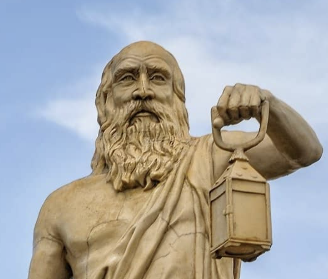
When the slave auctioneer asked in what he was proficient, he replied, "In ruling people."
▼
Source
source
Diogenes Laërtius, vi. 74
4 months 2 weeks ago
Philosophy ... is a science, and as such has no articles of faith; accordingly, in it nothing can be assumed as existing except what is either positively given empirically, or demonstrated through indubitable conclusions.
▼
Source
source
Vol I

3 months 2 weeks ago
It is the nature of all greatness not to be exact.
4 months 3 weeks ago
Men never do good unless necessity drives them to it; but when they are free to choose and can do just as they please, confusion and disorder become rampant.
▼
Source
source
Book 1, Ch. 3 (as translated by LJ Walker and B Crick)
4 months 2 weeks ago
Philosophy is to be studied, not for the sake of any definite answers to its questions, since no definite answers can, as a rule, be known to be true, but rather for the sake of the questions themselves; because these questions enlarge our conception of what is possible, enrich our intellectual imagination and diminish the dogmatic assurance which closes the mind against speculation; but above all because, through the greatness of the universe which philosophy contemplates, the mind is also rendered great, and becomes capable of that union with the universe which constitutes its highest good.
2 weeks 3 days ago
It is too narrow an understanding of production which confines it merely to the making of things. Production includes not merely the making of things, but the bringing of them to the consumer. The merchant or storekeeper is thus as truly a producer as is the manufacturer, or farmer, and his stock or capital is as much devoted to production as is theirs.
▼
Source
source
Book I, Ch. 2

2 weeks 4 days ago
We might as well say that the Newtonian system of philosophy is a part of the common law, as that the Christian religion is. The truth is that Christianity and Newtonianism being reason and verity itself, in the opinion of all but infidels and Cartesians, they are protected under the wings of the common law from the dominion of other sects, but not erected into dominion over them.
▼
Source
source
To Dr. Thomas Cooper Monticello, February 10, 1814

3 months 2 weeks ago
Do a man dirt, yourself you hurt.
1 month 1 week ago
A noble person attracts noble people, and knows how to hold on to them.
▼
Source
source
Torquato Tasso, Act I, sc. i
3 months 1 week ago
It is a familiar and significant saying that a problem well-put is half-solved.
▼
Source
source
"The Pattern of Inquiry"
2 weeks 1 day ago
Look at everything that exists, and observe that it is already in dissolution and change, and as it were putrefaction or dispersion, or that everything is so constituted in nature as to die.
▼
Source
source
X, 18
5 months 2 weeks ago
When one merely states that one has many subscribers and keeps on saying it, then one gets many; just as when one sheep goes to water, the next one also goes, and when it is continually said of a large flock of sheep that they go hither and yon to water, then the rest must also go, so people believe that it must be the demand of the times, that for the sake of use and custom, they must also subscribe.
4 months 2 weeks ago
The atheist who affects to reason, and the fanatic who rejects reason, plunge themselves alike into inextricable difficulties. The one perverts the sublime and enlightening study of natural philosophy into a deformity of absurdities by not reasoning to the end. The other loses himself in the obscurity of metaphysical theories, and dishonours the Creator, by treating the study of his works with contempt. The one is a half-rational of whom there is some hope, the other a visionary to whom we must be charitable.
▼
Source
source
A Discourse, &c. &c.
4 months 2 weeks ago
I never turned recreant to intellectual culture, or ceased to consider the power and practice of analysis as an essential condition both of individual and of social improvement. But I thought that it had consequences which required to be corrected, by joining other kinds of cultivation with it. The maintenance of a due balance among the faculties, now seemed to me of primary importance. The cultivation of the feelings became one of the cardinal points in my ethical and philosophical creed.
▼
Source
source
(pp. 143-144)
CivilSimian.com created by AxiomaticPanic, CivilSimian, Kalokagathia