


4 days ago
This poor amphibious Pope too gives loaves to the Poor; has in him more good latent than he is himself aware of. His poor Jesuits, in the late Italian Cholera, were, with a few German Doctors, the only creatures whom dastard terror had not driven mad: they descended fearless into all gulfs and bedlams; watched over the pillow of the dying, with help, with counsel and hope; shone as luminous fixed stars, when all else had gone out in chaotic night: honour to them!
1 month 4 weeks ago
Creativity is the universal of universals characterizing ultimate matter of fact. It is that ultimate principle by which the many, which are the universe disjunctively, become the one actual occasion, which is the universe conjunctively. It lies in the nature of things that the many enter into complex unity.
▼
Source
source
Pt. I, ch. 2, sec. 2.

1 month 3 weeks ago
The unbeliever walks for a quadrillion miles, yet one moments of reality makes up for it.
▼
Source
source
Chapter Seven, The Great Synthesis…
3 months 3 weeks ago
Cunning and deceit will every time serve a man better than force to rise from a base condition to great fortune.
▼
Source
source
Book 2, Ch. 13

2 months 2 weeks ago
In cities men cannot be prevented from concerting together, and from awakening a mutual excitement which prompts sudden and passionate resolutions. Cities may be looked upon as large assemblies, of which all the inhabitants are members; their populace exercises a prodigious influence upon the magistrates, and frequently executes its own wishes without their intervention. Variant translation: In towns it is impossible to prevent men from assembling, getting excited together and forming sudden passionate resolves. Towns are like great meeting houses with all the inhabitants as members. In them the people wield immense influence over their magistrates and often carry their desires into execution without intermediaries.
▼
Source
source
Chapter XVII.
3 weeks 5 days ago
Societies, not states, are 'the social atoms' with which students of history have to deal.
▼
Source
source
Vol. 1

2 months 6 days ago
Thou hast said: nevertheless I say unto you, Hereafter shall ye see the Son of man sitting on the right hand of power, and coming in the clouds of heaven.
▼
Source
source
26:64 (KJV) Said to Caiaphas, the high priest.

3 months 2 weeks ago
Belief in eternal hell fire was an essential item of Christian belief until pretty recent times. In this country, as you know, it ceased to be an essential item because of a decision of the Privy Council, and from that decision the Archbishop of Canterbury and the Archbishop of York dissented; but in this country our religion is settled by Act of Parliament, and therefore the Privy Council was able to override Their Graces and hell was no longer necessary to a Christian. Consequently I shall not insist that a Christian must believe in hell. What is a Christian?
▼
Source
source
1927

3 months 1 week ago
I had better never see a book than to be warped by its attraction clean out of my own orbit, and made a satellite instead of a system. The one thing in the world, of value, is the active soul.
▼
Source
source
par. 15

3 months 2 weeks ago
A mother gave her children Aesop's fables to read, in the hope of educating and improving their minds; but they very soon brought the book back, and the eldest, wise beyond his years, delivered himself as follows: This is no book for us; it's much too childish and stupid. You can't make us believe that foxes and wolves and ravens are able to talk; we've got beyond stories of that kind! In these young hopefuls you have the enlightened Rationalists of the future.
▼
Source
source
"Similes, Parables and Fables" Parerga and Paralipomena
2 months 5 days ago
Perhaps when distant people on other planets pick up some wave-length of ours all they hear is a continuous scream.
▼
Source
source
The Message to the Planet (1989) p. 509.

4 months 2 weeks ago
The modern scientific counterpart to belief in God is the belief in the universe as an organism: this disgusts me. This is to make what is quite rare and extremely derivative, the organic, which we perceive only on the surface of the earth, into something essential, universal, and eternal! This is still an anthropomorphizing of nature!
4 weeks 1 day ago
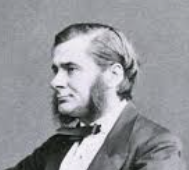
I neither deny nor affirm the immortality of man. I see no reason for believing in it, but, on the other hand, I have no means of disproving it.

2 weeks 6 days ago
While the Marxist faith in central planning is now confined to a few dingy sects, a quasi-religious belief in free markets continues to shape the policies of governments.Many writers have pointed to the havoc and ruin that have accompanied the imposition of free markets across the world. Whether in Africa, Asia, Latin America or post-communist Europe, policies of wholesale privatisation and structural adjustment have led to declining economic activity and social dislocation on a massive scale.
▼
Source
source
"The end of the world as we know it," The Guardian
2 months 2 weeks ago
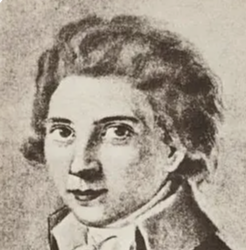
The most important subject, and the first problem of philosophy, is the restoration in man of the lost image of God; so far as this relates to science.Should this restoration in the internal consciousness be fully understood, and really brought about, the object of pure philosophy is attained.

3 months 1 week ago
Our conviction that the world is meaningless is due in part to the fact (discussed in a later paragraph) that the philosophy of meaningless lends itself very effectively to furthering the ends of political and erotic passion; in part to a genuine intellectual error - the error of identifying the world of science, a world from which all meaning has deliberately been excluded, with ultimate reality.
▼
Source
source
Ch. 14, p. 309 [2012 reprint]

2 months 1 week ago
Architecture, sculpture, painting, music, and poetry, may truly be called the efflorescence of civilised life.
▼
Source
source
Education: What Knowledge Is of Most Worth?
3 months 4 weeks ago
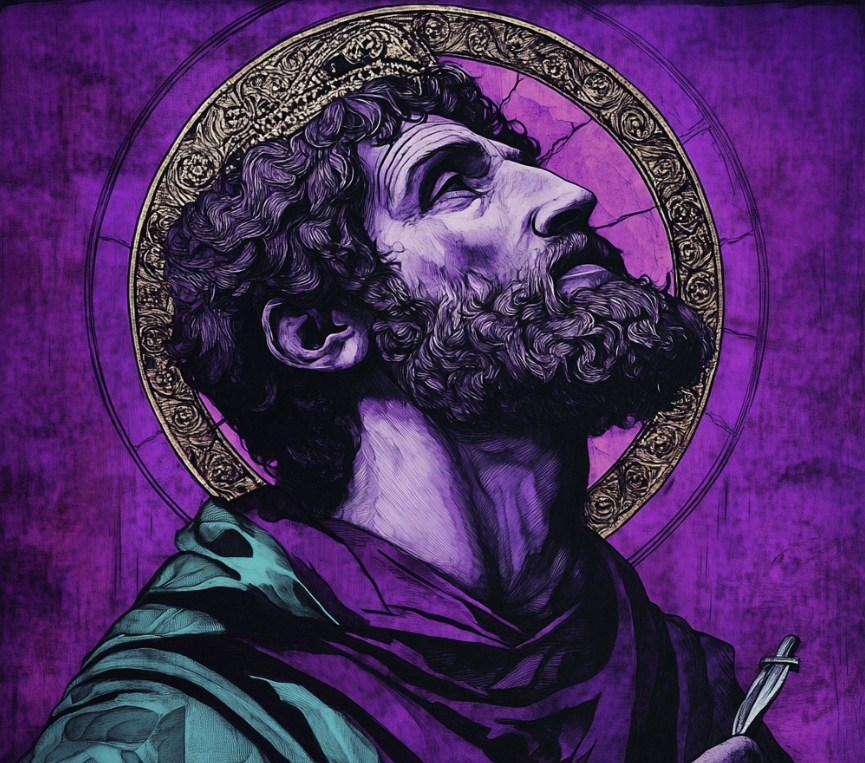
(On the Trinitarian indwelling personally experienced by Saint Augustine) But what is it that I love in loving You? Not corporeal beauty, nor the splendour of time, nor the radiance of the light, so pleasant to our eyes, nor the sweet melodies of songs of all kinds, nor the fragrant smell of flowers, and ointments, and spices, not manna and honey, not limbs pleasant to the embracements of flesh. I love not these things when I love my God; and yet I love a certain kind of light, and sound, and fragrance, and food, and embracement in loving my God, who is the light, sound, fragrance, food, and embracement of my inner man — where that light shines unto my soul which no place can contain, where that sounds which time snatches not away, where there is a fragrance which no breeze disperses, where there is a food which no eating can diminish, and where that clings which no satiety can sunder. This is what I love, when I love my God.
▼
Source
source
X, 6, 8

2 months 3 weeks ago
Cut not fire with a sword. Symbol 9 Variant translation: Poke not the fire with a sword.
▼
Source
source
As quoted in Short Sayings of Great Men: With Historical and Explanatory Notes (1882) by Samuel Arthur Bent, p. 455

1 month 1 week ago
At the speed of light there is no sequence; everything happens at the same instant.

2 months 2 weeks ago
Deny them this participation of freedom, and you break that sole bond, which originally made, and must still preserve the unity of the empire.
1 month 3 weeks ago
On the whole, the scientist is better off if he collects his facts by accident, little by little, so he can study them before he tries to fit them into a jigsaw puzzle, This is how the late Tom Lethbridge came to arrive at his theories about other dimensions of reality. It is also how Guy Lyon Playfair came to develop his own theories about the nature of the poltergeist.
▼
Source
source
p. 196

3 months 2 weeks ago
Any man more right than his neighbors constitutes a majority of one.
3 months 2 weeks ago
In the revolt against idealism, the ambiguities of the word "experience" have been perceived, with the result that realists have more and more avoided the word. It is to be feared, however, that if the word is avoided the confusions of thought with which it has been associated may persist.
▼
Source
source
On the Nature of Acquaintance: Neutral Monism, 1914
2 months 4 days ago
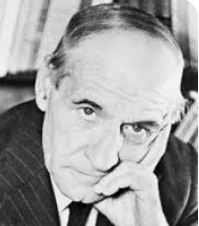
The primary meaning of the words "modern," "modernity," with which recent times have baptised themselves, brings out very sharply that feeling of "the height of time" which I am at present analysing. "Modern" is what is "in the fashion, "that is to say, the new fashion or modification which has arisen over against the old traditional fashions used in the past. The word "modern" then expresses a consciousness of a new life, superior to the old one, and at the same time an imperative call to be at the height of one's time. For the "modern" man, not to be "modern" means to fall below the historic level.
▼
Source
source
Chap. III: The Height Of The Times

3 months 2 weeks ago
The very cannibalism of the counterrevolution will convince the nations that there is only one way in which the murderous death agonies of the old society and the bloody birth throes of the new society can be shortened, simplified and concentrated, and that way is revolutionary terror.
▼
Source
source
"The Victory of the Counter-Revolution in Vienna," Neue Rheinische Zeitung, 7 November 1848.

2 months 1 week ago
Try to be free: you will die of hunger.

3 months 3 weeks ago
Jews hate the name of Christ and have a secret and innate rancor against the people among whom they live.
▼
Source
source
See Silent Truth by Mark Edwards
1 month 4 weeks ago
Education is the acquisition of the art of the utilisation of knowledge.
3 weeks 5 days ago
The punctuation of anniversaries is terrible, like the closing of doors, one after another between you and what you want to hold on to.
▼
Source
source
Diary entry on the first anniversary of the kidnapping and death of her son Charles Augustus Lindbergh III (1 March 1932)

1 month 1 week ago
If Mormonism is able to endure, unmodified, until it reaches the third and fourth generation, it is destined to become the greatest power the world has ever known.
▼
Source
source
This quote originates in Thomas J. Yates, "Count Tolstoi and the 'American Religion' ", Improvement Era (February 1939)
1 month 4 weeks ago
Thus the universe is to be conceived as attaining the active self-expression of its own variety of opposites of its own freedom and its own necessity, of its own multiplicity and its own unity, of its own imperfection and its own perfection. All the opposites are elements in the nature of things, and are incorrigibly there. The concept of God is the way in which we understand this incredible fact that what cannot be, yet is.

1 week 1 day ago
To conceive the good, in fact, is not sufficient; it must be made to succeed among men. To accomplish this less pure paths must be followed.
▼
Source
source
Ch. 5.
1 month 1 week ago
Radical changes of identity, happening suddenly and in very brief intervals of time, have proved more deadly and destructive of human values than wars fought with hardware weapons.
▼
Source
source
p. 97
4 months 2 weeks ago
Those who assert that the mathematical sciences say nothing of the beautiful or the good are in error. For these sciences say and prove a great deal about them; if they do not expressly mention them, but prove attributes which are their results or definitions, it is not true that they tell us nothing about them. The chief forms of beauty are order and symmetry and definiteness, which the mathematical sciences demonstrate in a special degree.

3 months 1 week ago
The collective name for the ripe fruits of religion in a character is Saintliness. The saintly character is the character for which spiritual emotions are the habitual centre of the personal energy; and there is a certain composite photograph of universal saintliness, the same in all religions, of which the features can easily be traced.
▼
Source
source
Lectures XI, XII, AND XIII : "Saintliness"
1 month 3 weeks ago
The problem with all this--the problem I discussed in the first lecture--is that if the causes/background conditions distinction is fundamentally subjective, not descriptive of the world in itself, then current philosophical explanations of the metaphysical nature of reference are bankrupt.
▼
Source
source
Lecture II: Realism and Reasonableness

3 months 2 weeks ago
With the greater part of rich people, the chief enjoyment of riches consists in the parade of riches, which in their eye is never so complete as when they appear to possess those decisive marks of opulence which nobody can possess but themselves.
▼
Source
source
Chapter XI, Part II, p. 202 (See also Thorstein Veblen).
2 weeks 6 days ago
The heterodox current in Judaism led by Jesus seems to have had no notion of an immortal soul, created by God and then infused into the body: immortality meant being raised from the dead in the body one had in life, then living for ever in a world without decay or corruption. In the Christian religion invented by Paul and Augustine, which was strongly influenced by Plato, immortality meant something quite different - a life out of time, enjoyed by the 'soul' or 'spirit' of the departed. How this Platonic immortality could preserve anything like the persons that once lived was not made clear.
▼
Source
source
Cross-correspondences (pp. 32-3)

4 months 1 week ago
Science fiction offers its writers chances of embarrassment that no other form of fiction does.
4 months 2 weeks ago
To what extent can truth endure incorporation? That is the question; that is the experiment.
1 month 1 week ago
As Narcissus fell in love with an outering (projection, extension) of himself, man seems invariably to fall in love with the newest gadget or gimmick that is merely an extension of his own body.
2 months 1 week ago
As one of our Swiss friends put it: "Now every German tailor living in Japan, China, or Moscow feels that he has the German navy and all of Germany's power behind him. This proud consciousness sends him into an insane rapture: the German has finally lived to see the day when he can say with pride, relying on his own state, like an Englishman or an American, 'I am a German.' True, when the Englishman or American says 'I am an Englishman,' or 'I am an American,' he is saying 'I am a free man.' The German, however, is saying 'I am a slave, but my emperor is stronger than all other princes, and the German soldier who is strangling me will strangle all of you.'"

3 months 1 week ago
Aim at being loved without being admired.
▼
Source
source
p. 38e

2 months ago
Shall we not perhaps be told, on the other hand, that if the sinner suffers an eternal punishment, it is because he does not cease to sin? - for the damned sin without ceasing. This however is no solution to the problem, which derives all its absurdity from the fact that punishment has been conceived as vindictiveness or vengeance, not as correction, and has been conceived after the fashion of barbarous peoples. And in the same way hell has been conceived as a sort of police institution, necessary in order to put fear into the world. And the worst of it is that it no longer intimidates, and therefore will have to be shut up.
2 months ago
An eternal purgatory, then, rather than a heaven of glory; an eternal ascent. If there is an end to all suffering, however pure and spiritualized we may suppose it to be, if there is an end to all desire, what is it that makes the blessed in paradise go on living? If in paradise they do not suffer for want of God, how shall they love Him? And if there, in the heaven of glory, while they behold God little by little and closer and closer, yet without ever wholly attaining Him, there does not always remain something more for them to know and desire, if there does not always remain a substratum of doubt, how shall they not fall asleep?
3 months 1 week ago
Never self-possessed, or prudent, love is all abandonment.
▼
Source
source
p. 158
3 months 1 week ago
The effectiveness of political and religious propaganda depends upon the methods employed, not upon the doctrines taught. These doctrines may be true or false, wholesome or pernicious-it makes little or no difference.
▼
Source
source
Chapter 7 (p. 63)

4 months 1 week ago
There is merely bad luck in not being loved; there is misfortune in not loving. All of us, today, are dying of this misfortune. For violence and hatred dry up the heart itself; the long fight for justice exhausts the love that nevertheless gave birth to it.
1 month 3 weeks ago
Perhaps power is never free from a feeling of lack.
CivilSimian.com created by AxiomaticPanic, CivilSimian, Kalokagathia