

9 months 1 week ago
"Let us work without reasoning," said Martin; "it is the only way to make life endurable."

6 months 2 weeks ago
As Malaparte saw it, Naples was a pagan city with an ancient sense of time. Christianity taught those who were converted to it to think of history as the unfolding of a single plot - a moral drama of sin and redemption. In the ancient world there was no such plot - only a multitude of stories that were forever being repeated. Inhabiting that ancient world, the Neapolitans did not expect any fundamental alteration in human affairs. Not having accepted the Christian story of redemption, they had not been seduced by the myth of progress. Never having believed civilization to be permanent, they were not surprised when it foundered.
▼
Source
source
An Old Chaos: Frozen Horses and Deserts of Brick (p. 22)

9 months 4 days ago
In writing a history of madness, Foucault has attempted-and this is the greatest merit, but also the very infeasibility of his book-to write a history of madness itself. Itself.
▼
Source
source
Of madness itself. That is by letting madness speak for itself. Cogito and The History of Madness, p.37 (Routledge classics edition)

10 months 1 week ago
First, there must be an end to war and national rivalry and only then could one turn to the internal miseries that, after all, had external conflict as their chief cause.
8 months 2 weeks ago
We are all instruments endowed with feeling and memory. Our senses are so many strings that are struck by surrounding objects and that also frequently strike themselves.
▼
Source
source
"Conversation Between D'Alembert and Diderot"
8 months 1 day ago
Freedom of thought and of expression are not mere rights to be claimed. They have their roots deep in the existence of individuals as developing careers in time. Their denial and abrogation is an abdication of individuality and a virtual rejection of time as opportunity.

9 months 5 days ago
There are two godheads: the world and my independent I. I am either happy or unhappy, that is all. It can be said: good or evil do not exist. A man who is happy must have no fear. Not even in the face of death. Only a man who lives not in time but in the present is happy.
▼
Source
source
Journal entry (8 July 1916), p. 74e


7 months 3 weeks ago
It is the fallacy of all intellectuals to believe that intellect can grasp life. It cannot, because it works in terms of symbols and language. There is another factor involved: consciousness. If the flame of consciousness is low, a symbol has no power to evoke reality, and intellect is helpless.
▼
Source
source
p. 112
5 months 2 weeks ago
All characteristics of material things as they are presented to us in the acts of external perception (e.g. colour) are endowed with the separateness of spatial extension, but it is only when we build up a single connected real world out of all our experiences that the spatial extension, which is a constituent of every perception, becomes a part of one and the same all-inclusive space. ... every material thing can, without changing content, equally well occupy a position in Space different from its present one. This immediately gives us the property of the homogeneity of space which is the root of the conception, Congruence.
▼
Source
source
Introduction

5 months 1 week ago
Every word is an adamantine shell which encloses a great explosive force. To discover its meaning you must let it burst inside you like a bomb and in this way liberate the soul which it imprisons.
▼
Source
source
Massacre, Ch. 10, p. 88

9 months 1 week ago
Capitals accumulate faster than the population; thus wages; thus population; thus grain prices; thus the difficulty of production and hence the exchange values.
▼
Source
source
Notebook III, The Chapter on Capital, p. 271.

9 months 1 week ago
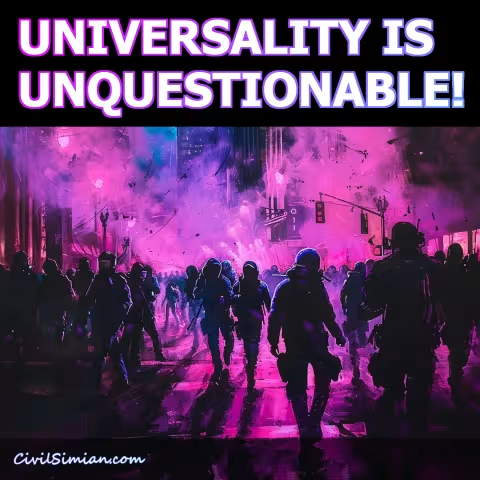
This inner revolution is realistic because it maintains itself deliberately within the framework of existing institutions; the oppressed reckon with the real situation.
▼
Source
source
p. 66

8 months 2 weeks ago
As one digs deeper into the national character of the Americans, one sees that they have sought the value of everything in this world only in the answer to this single question: how much money will it bring in?
▼
Source
source
Letter to Ernest de Chabrol, 9 June 1831 Selected Letters, ed. Roger Boesche, UofC Press 1985, p. 39.

9 months 3 weeks ago
By protracting life, we do not deduct one jot from the duration of death.
▼
Source
source
Book III, lines 1087-1088 (tr. Rouse)

9 months 1 week ago
There are many kinds of gods. Therefore there are many kinds of men.
▼
Source
source
"One and Many," p. 3

7 months 1 week ago
Computers can do better than ever what needn't be done at all. Making sense is still a human monopoly.
▼
Source
source
(p. 109)
10 months 1 week ago
He believes in that mummery a good deal less than I do, and I don't believe in it at all.

8 months 2 days ago
If thou wilt be perfect, go and sell that thou hast, and give to the poor, and thou shalt have treasure in heaven: and come and follow me.
▼
Source
source
19:21 (KJV)

10 months 6 days ago
A fate is not a punishment.

9 months 1 week ago
Even if a civil society were to be dissolved by the consent of all its members (e.g., if a people inhabiting an island decided to separate and disperse throughout the world), the last murderer remaining in prison would first have to be executed, so that each has done to him what his deeds deserve and blood guilt does not cling to the people for not having insisted upon this punishment; for otherwise the people can be regarded as collaborators in his public violation of justice.
▼
Source
source
Kt6:333

6 months 2 weeks ago
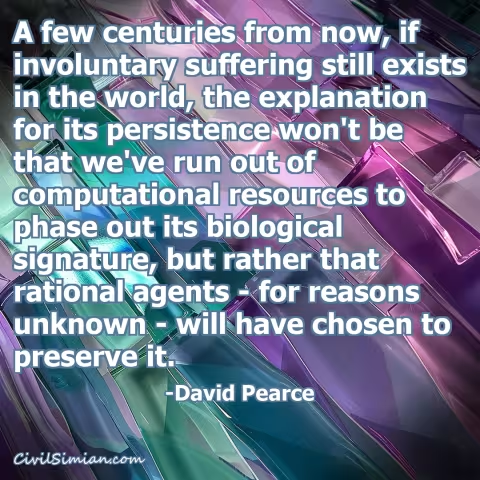
A global transition to a cruelty-free vegan diet won't just help non-human animals. The transition will also help malnourished humans who could benefit from the grain currently fed to factory-farmed animals. For factory-farming is not just cruel; it's energy-inefficient. Let's take just one example. Over the past few decades, millions of Ethiopians have died of "food shortages" while Ethiopia grew grain to sell to the West to feed cattle. Western meat-eating habits prop up the price of grain so that poor people in the developing world can't afford to buy it. In consequence, they starve by the millions.In my work, I explore futuristic, hi-tech solutions to the problem of suffering. But anybody who seriously wants to reduce human and non-human suffering alike should adopt a cruelty-free vegan lifestyle today.
▼
Source
source
"A World Without Suffering?", Instituto Humanitas Unisinos, Jan. 2011

5 months 3 weeks ago
Perhaps its destruction has been brought about only that it may be raised up again to a better destiny. Oftentimes a reverse has but made room for more prosperous fortune. Many structures have fallen only to rise to a greater height.
9 months 4 weeks ago
I am not bothered by the fact that I am not understood. I am bothered when I do not know others.

6 months ago
Ever, as before, does Madness remain a mysterious-terrific, altogether infernal boiling-up of the Nether Chaotic Deep, through this fair-painted Vision of Creation, which swims thereon, which we name the Real.
▼
Source
source
Bk. III, ch. 8.

5 months 6 days ago
Then what should we work for? Only this: proper understanding; unselfish action; truthful speech. A resolve to accept whatever happens as necessary and familiar, flowing like water from that same source and spring.
▼
Source
source
(Hays translation) IV, 33
8 months 3 weeks ago
There is geometry in the humming of the strings, there is music in the spacing of the spheres.
▼
Source
source
As quoted in The Mystery of Matter (1965) edited by Louise B. Young, p. 113
7 months 1 week ago
Schizophrenia may be a necessary consequence of literacy.
▼
Source
source
(p. 26)

7 months 3 weeks ago
Happiness is the proof that time can accommodate eternity.

9 months 1 week ago
Instinctively we divide mankind into friends and foes - friends, towards whom we have the morality of co-operation; foes, towards whom we have that of competition. But this division is constantly changing; at one moment a man hates his business competitor, at another, when both are threatened by Socialism or by an external enemy, he suddenly begins to view him as a brother. Always when we pass beyond the limits of the family it is the external enemy which supplies the cohesive force. In times of safety we can afford to hate our neighbour, but in times of danger we must love him.
▼
Source
source
Authority and the Individual, 1949

8 months 5 days ago
I don't need any support, advice, or compassion, because even if I am the most ruinous man, I still feel so powerful, so strong and fierce. For I am the only one that lives without hope.
7 months 1 week ago
My theory is that all women have hydrofluoric acid bottled up inside.
▼
Source
source
On difficulties with women, as quoted in "Kurt Vonnegut, Writer of Classics of the American Counterculture, Dies at 84" by Dinitia Smith in The New York Times

8 months 1 week ago
I must say, that the whole Scheme of the war is mistaken, (or appears to me to be so), for it ought to be, not for Dunkirk, or this or t'other Town-but to drive Jacobinism from the world.
▼
Source
source
Letter to Dr Charles Burney (14/15 September 1793), quoted in P. J. Marshall and John A. Woods (eds.)
5 months 6 days ago
Acquire the contemplative way of seeing how all things change into one another, and constantly attend to it, and exercise thyself about this part [of philosophy]. For nothing is so much adapted to produce magnanimity. ...But as to what any man shall say or think about him, or do against him, he never even thinks of it, being himself contented with these two things: with acting justly in what he now does, and being satisfied with what is now assigned to him; and he lays aside all distracting and busy pursuits, and desires nothing else than to accomplish the straight course through the law, and by accomplishing the straight course to follow God.
▼
Source
source
X, 11
9 months 1 week ago
The whole is a riddle, an aenigma, an inexplicable mystery. Doubt, uncertainty, suspence of judgment appear the only result of our most accurate scrutiny, concerning this subject. But such is the frailty of human reason, and such the irresistible contagion of opinion, that even this deliberate doubt could scarcely be upheld; did we not enlarge our view, and opposing one species of superstition to another, set them a quarrelling; while we ourselves, during their fury and contention, happily make our escape, into the calm, though obscure, regions of philosophy.
▼
Source
source
Part XV - General corollary

9 months 1 week ago
So monstrous is the making and keeping them slaves at all, abstracted from the barbarous usage they suffer, and the many evils attending the practice; as selling husbands away from wives, children from parents, and from each other, in violation of sacred and natural ties; and opening the way for adulteries, incests, and many shocking consequences, for all of which the guilty Masters must answer to the final Judge.
10 months 1 week ago
Necessity makes a joke of civilization.

8 months 1 week ago
To the Deity must be left the task of infinite perfection, while to us poor, weak, incapable mortals, there was no rule of conduct so safe as experience.
▼
Source
source
Speech in the House of Commons (6 May 1791), quoted in The Parliamentary History of England, From the Earliest Period to the Year 1803, Vol. XXIX (1817), column 388
6 months 3 weeks ago
Every living creature commences its existence under a form different from, and simpler than, that which it eventually attains.
▼
Source
source
Ch.2, p. 74

9 months 1 week ago
Literature is the effort of man to indemnify himself for the wrongs of his condition.
▼
Source
source
"Walter Savage Landor", from The Dial, xii, 1841
9 months 5 days ago
Burning in effigy. Kissing the picture of one's beloved... it aims at nothing at all; we just behave this way and then we feel satisfied.
▼
Source
source
Ch. 7 : Remarks on Frazer's Golden Bough, p. 123
8 months 1 week ago
I considerd a general War against Jacobins and Jacobinism, as the only possible chance of saving Europe, (and England as included in Europe) from a truly frightful revolution. ... It is my Protest against the delusion, by which some have been taught to look upon this Jacobin contest at home as an ordinary party squabble about place or Patronage; and to regard this Jacobin War abroad as a common War about Trade, or Territorial Boundaries, or about a political Balance of power among Rival or jealous States.
▼
Source
source
Letter to the Duke of Portland (29 September 1793), quoted in P. J. Marshall and John A. Woods (eds.)
9 months 1 week ago
The whole mystery of commodities, all the magic and necromancy that surrounds the products of labor as long as they take the form of commodities, vanishes therefore, so soon as we come to other forms of production.
▼
Source
source
Vol. I, ch.1, section 4.

CivilSimian.com created by AxiomaticPanic, CivilSimian, Kalokagathia