



7 months 2 weeks ago
Law could never, by determining exactly what is noblest and must just for one and all, enjoin upon them that which is best; for the differences of men and of actions and the fact that nothing, I may say, in human life is ever at rest, forbid any science whatsoever to promulgate any simple rule for everything and for all time. So, that which is persistently simple is inapplicable to things which are never simple.

4 months 2 weeks ago
The inner trip is not the sole prerogative of the LSD traveler; it's the universal experience of TV watchers.
6 months 3 weeks ago
Good roads, canals, and navigable rivers, by diminishing the expence of carriage, put the remote parts of the country more nearly upon a level with those of the neighbourhood of the town. They are upon that the greatest of all improvements.
▼
Source
source
Chapter XI, Part I, p. 174.
4 months 1 week ago
I shall cheerfully bear the reproach of having descended below the dignity of history if I can succeed in placing before the English of the nineteenth century a true picture of the life of their ancestors.
▼
Source
source
Vol. I, ch. 1

5 months 3 weeks ago
Every central government worships uniformity: uniformity relieves it from inquiry into an infinity of details.
▼
Source
source
Book Four, Chapter III.

2 months 2 weeks ago
But it will be asked, are we to have no banks? Are merchants and others to be deprived of the resource of short accommodations, found so convenient? I answer, let us have banks; but let them be such as are alone to be found in any country on earth, except Great Britain. There is not a bank of discount on the continent of Europe (at least there was not one when I was there) which offers anything but cash in exchange for discounted bills.
▼
Source
source
ME 13:277
6 months 3 weeks ago
We must therefore glean up our experiments in this science from a cautious observation of human life, and take them as they appear in the common course of the world, by men's behaviour in company, in affairs, and in their pleasures. Where experiments of this kind are judiciously collected and compared, we may hope to establish on them a science, which will not be inferior in certainty, and will be much superior in utility to any other of human comprehension.
▼
Source
source
Introduction
2 months 1 week ago
I lie on the beach like a crocodile and let myself be roasted by the sun. I never see a newspaper and don't give a damn for what is called the world.

4 months 3 weeks ago
To every action there is always opposed an equal reaction; or, the mutual actions of two bodies upon each other are always equal, and directed to contrary parts.
▼
Source
source
Laws of Motion, III

7 months 2 weeks ago
A punishment that penalizes without forestalling is indeed called revenge.

2 months 2 weeks ago
Likewise, they call it "Chaos," which is Hesiod's first generator, because Chaos gives rise to everything else, as the monad does. It is also thought to be both "mixture" and "blending," "obscurity" and "darkness" thanks to the lack of articulation and distinction of everything which ensues from it. Anatolius says that it is called "matrix" and "matter," on the grounds that without it there is no number. The mark which signifies the monad is the source of all things.
▼
Source
source
On the Monad
4 months 5 days ago
In a well worn metaphor, a parallel is drawn between the life of man and the metamorphosis of the caterpillar into the butterfly; but the comparison may be more just as well as more novel, if for its former term we take the mental progress of the race. History shows that the human mind, fed by constant accessions of knowledge, periodically grows too large for its theoretical coverings, and bursts them asunder to appear in new habiliments, as the feeding and growing grub, at intervals, casts its too narrow skin and assumes another, itself but temporary. Truly the imago state of Man seems to be terribly distant, but every moult is a step gained, and of such there have been many.
▼
Source
source
Ch.2, p. 72
5 months 6 days ago
It appears that liberty is bound up with imperfection, with a right to imperfection. Socialism leads to the same type of authoritarian state as Theocracy. ... One must choose: either Socialism or liberty of spirit, the liberty of man's conscience. ... Socialism uses a "sacred" authority and establishes a "sacred" society in which there is no place for the "lay," for the free, for choice, for the unrestrained activity of human forces.
▼
Source
source
pp. 188-189

5 months 1 day ago
Asceticism is the trifling of an enthusiast with his power, a puerile coquetting with his selfishness or his vanity, in the absence of any sufficiently great object to employ the first or overcome the last.
▼
Source
source
Letter (5 September 1857), quoted in The Life of Florence Nightingale (1913) by Edward Tyas Cook, p. 369

6 months 2 weeks ago
Ambition is the death of thought.
▼
Source
source
p. 77e

6 months 2 weeks ago
The plain fact is that men's minds are built, as has been often said, in water-tight compartments. Religious after a fashion, they yet have many other things in them beside their religion, and unholy entanglements and associations inevitably obtain. The basenesses so commonly charged to religion's account are thus, almost all of them, not chargeable at all to religion proper, but rather to religion's wicked practical partner, the spirit of corporate dominion. And the bigotries are most of them in their turn chargeable to religion's wicked intellectual partner, the spirit of dogmatic dominion, the passion for laying down the law in the form of an absolutely closed-in theoretic system. The ecclesiastical spirit in general is the sum of these two spirits of dominion.
▼
Source
source
Lectures XIV and XV, "The Value of Saintliness"

6 months 2 weeks ago
And when we speak of "abandonment" - a favorite word of Heidegger - we only mean to say that God does not exist and that it is necessary to draw the consequences of his absence to the end.
▼
Source
source
pp. 32-33

3 months 4 weeks ago
Negative-utilitarianism is only one particular denomination of a broad church to which the reader may well in any case not subscribe. Fortunately, the program can be defended on grounds that utilitarians of all stripes can agree on. So a defence will be mounted against critics of the theory and application of a utilitarian ethic in general. For in practice the most potent and effective means of curing unpleasantness is to ensure that a defining aspect of future states of mind is their permeation with the molecular chemistry of ecstasy: both genetically precoded and pharmacologically fine-tuned. Orthodox utilitarians will doubtless find the cornucopian abundance of bliss this strategy delivers is itself an extra source of moral value. Future generations of native ecstatics are unlikely to disagree.
▼
Source
source
2.7 Why Be Negative?
2 months 2 weeks ago
The rosy mountain peaks laughed like high lustrous thoughts,and Helen, speechless, raised her pale hands toward the sunand joyed to feel its warm rays falling on her frozen palms.
▼
Source
source
Book IV, line 1361

2 months 2 weeks ago
Eating is an agricultural act.
▼
Source
source
The Pleasures of Eating

5 months 2 days ago
The people are asleep; they remain indifferent. They forge their own chains and do the bidding of their masters to crucify their Christs.
▼
Source
source
(p. 304)
6 months 3 weeks ago
... happiness is not an ideal of reason, but of imagination, resting on merely empirical grounds…
▼
Source
source
4:418-19, p.29
6 months 3 weeks ago
Ancient histories, as one of our wits has said, are but fables that have been agreed upon.
▼
Source
source
Jeannot et Colin, 1764
5 months 2 weeks ago
The bigger the crowd, the more negligible the individual.
▼
Source
source
p 14

5 months 2 weeks ago
Nothing deserves to be undone, doubtless because nothing deserved to be done.

6 months 4 weeks ago
But plants, though they have not powers of perception, yet, as they have life, certainly approach very nearly to those things which are endowed with sentient faculties. What then is so completely insensible as stony substance? yet even in this, there appears to be a desire of union. Thus the loadstone attracts iron to it, and holds it fast in its embrace, when so attracted. Indeed, the attraction of cohesion, as a law of love, takes place throughout all inanimate nature.
3 months 1 week ago
Rosa Luxemburg is an outstanding example of a type of mind that is often met with in the history of Marxism and appears to be specially attracted by the Marxist outlook. It is characterized by slavish submission to authority, together with a belief that in that submission the values of scientific thought can be preserved. No doctrine was so well suited as Marxism to satisfy both these attitudes, or to provide a mystification combining extreme dogmatism with the cult of "scientific" thinking, in which the disciple could find mental and spiritual peace. Marxism thus played the part of a religion for the intelligentsia, which did not prevent some of them, like Rosa Luxemburg herself, from trying to improve the deposit of faith by reverting to first principles, thus strengthening their own belief that they were independent of dogma.
▼
Source
source
(pp. 94-5)
6 months 3 weeks ago
Even if a civil society were to be dissolved by the consent of all its members (e.g., if a people inhabiting an island decided to separate and disperse throughout the world), the last murderer remaining in prison would first have to be executed, so that each has done to him what his deeds deserve and blood guilt does not cling to the people for not having insisted upon this punishment; for otherwise the people can be regarded as collaborators in his public violation of justice.
▼
Source
source
Kt6:333
5 months 1 week ago
The pint would call the quart a dualist, if you tried to pour the quart into him.
▼
Source
source
p. 60
5 months 2 weeks ago
History shows that the thinkers who mounted on the top of the ladder of questions, who set their foot on the last rung, that of the absurd, have bequeathed to posterity only an example of sterility.
3 months 1 day ago
Psychotherapists ... are dealing with people whose distress arises from what may be termed maya, to use the Hindu-Buddhist word whose exact meaning is not merely 'illusion' but the entire world-conception of a culture, considered as illusion in the strict etymological sense of a play (Latin, ludere). The aim of a way of liberation is not the destruction of maya but seeing it for what it is, or seeing through it. Play is not to be taken seriously, or, in other words, ideas of the world and of oneself which are social conventions and institutions are not to be confused with reality.
▼
Source
source
p. 9

3 months 1 week ago
That, on the whole, if you have got the intrinsic qualities, you have got everything, and the preliminaries will prove attainable; but that if you have got only the preliminaries, you have yet got nothing. A man of real dignity will not find it impossible to bear himself in a dignified manner; a man of real understanding and insight will get to know, as the fruit of his very first study, what the laws of his situation are, and will conform to these.

6 months 3 weeks ago
Faith ever says, "If Thou wilt," not "If Thou canst."
▼
Source
source
p. 241
5 months 1 week ago
Individuality, conceived as a temporal development involves uncertainty, indeterminacy, or contingency. Individuality is the source of whatever is unpredictable in the world.



6 months 1 week ago
And yet it will be obvious that it is difficult to really know of what sort each thing is.
6 months 2 weeks ago
...and if you are common, you can dress up as a woman, show you behind or write poems: there's nothing offensive about a naked behind if it's everybody's; each person will be mirrored in it.
▼
Source
source
p. 463

6 months 2 weeks ago
The constitution of madness as mental illness, at the end of the eighteenth century, bears witness to a rupture in a dialogue, gives the separation as already enacted, and expels from the memory all those imperfect words, of no fixed syntax, spoken falteringly, in which the exchange between madness and reason was carried out. The language of psychiatry, which is a monologue by reason about madness, could only have come into existence in such a silence.
▼
Source
source
Preface to 1961 edition

5 months 5 days ago
It is because of my wretchedness that I am "I." It is on account of the wretchedness of the universe that, in a sense, God is "I" (that is to say a person).
▼
Source
source
p. 83
6 months 3 weeks ago
...an intellectual concept abstracts from everything sensuous, it is not abstracted from sensuous things, and perhaps would be more correctly called abstracting than abstract. Intellectual concepts it is more cautious, therefore, to call pure ideas, and concepts given only empirically, abstract ideas.
6 months 2 weeks ago
Although objectively greater demands are placed on this authority, it operates less as a public opinion giving a rational foundation to the exercise of political and social authority, the more it is generated for the purpose of an abstract vote that amounts to no more than an act of acclamation within a public sphere temporarily manufactured for show or manipulation.
▼
Source
source
p. 222

6 months 3 weeks ago
Long discourses, and philosophical readings, at best, amaze and confound, but do not instruct children. When I say, therefore, that they must be treated as rational creatures, I mean that you must make them sensible, by the mildness of your carriage, and in the composure even in the correction of them, that what you do is reasonable in you, and useful and necessary for them; and that it is not out of caprichio, passion or fancy, that you command or forbid them any thing.
▼
Source
source
Sec. 81

6 months 2 weeks ago
Everyone feels benevolent if nothing happens to be annoying him at the moment.

4 months 2 weeks ago
The civilized pagan recognizes life not in himself alone, but in societies of men-in the tribe, the clan, the family, the kingdom -and sacrifices his personal good for these societies. The motive power of his life is glory. His religion consists in the exaltation of the glory of those who are allied to him-the founders of his family, his ancestors, his rulers-and in worshiping gods who are exclusively protectors of his clan, his family, his nation, his government.
▼
Source
source
Chapter IV, Christianity Misunderstood by Men of Science
5 months 2 weeks ago
The healthy man does not torture others-generally it is the tortured who turn into torturers.
▼
Source
source
In Du, May 1941

5 months 3 days ago
The basic paradox about sex is that it always seems to be offering more than it can deliver. A glimpse of a girl undressing through a lighted bedroom window induces a vision of ecstatic delight, but in the actual process of persuading the girl into bed, the vision somehow evaporates.
▼
Source
source
p. 16
5 months 1 week ago
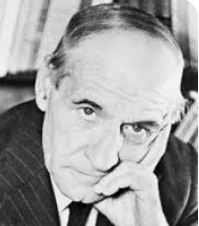
It is not a question of the mass-man being a fool. On the contrary, to-day he is more clever, has more capacity of understanding than his fellow of any previous period. But that capacity is of no use to him; in reality, the vague feeling that he possesses it seems only to shut him up more within himself and keep him from using it. Once for all, he accepts the stock of commonplaces, prejudices, fag-ends of ideas or simply empty words which chance has piled up within his mind, and with a boldness only explicable by his ingenuousness, is prepared to impose them everywhere.... Why should he listen if he has within him all that is necessary? There is no reason now for listening, but rather for judging, pronouncing, deciding. There is no question concerning public life, in which he does not intervene, blind and deaf as he is, imposing his "opinions."
▼
Source
source
Chap. VIII: The Masses Intervene In Everything, And Why Their Intervention Is Solely By Violence
5 months 2 weeks ago
"What is truth?" is a fundamental question. But what is it compared to "How to endure life?" And even this one pales beside the next: "How to endure oneself?" - That is the crucial question in which no one is in a position to give us an answer.
CivilSimian.com created by AxiomaticPanic, CivilSimian, Kalokagathia