


5 months 2 weeks ago
A fire eater must eat fire even if he has to kindle it himself.

3 months 3 days ago
Truths dead and forgotten long ago, conceptions of the world and its people, covered with mould, even during the times of our grandmothers, are being hammered into the heads of our young generation.
4 months 1 week ago
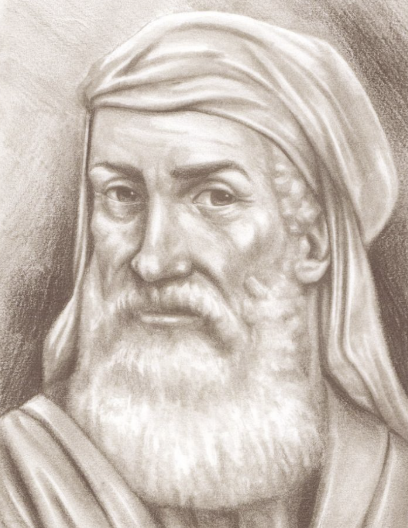
Hear first the four roots of all things: shining Zeus, life-bringing Hera, Aidoneus, and Nestis, who wets with tears the mortal wellspring.
▼
Source
source
fr. 6

2 months 2 weeks ago
My main theme is the extension of the nervous system in the electric age, and thus, the complete break with five thousand years of mechanical technology. This I state over and over again. I do not say whether it is a good or bad thing. To do so would be meaningless and arrogant.
▼
Source
source
Letter to Robert Fulford, 1964. Letters of Marshall McLuhan (1987), p. 300
3 months 2 weeks ago
If there is anything that we wish to change in the child, we should first examine it and see whether it is not something that could better be changed in ourselves.
▼
Source
source
p. 285

4 months 3 weeks ago
And the final event to himself has been, that, as he rose like a rocket, he fell like the stick.
▼
Source
source
On Edmund Burke's reactions to the American and French revolutions.

3 months 2 weeks ago
The true hero fights and dies in the name of his destiny, and not in the name of a belief.
3 months 2 weeks ago
Everyone is mistaken, everyone lives in illusion. At best, we can admit a scale of fictions, a hierarchy of unrealities, giving preference to one rather than to another; but to choose, no, definitely not that...

4 months 2 weeks ago
In every stock-jobbing swindle everyone knows that some time or other the crash must come, but every one hopes that it may fall on the head of his neighbour, after he himself has caught the shower of gold and placed it in safety.
▼
Source
source
Vol. I, Ch. 10, Section 5, pg. 296.
3 months 2 weeks ago
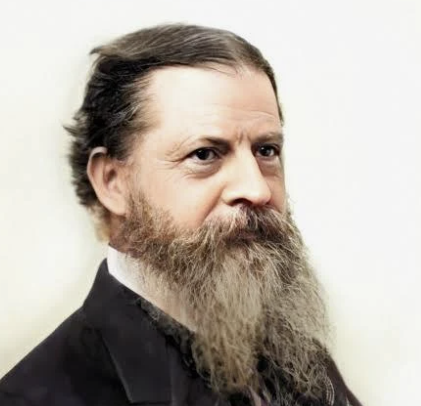
In an article published in The Monist for January, 1891, I endeavored to show what ideas ought to form the warp of a system of philosophy, and particularly emphasized that of absolute chance. In the number of April, 1892, I argued further in favor of that way of thinking, which it will be convenient to christen tychism (from τύχη, chance). A serious student of philosophy will be in no haste to accept or reject this doctrine; but he will see in it one of the chief attitudes which speculative thought may take, feeling that it is not for an individual, nor for an age, to pronounce upon a fundamental question of philosophy. That is a task for a whole era to work out. I have begun by showing that tychism must give birth to an evolutionary cosmology, in which all the regularities of nature and of mind are regarded as products of growth, and to a Schelling-fashioned idealism which holds matter to be mere specialized and partially deadened mind.
3 months 2 weeks ago
In the present state of society it appears necessary to go back to first principles in search of the most simple truths, and to dispute with some prevailing prejudice every inch of ground. To clear my way, I must be allowed to ask some plain questions, and the answers will probably appear as unequivocal as the axioms on which reasoning is built; though, when entangled with various motives of action, they are formally contradicted either by the words or conduct of men.
▼
Source
source
Ch. 1, opening
1 month 1 week ago
It is life that educates, and perhaps love more than anything else in life.
▼
Source
source
Ch. 2 : On Youth

3 months 3 weeks ago
All persons possessing any portion of power ought to be strongly and awfully impressed with an idea that they act in trust and that they are to account for their conduct in that trust to the one great Master, Author, and Founder of society.

4 months 3 weeks ago
The youth gets together his materials to build a bridge to the moon, or, perchance, a palace or temple on the earth, and, at length, the middle-aged man concludes to build a woodshed with them.
▼
Source
source
July 14, 1852
4 months 3 weeks ago
While there are manners and compliments we do not meet, we do not teach one another the lessons of honesty and sincerity that the brutes do, or of steadiness and solidity that the rocks do. The fault is commonly mutual, however; for we do not habitually demand any more of each other.
▼
Source
source
p. 490
2 weeks 3 days ago
Among the arts of expression one is suited to this purpose, another to that. It is hard to express movement in stone or rest in music. It is harder still to express permanence in speech.
3 months 1 week ago
And whereas many men, by accident unevitable, become unable to maintain themselves by their labour; they ought not to be left to the Charity of private persons; but to be provided for, (as far-forth as the necessities of Nature require,) by the Lawes of the Common-wealth. For as it is Unchariablenesse in any man, to neglect the impotent; so it is in the Soveraign of a Common-wealth, to expose them to the hazard of such uncertain Charity.
▼
Source
source
The Second Part, Chapter 30, p. 181
4 months 3 weeks ago
Even if there never have been actions arising from such pure sources, what is at issue here is not whether this or that happened; that, instead, reason by itself and independently of all appearances commands what ought to happen; that, accordingly, actions of which the world has perhaps so far given no example, and whose very practicability might be very much doubted by one who bases everything on experience, are still inflexibly commanded by reason ... because ... duty ... lies, prior to all experience, in the idea of a reason determing the will by means of apriori grounds.

2 weeks 3 days ago
External things are not the problem. It's your assessment of them. Which you can erase right now.
▼
Source
source
(Hays translation) VIII, 47
2 weeks 3 days ago
Whenever you suffer pain, keep in mind that it's nothing to be ashamed of and that it can't degrade your guiding intelligence, nor keep it from acting rationally and for the common good. And in most cases you should be helped by the saying of Epicurus, that pain is never unbearable or unending, so you can remember these limits and not add to them in your imagination. Remember too that many common annoyances are pain in disguise, such as sleepiness, fever and loss of appetite. When they start to get you down, tell yourself you are giving in to pain.
▼
Source
source
VII. 64:280

3 months 3 days ago
Man is as much a slave to his immediate surroundings now as he was when he lived in tree-huts. Give him the highest, the most exciting thoughts about man's place in the universe, the meaning of history; they can all be snuffed out in a moment if he wants his dinner, or feels irritated by a child squalling on a bus. He is bound by pettiness.
▼
Source
source
Chapter Two, World Without Values

3 months 3 weeks ago
The world that I regard is my selfe, it is the Microcosme of mine owne frame, that I cast mine eye on; for the other, I use it but like my Globe, and turne it round sometimes for my recreation. Men that look upon my outside, perusing onely my condition, and fortunes, do erre in my altitude; for I am above Atlas his shoulders.
▼
Source
source
Section 12

3 months ago
To be content with life - or to live merrily, rather - all that is required is that we bestow on all things only a fleeting, superficial glance; the more thoughtful we become the more earnest we grow.
▼
Source
source
K 29
3 months 1 week ago
People talk, indeed, of a "primitive mentality", as, for example, to-day that of the inferior races, and in days gone by that of humanity in general, at whose door the responsibility for superstition should be laid.
▼
Source
source
Chapter II : Static Religion

3 months 3 weeks ago
If it be of the highest importance to man, as an individual, that his religion should be true, the case of society is not the same. Society has no future life to hope for or to fear; and provided the citizens profess a religion, the peculiar tenets of that religion are of very little importance to its interests. Variant translation: Though it is very important for man as an individual that his religion should be true, that is not the case for society. Society has nothing to fear or hope from another life; what is most important for it is not that all citizens profess the true religion but that they should profess religion.
▼
Source
source
Chapter XVII.

3 months 2 weeks ago
If the world is a precipitation of human nature, so to speak, then the divine world is a sublimation of the same. Both occur in one act. No precipitation without sublimation. What goes lost there in agility, is won here.
▼
Source
source
Fragment No. 96
1 month 1 week ago
In the development of any science, the first received paradigm is usually felt to account quite successfully for most of the observations and experiments easily accessible to that science's practitioners. Further development, therefore, ordinarily calls for the construction of elaborate equipment, the development of an esoteric vocabulary and skills, and a refinement of concepts that increasingly lessens their resemblance to their usual common-sense prototypes. That professionalization leads, on the one hand, to an immense restriction of the scientist's vision and to a considerable resistance to paradigm change. The science has become increasingly rigid. On the other hand, within those areas to which the paradigm directs the attention of the group, normal science leads to a detail of information and to a precision of the observation-theory match that could be achieved in no other way.
▼
Source
source
p. 64

4 months 3 weeks ago
Hear the verbal protestations of all men: Nothing so certain as their religious tenets. Examine their lives: You will scarcely think that they repose the smallest confidence in them. The greatest and truest zeal gives us no security against hypocrisy: The most open impiety is attended with a secret dread and compunction. No theological absurdities so glaring that they have not, sometimes, been embraced by men of the greatest and most cultivated understanding. No religious precepts so rigorous that they have not been adopted by the most voluptuous and most abandoned of men.
▼
Source
source
Part XV - General corollary
3 months 2 days ago
Man is born as a freak of nature, being within nature and yet transcending it. He has to find principles of action and decision-making which replace the principles of instincts. He has to have a frame of orientation which permits him to organize a consistent picture of the world as a condition for consistent actions. He has to fight not only against the dangers of dying, starving, and being hurt, but also against another danger which is specifically human: that of becoming insane. In other words, he has to protect himself not only against the danger of losing his life but also against the danger of losing his mind.
▼
Source
source
The Revolution of Hope: Toward a Humanized Technology (1968), p. 61

4 months 4 weeks ago
When I am attacked by gloomy thoughts, nothing helps me so much as running to my books. They quickly absorb me and banish the clouds from my mind.
2 months 2 weeks ago
Genes do indirectly control the manufacture of bodies, and the influence is strictly one way: acquired characteristics are not inherited. No matter how much knowledge and wisdom you acquire during your life, not one jot will be passed on to your children by genetic means. Each new generation starts from scratch.
▼
Source
source
Ch. 3. Immortal Coils
3 months 2 weeks ago
Whenever government assumes to deliver us from the trouble of thinking for ourselves, the only consequences it produces are those of torpor and imbecility.
▼
Source
source
Vol. 2, bk. 6, ch. 1
2 months 2 weeks ago
The mask, like the side-show freak, is mainly participatory rather than pictorial in its sensory appeal.
▼
Source
source
(p. 352)

2 weeks 6 days ago
That one hundred and fifty lawyers should do business together ought not to be expected.
▼
Source
source
On the U.S. Congress, in his Autobiography, 6 January 1821

4 months 4 weeks ago
But by far the greatest hindrance and aberration of the human understanding proceeds from the dullness, incompetency, and deceptions of the senses; in that things which strike the sense outweigh things which do not immediately strike it, though they be more important. Hence it is that speculation commonly ceases where sight ceases; insomuch that of things invisible there is little or no observation.
▼
Source
source
Aphorism 50

4 months 2 weeks ago
I wished, by treating Psychology like a natural science, to help her to become one.
▼
Source
source
A Plea for Psychology as a Natural Science, 1892

4 months 4 weeks ago
In the country of the blind the one-eyed man is king.
▼
Source
source
Adagia (first published 1500, with numerous expanded editions through 1536), III, IV, 96

1 month 5 days ago
If you set a high value on liberty, you must set a low value on everything else.

4 months 3 weeks ago
May it not be the fact that mankind, who after all are made up of single human beings, obtain a greater sum of happiness when each pursues his own, under the rules and conditions required by the good of the rest, than when each makes the good of the rest his only object, and allows himself no personal pleasures not indispensable to the preservation of his faculties? The regimen of a blockaded town should be cheerfully submitted to when high purposes require it, but is it the ideal perfection of human existence?
▼
Source
source
Auguste Comte and Positivism, p. 142

4 months 2 weeks ago
The man who comes back through the Door in the Wall will never be quite the same as the man who went out. He will be wiser but less sure, happier but less self-satisfied, humbler in acknowledging his ignorance yet better equipped to understand the relationship of words to things, of systematic reasoning to the unfathomable mystery which it tries, forever vainly, to comprehend.
4 months 2 weeks ago
Many people think they are thinking when they are merely rearranging their prejudices.
▼
Source
source
To his young son from the Yosemite Valley on
2 months 4 days ago
I have repeatedly stressed that the rape of the Earth and rape of women are intimately linked - both metaphorically, in shaping world-views, and materially, in shaping women's everyday lives. The deepening economic vulnerability of women makes them more vulnerable to all forms of violence, including sexual assault, as we found out during a series of public hearings on the impact of economic reforms on women organized by the National Commission on Women and the Research Foundation for Science, Technology and Ecology.
▼
Source
source
Ecofeminism, by Maria Mies and Vandana Shiva, 1993, (full text pdf)

4 months 3 weeks ago
The fundamental concept in social science is Power, in the same sense in which Energy is the fundamental concept in physics.
▼
Source
source
Ch. 1: The Impulse to Power
3 months 1 week ago
Every morning I shall concern myself anew about the boundary Between the love-deed-Yes and the power-deed-No And pressing forward honor reality. We cannot avoid Using power, Cannot escape the compulsion To afflict the world, So let us, cautious in diction And mighty in contradiction, Love powerfully.
▼
Source
source
"Power and Love"
2 months 1 week ago
Our liberty is neither Greek nor Roman; but essentially English. It has a character of its own,-a character which has taken a tinge from the sentiments of the chivalrous ages, and which accords with the peculiarities of our manners and of our insular situation. It has a language, too, of its own, and a language singularly idiomatic, full of meaning to ourselves, scarcely intelligible to strangers.
▼
Source
source
History', The Edinburgh Review (May 1828), quoted in The Miscellaneous Writings of Lord Macaulay, Vol. I (1860), pp. 252-253
4 months 3 weeks ago
Granted that any practice causes more pain to animals than it gives pleasure to man; is that practice moral or immoral? And if, exactly in proportion as human beings raise their heads out of the slough of selfishness, they do not with one voice answer 'immoral,' let the morality of the principle of utility be for ever condemned.
▼
Source
source
Dr. Whewell on Moral Philosophy (1852), in Dissertations and Discussions: Political, Philosophical, and Historical, vol. 2, London: John W. Parker and son, 1859, p. 485
3 months 2 weeks ago
Death is too exact; it has all the reasons on its side. Mysterious for our instincts, it takes shape, to our reflection, limpid, without glamor, and without the false lures of the unknown. By dint of accumulating non-mysteries and monopolizing non-meanings, life inspires more dread than death: it is life which is the Great Unknown.

1 month 3 weeks ago
The most important feature of natural selection is that it is a process of drift. Evolution has no end-point or direction, so if the development of society is an evolutionary process it is one that is going nowhere.
▼
Source
source
An Old Chaos: Humanism and Flying Saucers (p. 78)
CivilSimian.com created by AxiomaticPanic, CivilSimian, Kalokagathia